






Sanuki Udon is the famous chewy wheat noodle of Kagawa Prefecture, the smallest prefecture in Japan and the proud home of udon culture. Locals proudly call Kagawa “Udon Prefecture,” and more than a few travelers fly there just to eat. This guide explains what makes these noodles special, how to order them like a local, and where to taste the real thing.
- Sanuki Udon uses only wheat flour, salt, and water, yet kneading and aging create its famous chewy texture.
- The light dashi broth comes from iriko, dried sardines caught in the Seto Inland Sea.
- Kagawa’s self-service udon shops serve fresh bowls for just a few hundred yen.
What Is Sanuki Udon?
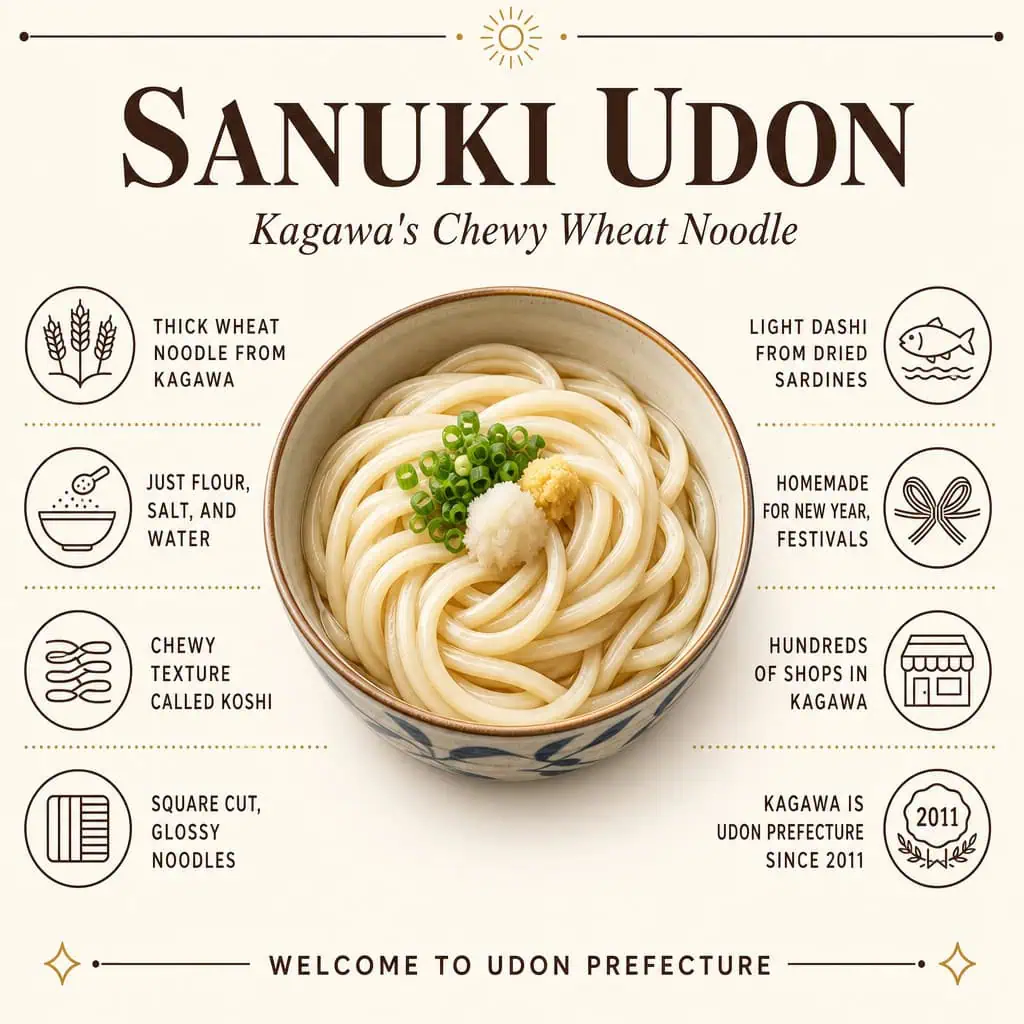
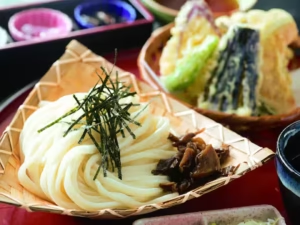
Sanuki Udon is a thick wheat noodle from Kagawa Prefecture on the island of Shikoku. Sanuki is the old name of the region. The noodles have a square cut, glossy surface, and a firm, springy bite that Japanese people call koshi. Shops usually serve them in a light dashi broth or with a simple dipping sauce.
Udon runs deep in local life here. Families once made the noodles at home for New Year, festivals, and guests. Today Kagawa holds hundreds of udon shops, and the prefectural government even rebranded its tourism campaign as “Udon Prefecture” in 2011. The nickname stuck, and honestly, it fits.
Why Is Sanuki Udon Famous?
Sanuki Udon is famous for three reasons: exceptional texture, a perfect local pantry, and a one-of-a-kind shop culture. The chewy noodles set the national standard, so much so that “Sanuki style” now appears on udon shop signs across Japan. Geography explains the rest. Kagawa’s dry, warm climate suited quality wheat, the Seto Inland Sea supplied sardines for dashi and salt from its shallow coasts, and nearby Shodoshima produced soy sauce. In addition, the cheap self-service shops turned everyday noodles into a travel destination. Few dishes can claim that an entire prefecture renamed itself after them.
What Does Sanuki Udon Taste Like?
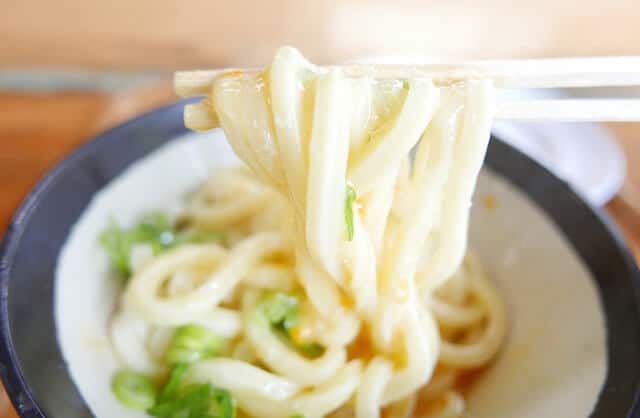
Expect a clean, gentle bowl where the noodle itself is the star. Here is how the texture and flavor break down.
Texture
The first bite surprises most visitors. The surface feels smooth and almost slippery, yet the center pushes back with a firm, elastic chew. That contrast is the whole point of koshi. I will admit I did not expect a plain noodle to be this addictive, but the bounce keeps you reaching for the next strand.
Flavor and Aroma
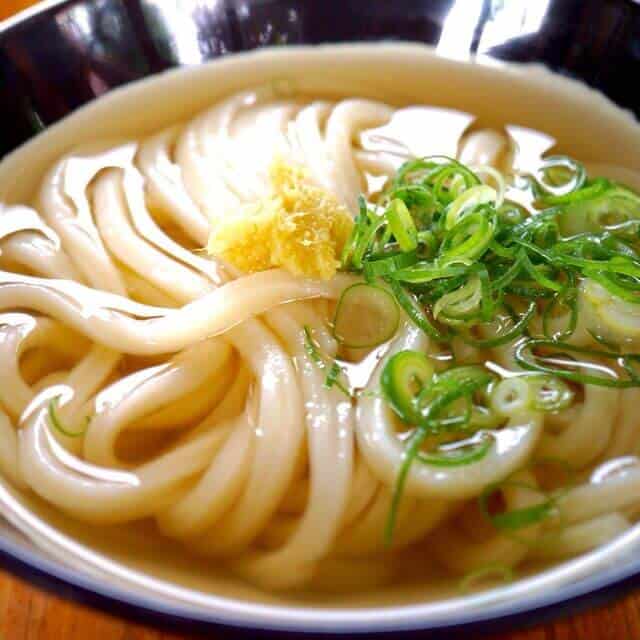
The noodles carry a faint, sweet wheat aroma that grows with each chew. Meanwhile, the dashi broth stays light and savory rather than salty. Iriko, the dried sardines from the Seto Inland Sea, give it a rounder, deeper flavor than bonito-based broths. Grated ginger and green onions lift everything without covering the wheat. Simple, yes, but never boring.
Sanuki Udon Ingredients
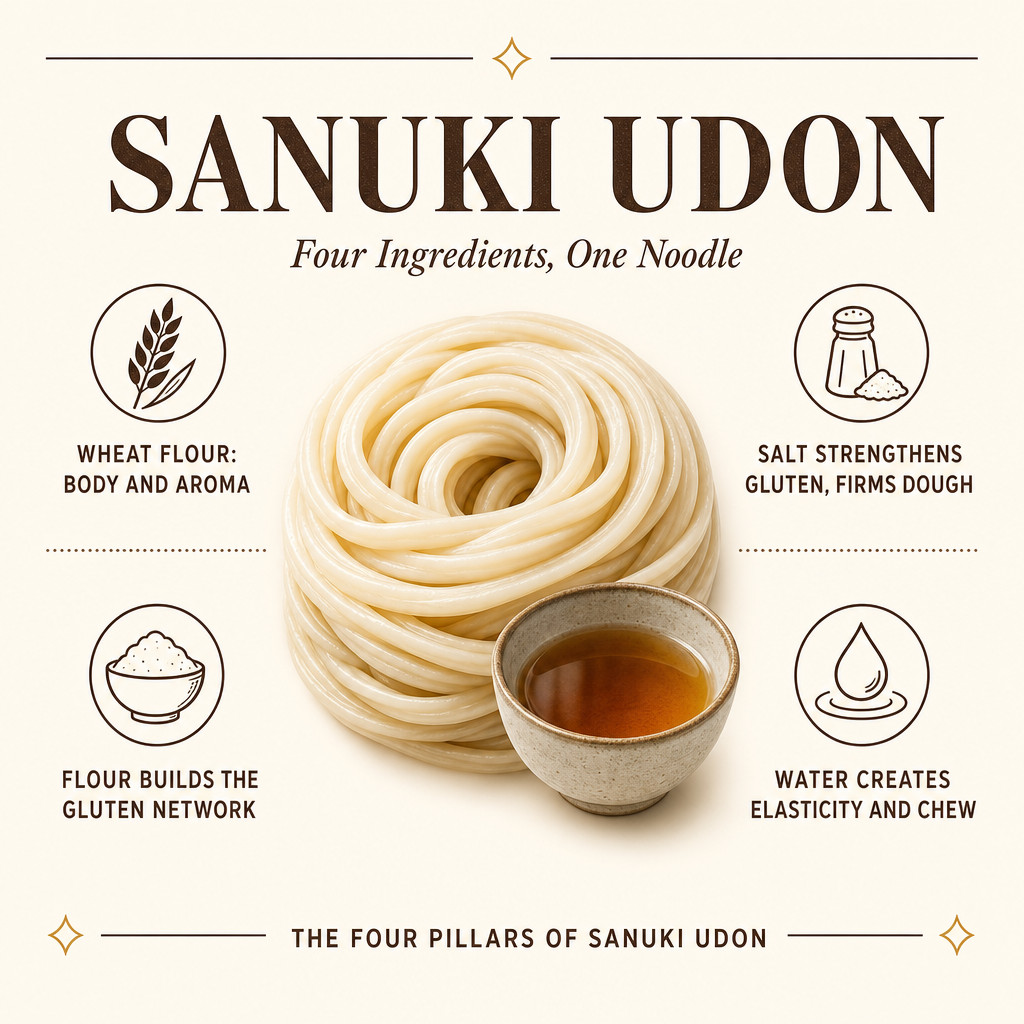
Sanuki Udon uses only flour, salt, and water. However, kneading and aging techniques create major differences in texture and quality. The dashi broth adds a fourth pillar. The table shows what each element does.
| Ingredient | Role | Notes |
|---|---|---|
| Wheat flour | Body and aroma | Medium-strength flour builds the gluten network |
| Salt | Strengthens gluten | Controls enzymes and firms the dough |
| Water | Elasticity | High hydration creates the chewy bite |
| Iriko dashi | The broth | Dried sardines from the Seto Inland Sea |
Industry labeling standards even define the name. Noodles sold as “Sanuki udon” should use water at roughly 40 percent or more of flour weight and salt at about 3 percent. The dough then rests for two hours or longer, and a boil of up to about 15 minutes fully gelatinizes the starch. Those numbers sound technical, yet they are exactly why the noodles bounce.
The History of Sanuki Udon
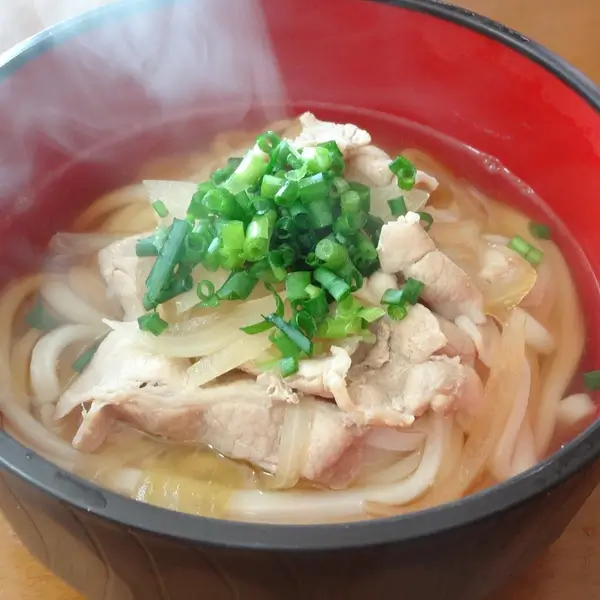
Here is the short version first. Udon was already common in Kagawa by the Edo period, since a famous folding screen of the Konpira shrine festival from that era shows udon shops in business. How the noodle first arrived, however, remains a mystery with two competing legends.
The Kobo Daishi Legend
The most beloved theory stars Kukai, the Buddhist monk also known as Kobo Daishi, who was born in Sanuki. He studied in Tang dynasty China in the early 800s. According to the legend, he brought back wheat cultivation and a boiled flour dumpling called konton. The word supposedly shifted over centuries from konton to unton and finally to udon. It is a lovely story, though historians cannot confirm it.
The Dango Soup Theory
A second theory points to the Muromachi period, when stone mills spread among ordinary people. Anyone could now grind wheat into flour, so dumpling soups became a filling everyday meal. Over time, cooks flattened and cut the dumplings into strips that were easier to eat. Those strips gradually evolved into noodles. Researchers have not confirmed this account either, and the true origin of Sanuki Udon stays pleasantly unsolved.
From Farm Food to National Fame
The Sanuki region suffered from low rainfall, so rice often failed and wheat filled the gap. Farm families turned that wheat into udon and served it on special days. After the war, small noodle factories and self-service shops spread across the prefecture. A nationwide “Sanuki udon boom” followed in the 1990s and 2000s, fueled by guidebooks and road-trip culture. In 2007, the national government selected Sanuki Udon among its 100 great regional dishes. The 2011 Udon Prefecture campaign then sealed its fame for good.
Types of Sanuki Udon
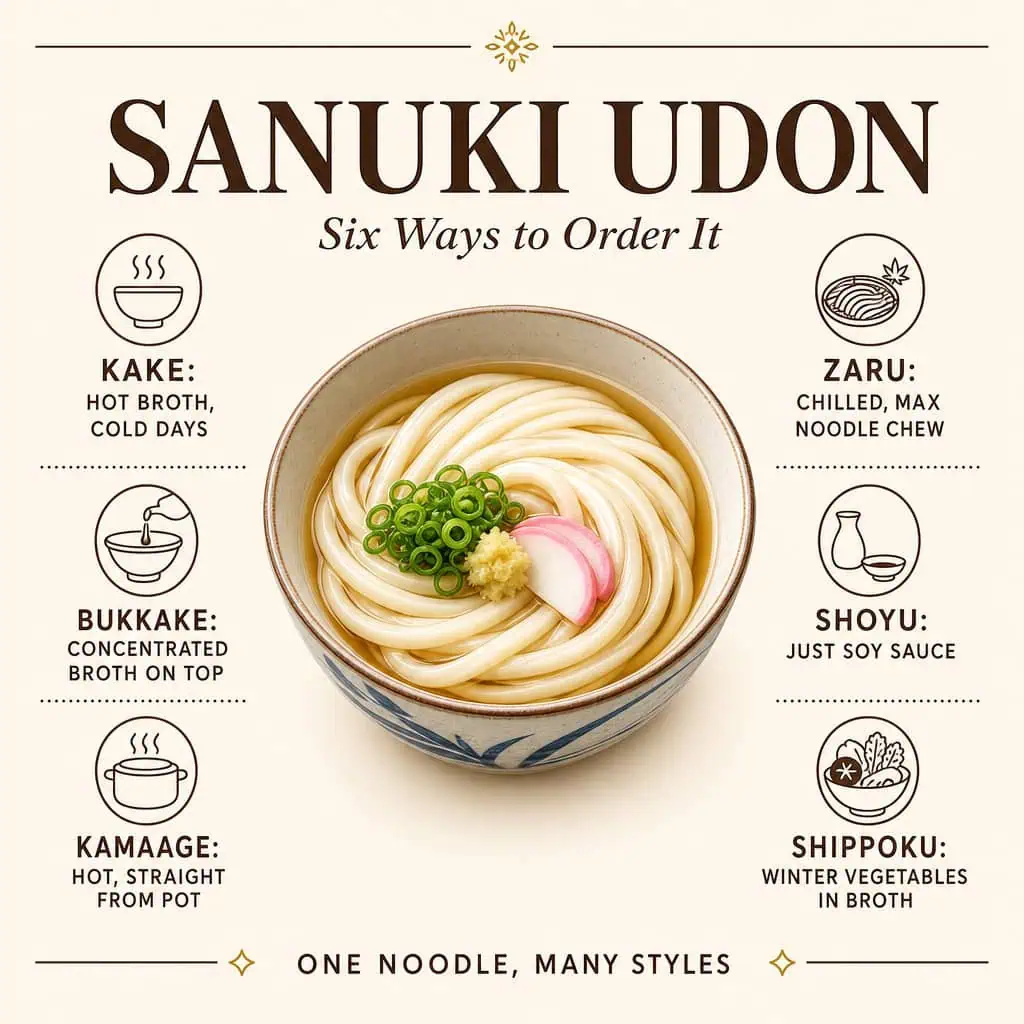
One noodle, many styles. Most shops list the same core menu, so learning these names before your trip pays off immediately.
| Style | How it works | Best for |
|---|---|---|
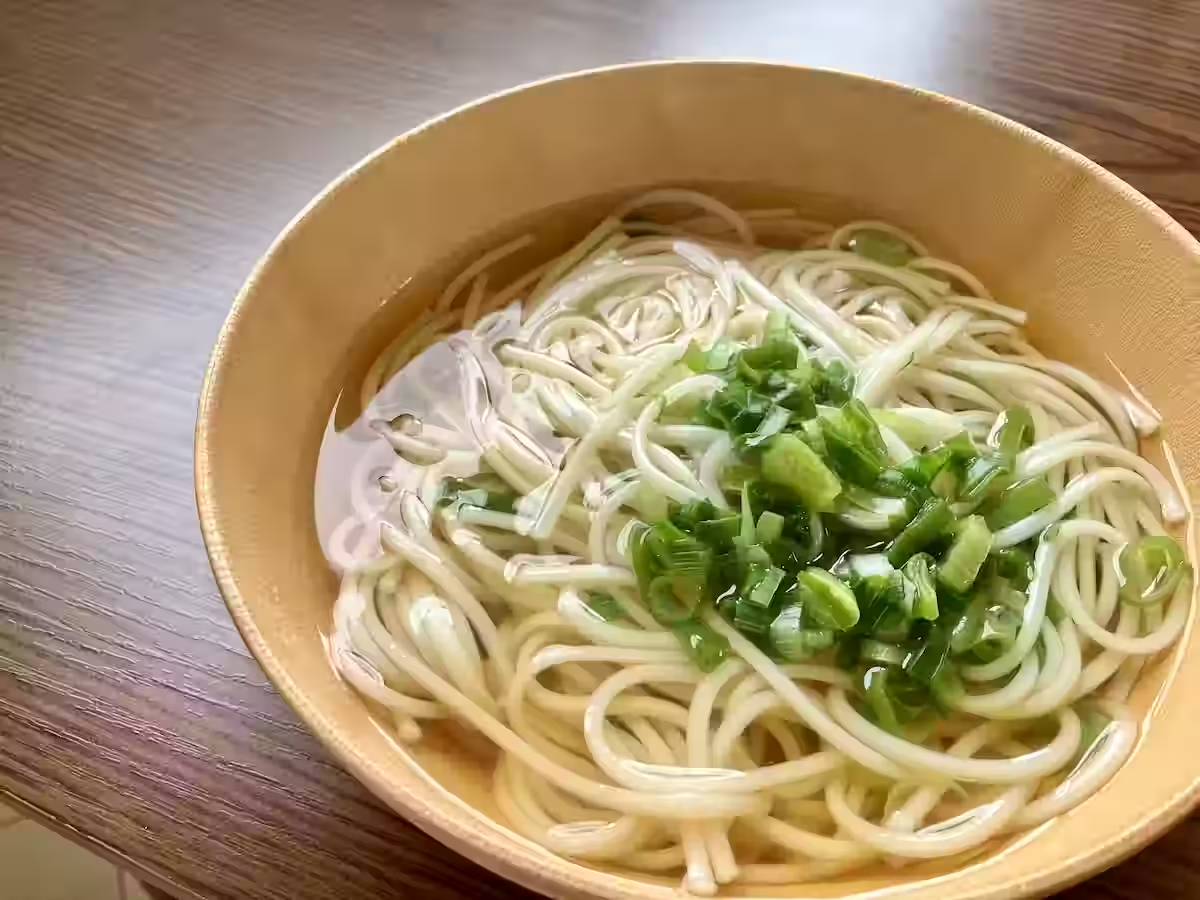
| Kake | Noodles in hot dashi broth | Cold days, first-timers |
| Bukkake | Concentrated dashi poured over noodles | Tasting the noodle itself |
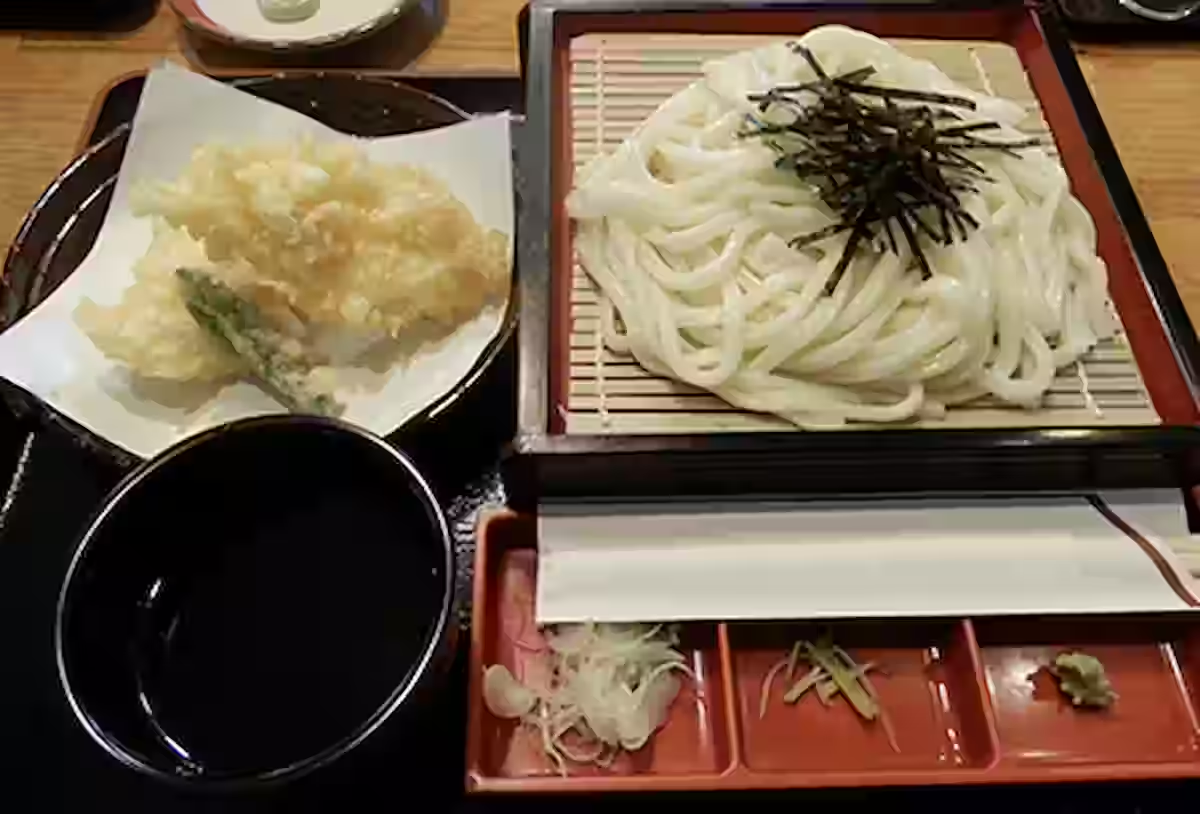
| Kamaage | Hot noodles straight from the pot, with dipping sauce | Soft, freshly boiled texture |
| Zaru | Chilled noodles with dipping sauce | Summer, maximum chew |
| Shoyu | A splash of soy sauce, nothing else | Purists |
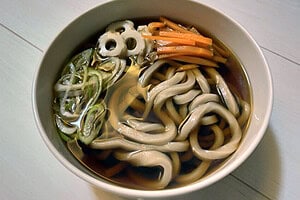
| Shippoku | Winter vegetables simmered in iriko broth | Kagawa’s classic winter dish |
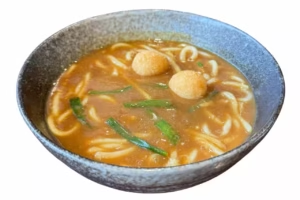
| Uchikomi | Miso-style soup with noodles cooked in | The old farmhouse taste |
Shippoku and uchikomi deserve a note. Both are recognized regional dishes of Kagawa, and both survive from the days when families cooked udon at home. If you visit in winter, shippoku udon is worth hunting down.
Popular Toppings
Toppings stay simple so the noodle can lead. Even so, a few favorites appear on almost every counter.
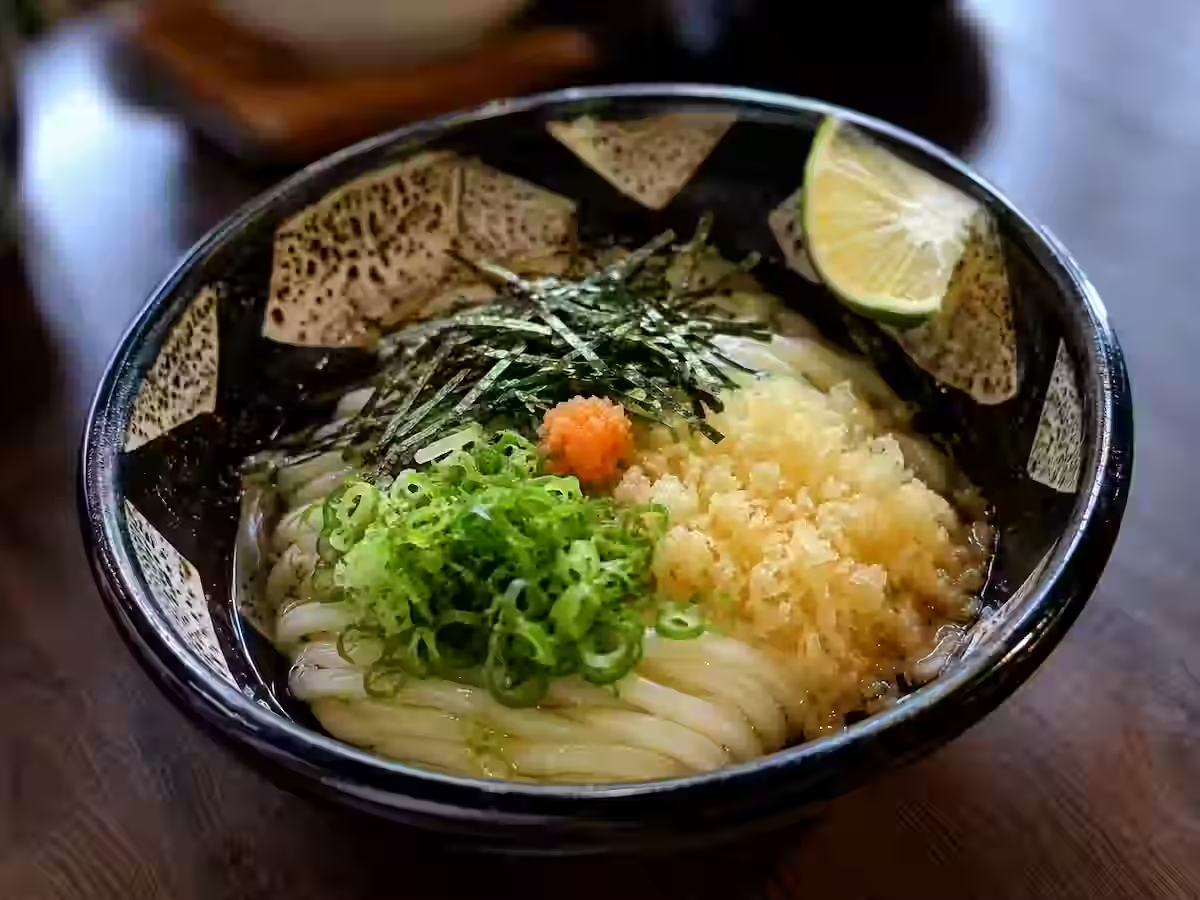
- Tempura: shrimp, vegetables, and the local favorite chikuwa fish cake, picked up self-service style.
- Green onions and grated ginger: the classic pair that brightens iriko dashi.
- Raw or soft-boiled egg: turns shoyu or bukkake udon silky and rich.
- Tenkasu: crunchy tempura bits, usually free at the counter.
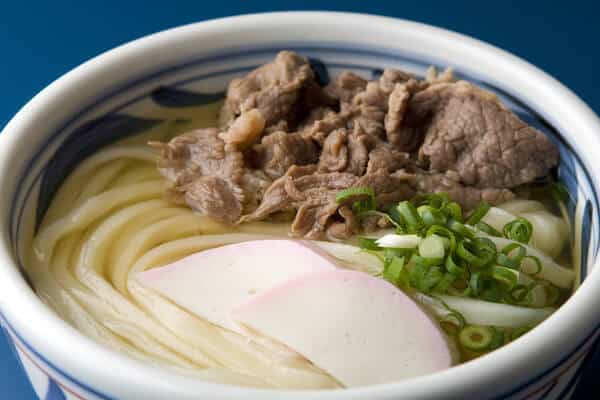
- Simmered beef: the hearty niku udon option for hungry travelers.
- Sudachi citrus and sesame: seasonal accents that older locals swear by.
How to Enjoy Sanuki Udon in Kagawa
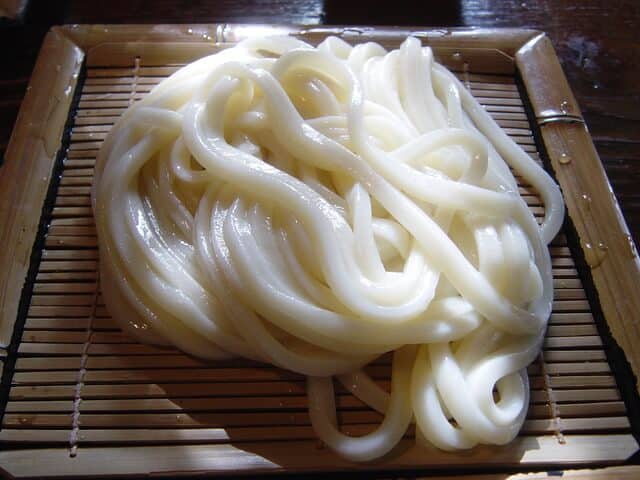
Kagawa’s self-service shops confuse first-time visitors, and that is part of the fun. The system rewards speed and confidence. Follow these steps and you will look like a regular.
- Tell the counter staff how many noodle balls you want, and whether you want them hot or cold.
- At many shops, you warm the noodles yourself by swishing the strainer in hot water.
- Pour the dashi broth from the pot or tap, then add free green onions, ginger, and tenkasu.
- Grab tempura or chikuwa from the tray with tongs. Each piece costs a small extra fee.
- Pay at the register, eat, and return your bowl to the counter when finished.
A full bowl often costs only 300 to 500 yen at self-service shops. Popular places sell out and close by early afternoon, so locals eat udon for breakfast or lunch, rarely for dinner. Plan your route accordingly.
How to Cook Sanuki Udon at Home
Packaged Sanuki Udon comes fresh, half-dried, dried, or frozen. Half-dried noodles are a local specialty: producers dry them gently with warm air, so they keep more moisture and wheat flavor than fully dried noodles while lasting longer than fresh ones. Whichever type you buy, the cooking method matters.
Use a large pot with at least 1 liter of water per serving. Why this step matters: crowded noodles cool the water and turn gummy instead of chewy.
Follow the package time, usually 10 to 13 minutes for dried noodles, and keep the water bubbling. Why this step matters: a full boil gelatinizes the starch that creates the springy center.
Drain the noodles, then rinse them quickly under cold running water while rubbing off the surface starch. Why this step matters: the cold shock firms the noodles and sharpens the chew.
For kake udon, rewarm the noodles briefly and pour hot iriko or kombu dashi over them. For bukkake or zaru, serve them cold with concentrated sauce, ginger, and green onions. Why this step matters: matching temperature to style is the heart of udon culture.
Sanuki Udon vs Other Udon Styles
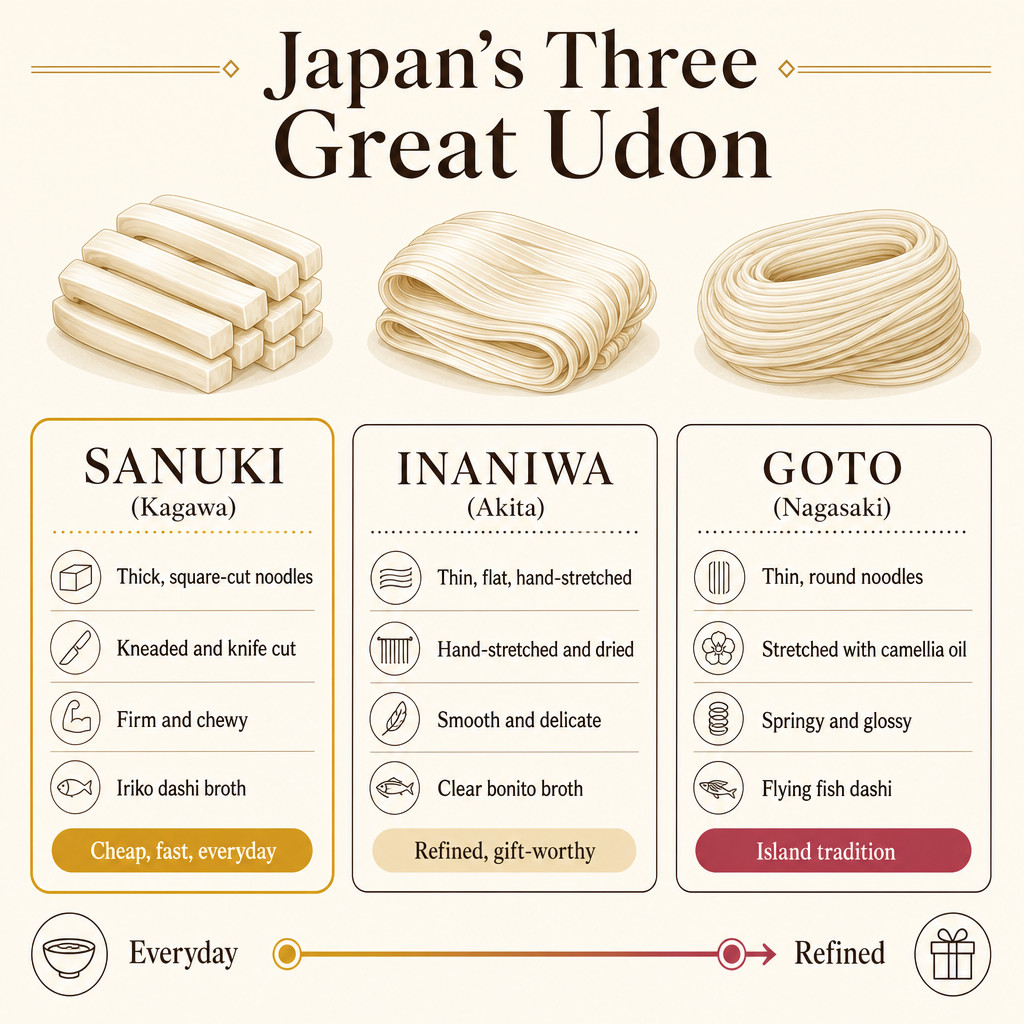
Japan counts three great regional udon, and each takes a completely different path. Sanuki stands for thick, chewy noodles, while Inaniwa Udon from Akita is thin, hand-stretched, and silky. Goto Udon from Nagasaki’s islands is rounder still, stretched with camellia oil.
| Feature | Sanuki (Kagawa) | Inaniwa (Akita) | Goto (Nagasaki) |
|---|---|---|---|
| Shape | Thick, square cut | Thin, flat | Thin, round |
| Method | Kneaded and knife cut | Hand stretched, dried | Hand stretched with camellia oil |
| Texture | Firm and chewy | Smooth and delicate | Springy and glossy |
| Broth | Iriko dashi | Clear bonito-based | Flying fish dashi |
| Vibe | Cheap, fast, everyday | Refined, gift-worthy | Island tradition |
Curious about the wider noodle world, from soba to somen? Our Japanese noodles guide maps the whole family, and Tanuki Udon shows how Tokyo tops its bowls.
Buying Sanuki Udon: Souvenirs and Online Shopping
Sanuki Udon travels well, which makes it one of Kagawa’s best souvenirs. Half-dried and dried packs keep for weeks and sell everywhere: Takamatsu Airport, JR Takamatsu Station, highway rest stops, and supermarkets across the prefecture. Moreover, many packs include concentrated iriko dashi, so one bag holds a complete meal. Frozen Sanuki Udon is another strong option, since freezing preserves the chewy texture surprisingly well. Outside Japan, look for dried or frozen Sanuki noodles at Japanese grocery stores or major online retailers. Prices stay modest, and the difference from generic udon is obvious from the first bite.
Is Sanuki Udon Vegetarian?
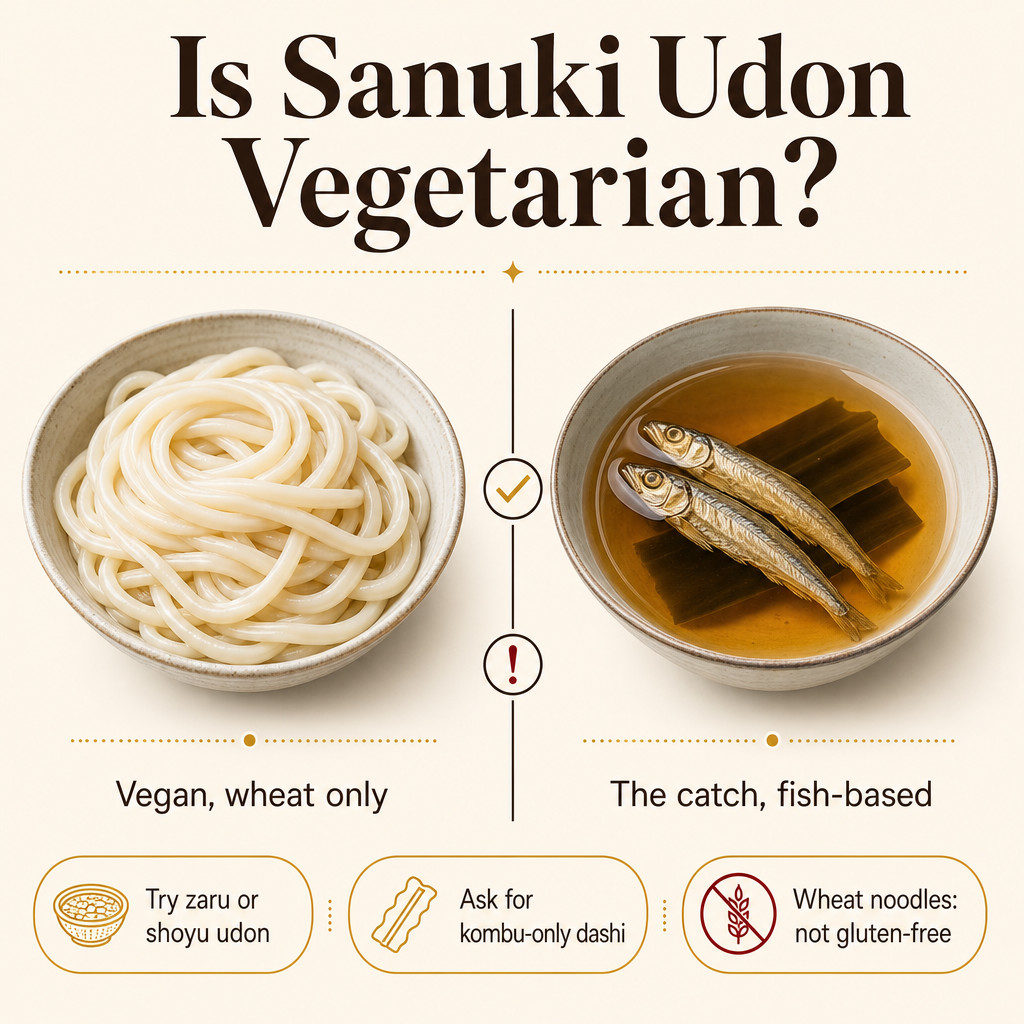
The noodles are vegan, since they contain only wheat flour, salt, and water. However, the broth is the catch. Standard dashi uses iriko dried sardines, and many dipping sauces include bonito. Vegetarians have workarounds, though. For example, zaru or shoyu udon with plain soy sauce avoids fish broth, and some shops can prepare kombu-only dashi if you ask. A few restaurants in Takamatsu now list vegan options clearly. When in doubt, ask whether the broth contains fish before ordering. Note for allergies: the noodles are pure wheat, so they are not gluten-free.
Where to Eat Sanuki Udon: Recommended Restaurants
The best Sanuki Udon in Kagawa hides in ordinary neighborhoods, factories, and farm roads rather than tourist streets. Here is a quick overview, followed by details on each shop.
| Shop | Area | Known for |
|---|---|---|
| Okasen | Utazu | Media-famous all-rounder |
| Gamo Udon | Sakaide | Rural self-service classic |
| Hinode Seimen Jyo | Sakaide | Noodle factory open 1 hour a day |
| Suzaki Foods Shop | Mitoyo | Shoyu udon with raw egg |
| Handmade Udon Tamura | Ayagawa | Legendary old-school craft |
Okasen
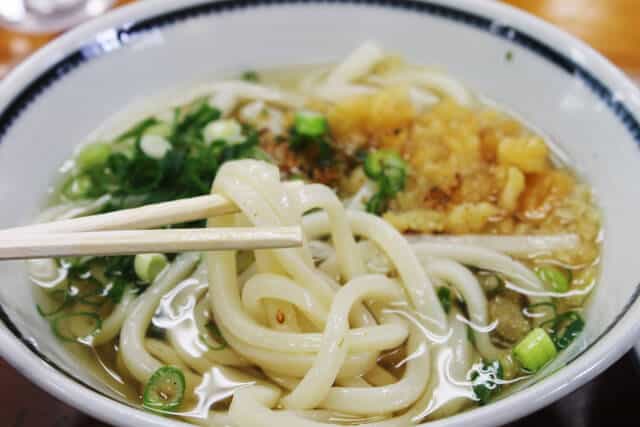
Okasen appears in Japanese media constantly, and for good reason. The noodles hit the ideal balance of softness and chew, and the menu covers every classic style. Friendly staff make it an easy first stop for overseas visitors. Expect a lunchtime line, which moves faster than it looks.
Gamo Udon
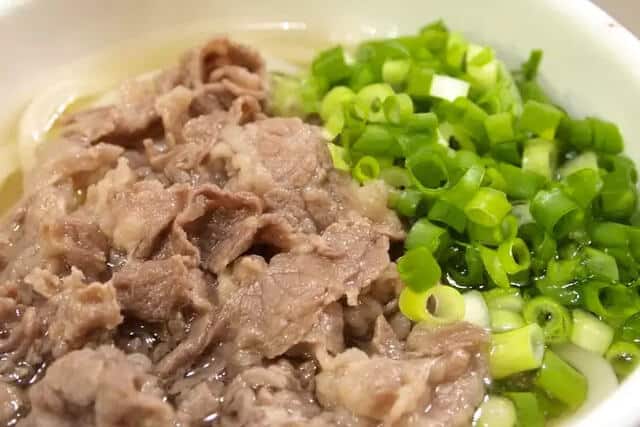
Gamo sits among rice fields in Sakaide City and has drawn pilgrims since the first Sanuki udon boom. The system is pure self-service: state your noodle count, choose hot or cold, pick toppings, and pour your own broth. On sunny days, eating on the outdoor bench beats any table inside. The shop sometimes closes during Golden Week to spare the neighborhood from traffic, which tells you everything about its popularity.
Hinode Seimen Jyo
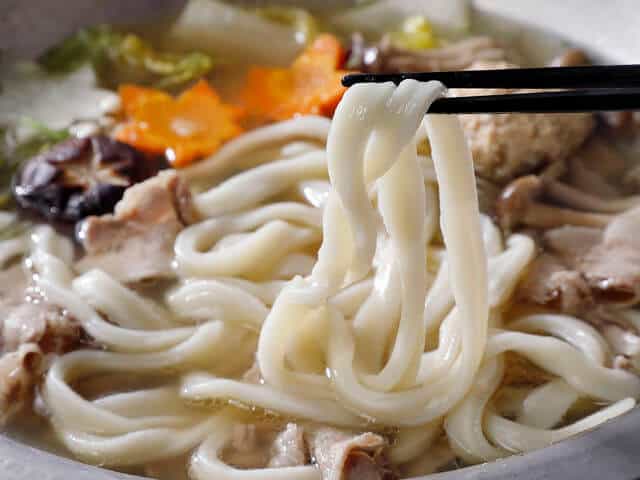
This long-established noodle factory opens its doors for exactly one hour a day, from 11:30 to 12:30. The custom began when customers asked to eat on the spot, so the factory simply set out desks and chairs. Staff hand you the noodles, and you pour the broth yourself from a pot on the table. The award-winning noodles cost remarkably little, and the whole experience feels wonderfully unpolished. Line up by 12:30 for the last order.
Suzaki Foods Shop
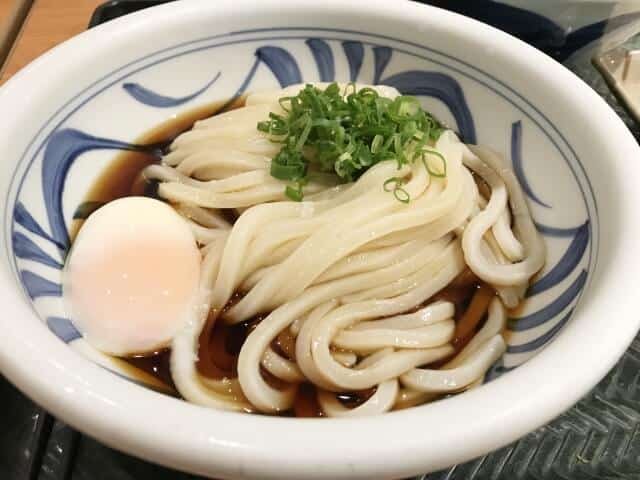
From the street, Suzaki barely looks like a restaurant at all. Inside, the menu is beautifully minimal: thick, old-fashioned noodles with soy sauce, and perhaps a raw egg on top. That bare seasoning exposes the strength and flavor of the noodle completely. Morning visits work best, since the shop closes before noon. A 25-car parking lot handles the road-trip crowd.
Handmade Udon Tamura
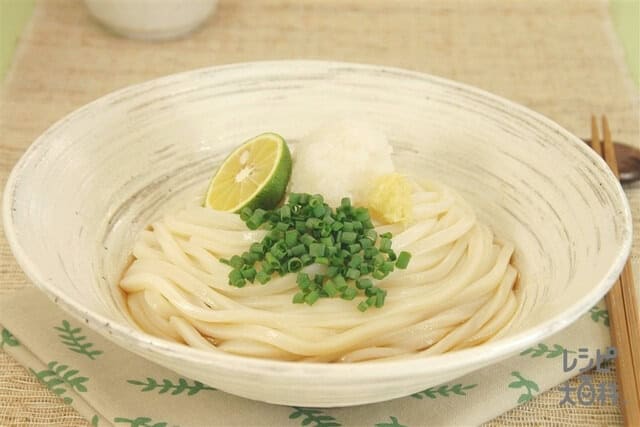
Tamura was a whispered local secret long before the udon boom. The previous owner was said to have the hand of God, and the current owner carries that craft on, boiling noodles in an iron kettle. Order at the counter, season your bowl, and pay afterward on the honor system. The soy sauce udon here shows exactly why simple can be extraordinary.
Another Udon in Japan
If you love Udon, check out other udon styles across Japan! There are many regional bowls to discover.
Click here for it !
Videos
Why Sanuki Udon Remains Japan’s Most Famous Udon
Sanuki Udon endures because it turns three humble ingredients into something people plan trips around. The chewy noodles, the iriko dashi, and the cheerful chaos of self-service shops form an experience no other udon culture matches. Kagawa did not just make a noodle famous. It built an identity around one, and visiting feels like joining a friendly local obsession. Go hungry, start early, and try at least two shops in one morning. That is the Udon Prefecture way.
Save this article to your bookmarks if you plan an udon trip to Kagawa. Feel free to share it on social media too!
Sanuki Udon FAQ
What is Sanuki Udon?
Sanuki Udon is the signature wheat noodle of Kagawa Prefecture, made from flour, salt, and water. The noodles have a square cut, a glossy surface, and famously chewy texture. Shops serve them in a light dashi broth made from dried sardines, or simply with soy sauce. Sanuki is the historical name of the Kagawa region.
What makes Sanuki Udon different from other udon?
The texture sets it apart. High hydration, added salt, and long aging build a firm, elastic chew called koshi that softer udon styles lack. The broth differs too, since Kagawa uses iriko dried sardines instead of the bonito base common elsewhere. Finally, the cheap self-service shop culture exists nowhere else at this scale.
How is Sanuki Udon traditionally served?
The core styles are kake, bukkake, kamaage, zaru, and shoyu. Kake means hot broth, while bukkake pours concentrated dashi over the noodles. Kamaage serves noodles straight from the pot with dipping sauce on the side. In winter, locals also love shippoku udon, which tops the noodles with vegetables simmered in iriko broth.
Where can I eat authentic Sanuki Udon?
Kagawa Prefecture is the only real answer, and the shops cluster around Takamatsu, Sakaide, and the surrounding countryside. Self-service restaurants serve fresh bowls for a few hundred yen, often from morning until early afternoon. Famous names include Gamo, Tamura, and Hinode Seimen Jyo. Many close once the day’s noodles sell out, so go early.
How does a self-service udon shop work?
You order the number of noodle balls and choose hot or cold at the counter. At many shops you warm the noodles yourself, pour your own dashi broth, and add free condiments like green onions and ginger. Tempura sits on trays, and you take pieces with tongs. Pay at the register, then return your bowl after eating.
Is Sanuki Udon suitable for vegetarians?
The noodles themselves are vegan, since they contain only wheat flour, salt, and water. However, the standard dashi broth uses dried sardines, and dipping sauces often contain bonito. Choose shoyu or zaru styles with plain soy sauce, or ask for kombu-only broth where available. A few Takamatsu shops now label vegan options clearly.
Can I buy Sanuki Udon as a souvenir?
Yes, and it is one of Kagawa’s most practical gifts. Dried and half-dried packs keep for weeks and often include dashi sachets. You can find them at Takamatsu Airport, train stations, and supermarkets across the prefecture. Online retailers and Japanese grocery stores overseas also stock dried and frozen versions.
How do I cook Sanuki Udon at home?
Boil the noodles in plenty of water at a strong rolling boil, following the package time. Then rinse them under cold water while rubbing off the surface starch, which tightens the chewy texture. Rewarm them for hot dishes, or serve cold with dipping sauce. Frozen Sanuki Udon needs only a few minutes in boiling water.
References
- Ministry of Agriculture, Forestry and Fisheries (MAFF), Our Regional Cuisines: Shippoku Udon (Kagawa), https://www.maff.go.jp/j/keikaku/syokubunka/k_ryouri/search_menu/menu/sippoku_udon_kagawa.html (Surveyed: July 2026)
- Ministry of Agriculture, Forestry and Fisheries (MAFF), Our Regional Cuisines: Uchikomi Jiru (Kagawa), https://www.maff.go.jp/j/keikaku/syokubunka/k_ryouri/search_menu/menu/uchikomi_jiru_kagawa.html (Surveyed: July 2026)
- Travel Kagawa (Kagawa Prefecture Official Tourism), Shippoku Udon in Winter, https://travel.my-kagawa.jp/2024/winter/shippoku-udon.html (Surveyed: July 2026)
- Japan Society of Cookery Science, Physical Properties and Mastication Characteristics of Udon with Different Moisture Gradients, Annual Meeting Proceedings (2023), https://www.jstage.jst.go.jp/article/ajscs/34/0/34_59/_article/-char/ja/ (Surveyed: July 2026)
- Ishige, N. (2001). The History and Culture of Japanese Food. London: Kegan Paul. (Surveyed: July 2026)
- Kushner, B. (2012). Slurp! A Social and Culinary History of Ramen, Japan’s Favorite Noodle Soup. Leiden: Global Oriental / Brill. (Surveyed: July 2026)
Related Articles
- Inaniwa Udon (稲庭うどん) (Surveyed: July 2026)
- Goto Udon (五島うどん) (Surveyed: July 2026)
- Tanuki Udon (たぬきうどん) (Surveyed: July 2026)
- Japanese Noodles Guide (Surveyed: July 2026)



Comments
List of comments (2)
Its like you read my mind! You seem to know a lot about this, like you wrote the
book in it or something. I think that you could do with some
pics to drive the message home a bit, but instead of that,
this is wonderful blog. A fantastic read. I will certainly be back.
Thank you for reading!
Try posting interesting article more, so please come back to read!