




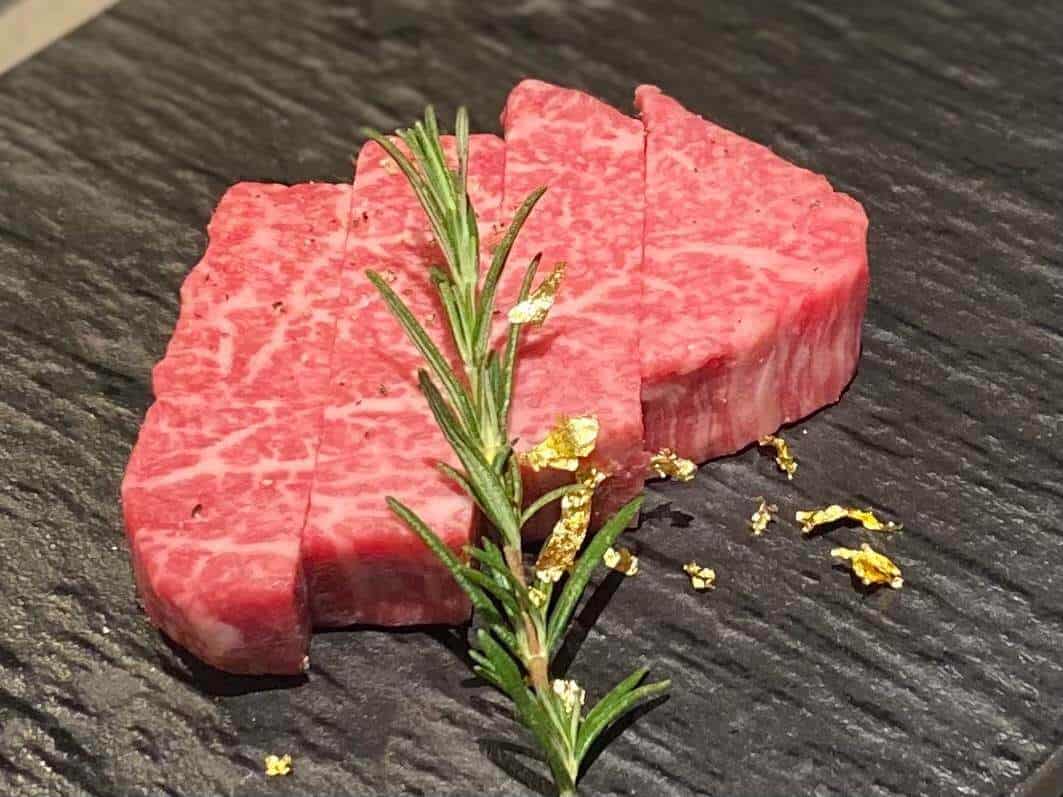
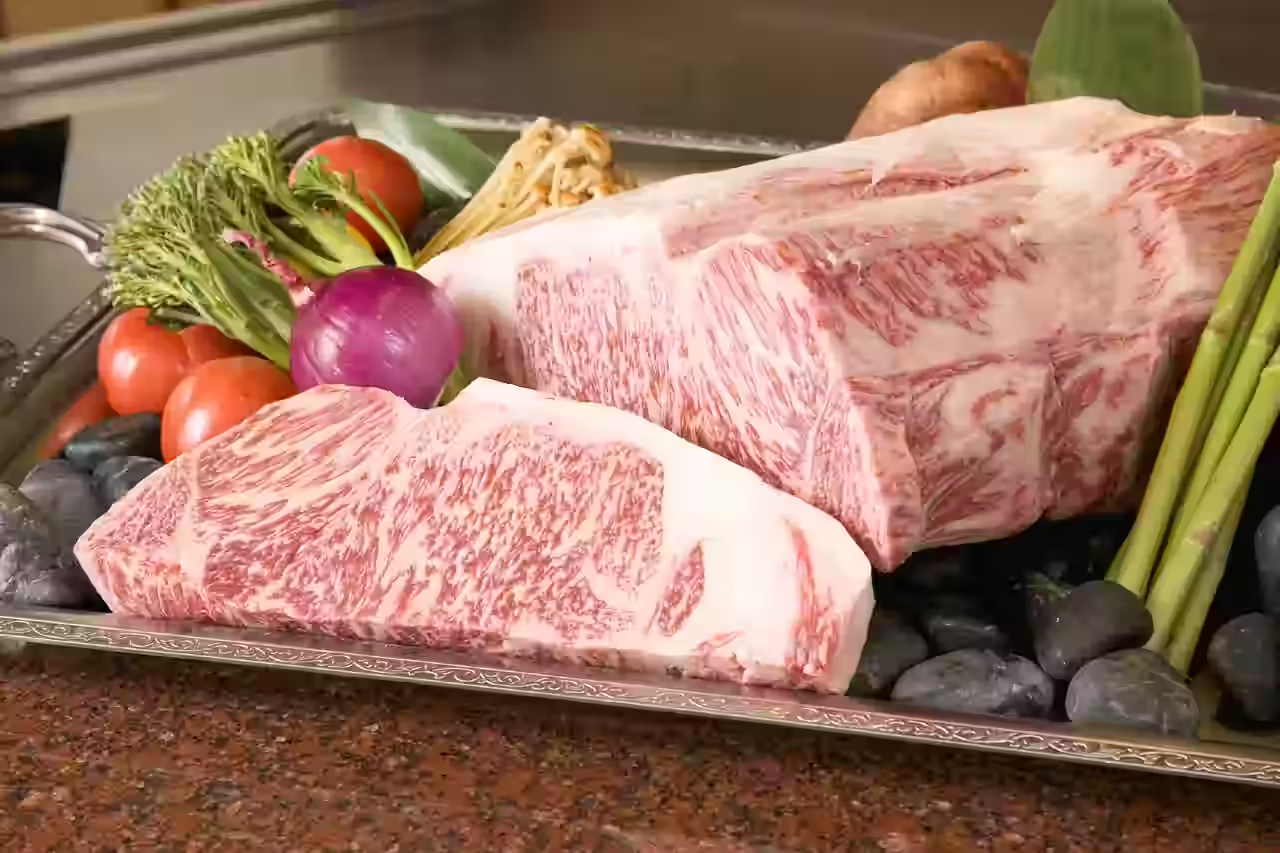
Matsusaka beef (松阪牛) is a regional wagyu brand from Mie Prefecture, and its rules are among the strictest in Japan. Specifically, producers raise only registered Japanese Black heifers that have never calved, inside a defined area around Matsusaka City. As a result, the beef shows fine marbling, a sweet wagyu aroma, and fat that softens at a low temperature.
This page covers seven things: the official definition, certification, taste, price, where to eat, where to buy, and home cooking. Because menus in this category change often, prices and restaurant details carry their own “last checked” dates.
- Japanese
- 松阪牛, read Matsusaka-ushi or Matsusaka-gyu; “Matsuzaka” is a misspelling
- Origin
- Mie Prefecture, central Japan; production area centered on Matsusaka City
- Cattle
- Japanese Black heifers that have never calved, registered individually
- Defining features
- Fine marbling, low-melting fat, sweet wagyu aroma
- Brand protection
- Regional collective trademark No. 5022671; the “Special Grade” tier holds GI registration No. 25 (2017)
- Scale
- 68 fattening farms and 16,772 head on 31 March 2026, per the Matsusaka Beef Council
- Traceability
- 10-digit individual identification number on the certificate and seal
- Price band
- Roughly 1,900 to 3,000 yen per 100 g at retail; restaurant courses from about 9,000 yen
- Best for
- Sukiyaki and shabu-shabu for aroma, steak for texture, or a beef bowl for a first taste
- Sukiyaki for the sweet aroma and the softest texture
- Steak for a thicker bite and a clear sense of the marbling
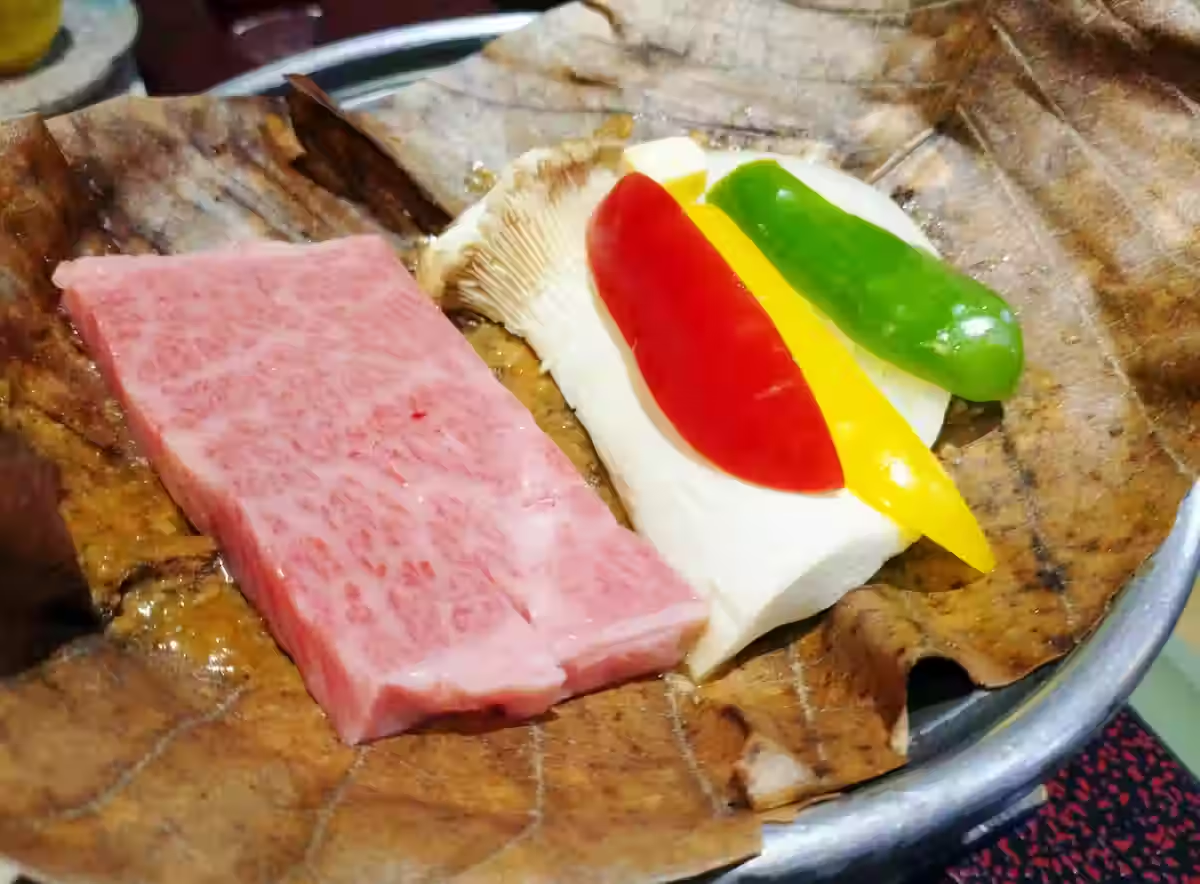
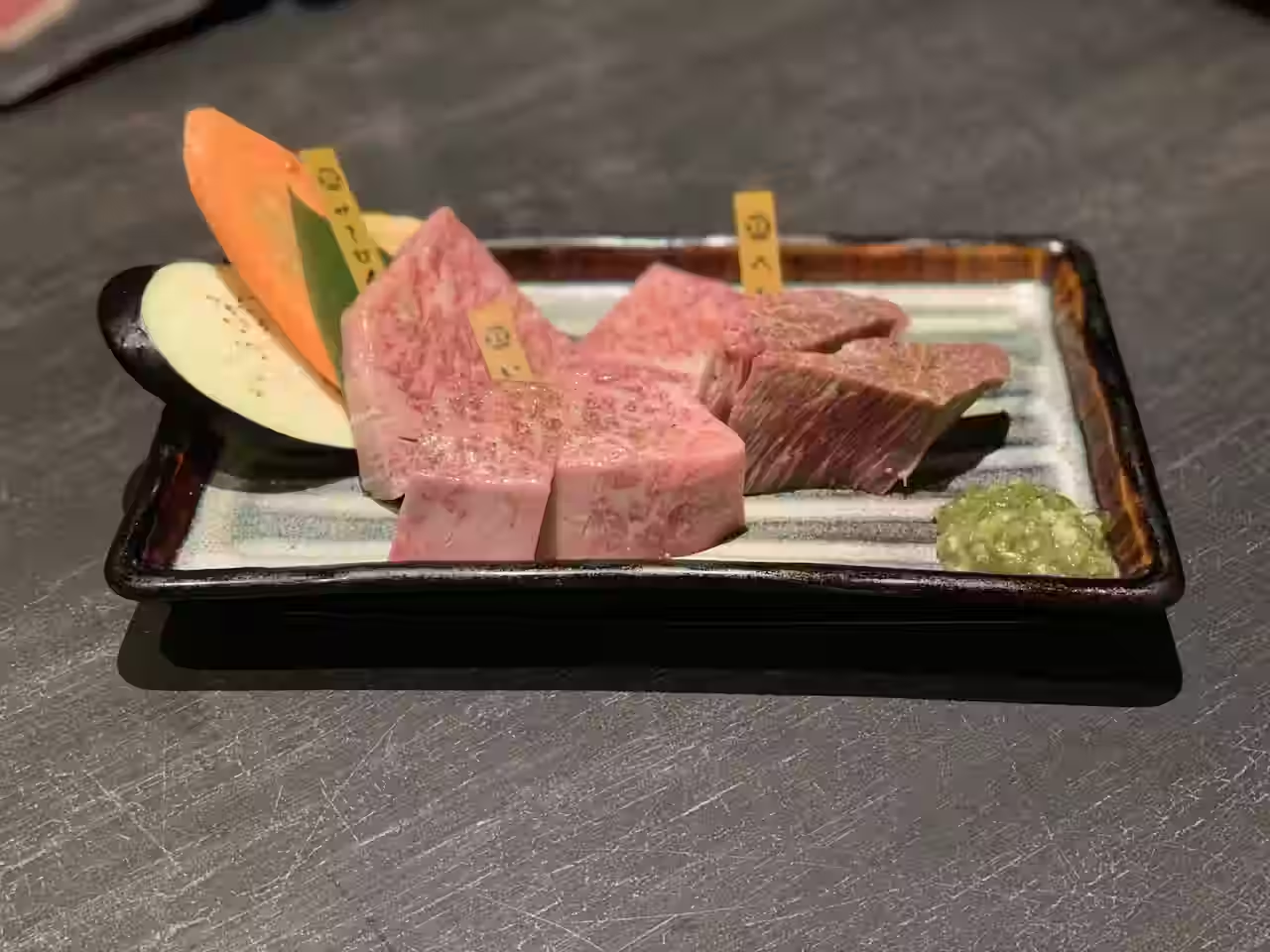
- Yakiniku if you want to compare several cuts in one meal
- Lunch bowl or croquette for a lower-cost introduction
What Is Matsusaka Beef?
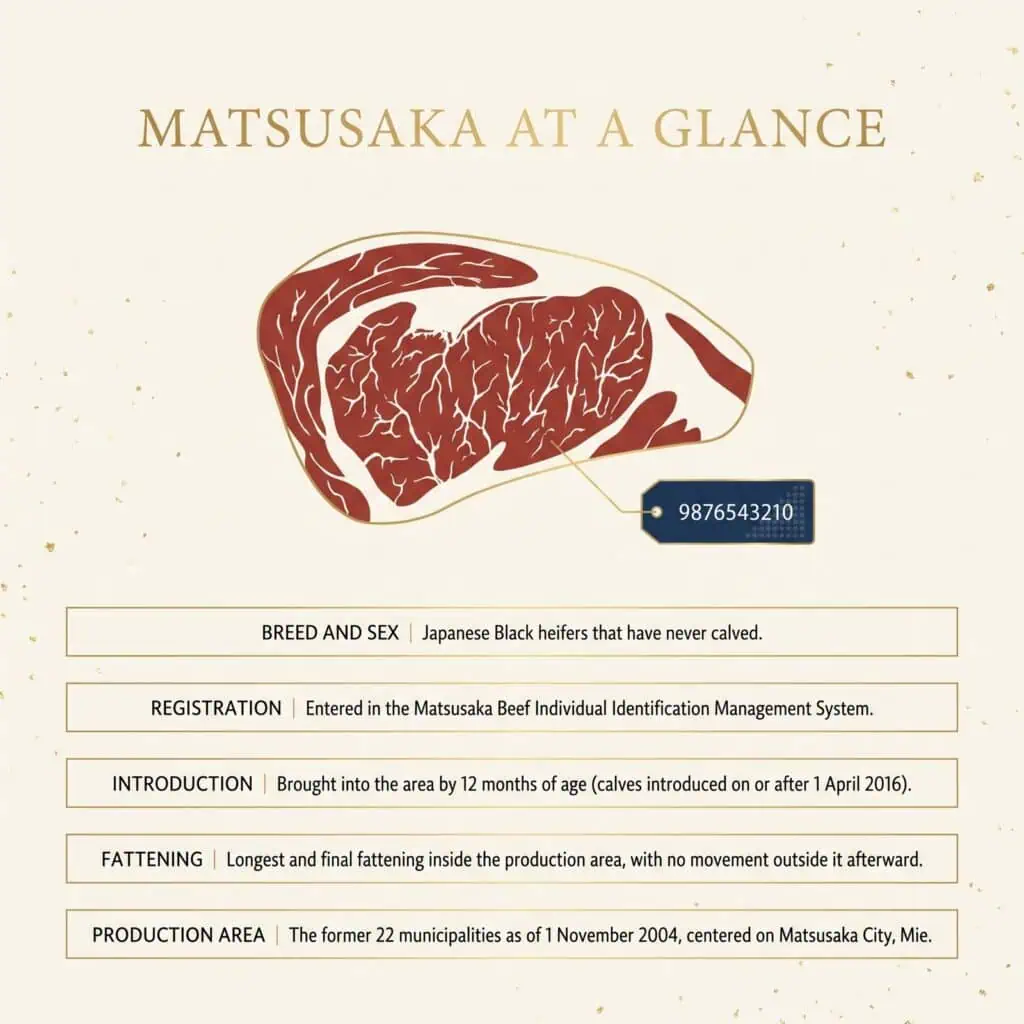
Matsusaka beef is not a separate cattle breed. The designation applies to registered Japanese Black heifers that meet the brand’s production-area and fattening requirements. A heifer here means a female that has never calved, and the term is used that way throughout this guide. The cattle may be born anywhere in Japan. However, their longest and final fattening must take place inside the designated area in Mie Prefecture.
Official Definition
The Matsusaka Beef Council, made up of fattening farms and local governments, sets the rules. Specifically, its definition rests on four requirements, summarized in the table. One detail trips up many visitors: the brand does not require birth in Matsusaka. In fact, many calves come from other regions while still young.
| Requirement | Rule |
|---|---|
| Breed and sex | Japanese Black heifers that have never calved |
| Registration | Entered in the Matsusaka Beef Individual Identification Management System |
| Introduction | Brought into the area by 12 months of age, for calves introduced on or after 1 April 2016 |
| Fattening | Longest and final fattening inside the production area, with no movement outside it afterward |
| Production area | The former 22 municipalities as they stood on 1 November 2004, centered on Matsusaka City |
The area follows old municipal lines because later mergers redrew the map. Three rivers, the Kumozu, Kushida, and Miyagawa, run through this farming district. The GI materials link the area’s rice farming and river plains to its cattle history. Still, water alone certifies nothing. For other dishes from the region, see our guide to regional foods from Mie Prefecture.
Name, Pronunciation, and Brand Protection
Both Matsusaka-ushi and Matsusaka-gyu are accepted readings, and the Japan Patent Office lists both under regional collective trademark No. 5022671. The English spelling is Matsusaka. By contrast, “Matsuzaka” is a common error, and 松坂 is a different set of characters. Breed terms sit one level above. Wagyu describes Japan’s beef cattle breeds, whereas Matsusaka names a brand built on one of them. Our Japanese wagyu grading guide covers the breeds and the carcass grades.
What Does Matsusaka Beef Taste Like?
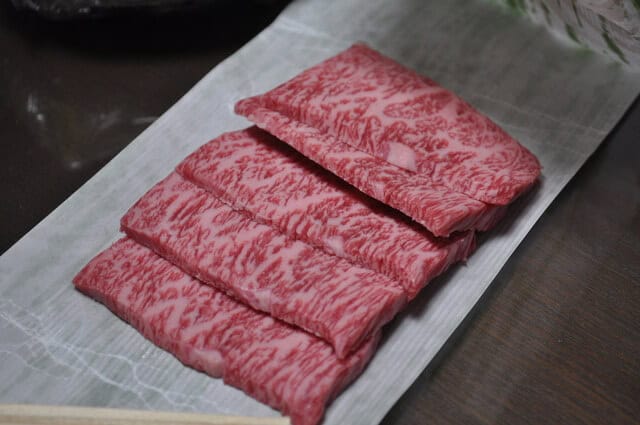
Matsusaka beef tastes sweet and rich, with a soft texture and a clean finish. The fat softens at a low temperature, so thin slices feel smooth almost at once. In addition, a sweet aroma rises as the meat warms, which is why sukiyaki and shabu-shabu suit it so well.
Aroma
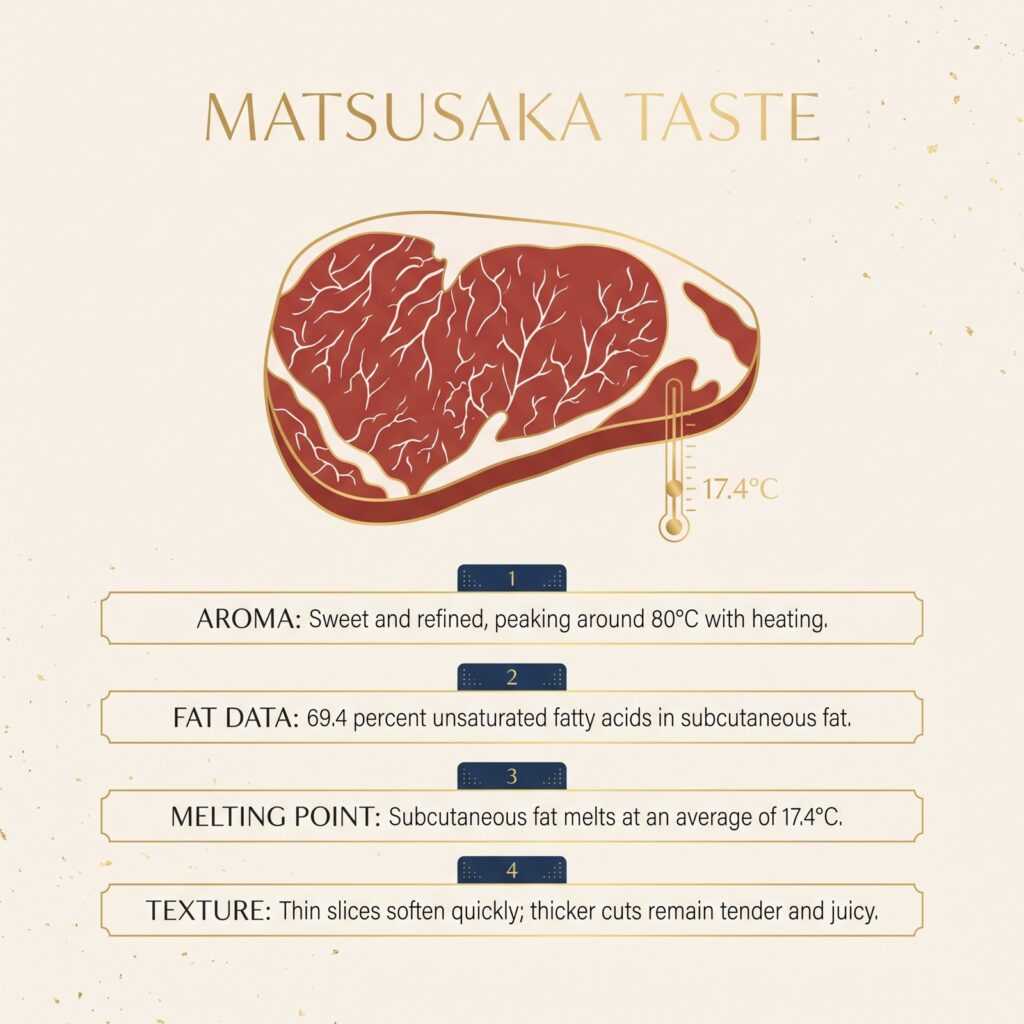
Matsusaka City describes the brand’s scent as sweet and refined, and it uses the term wagyu-ko, or wagyu aroma. However, the research behind that term, by Matsuishi and colleagues, examined Japanese Black beef in general rather than this brand alone. In those studies, for example, the aroma peaked at around 80°C after a couple of minutes of heating. So the finding supports gentle, moist cooking for wagyu broadly.
Fat and Texture
Here the brand has its own data, with limits. Research data published by Matsusaka City recorded a 69.4 percent unsaturated fatty acid share in subcutaneous fat. That sample covered 2,850 animals as of 27 March 2006. A related figure often quoted is an average subcutaneous fat melting point of 17.4°C. Both numbers describe subcutaneous fat from a dated sample, so they are not a guaranteed melting point for every retail cut. Likewise, individual animals vary.
In the mouth, that chemistry reads as smoothness. Thin slices soften quickly, while thicker cuts stay tender and juicy. Even so, this is rich meat, and a moderate portion usually tastes better than a large one. The thin cuts explain why our sukiyaki cooking guide pairs so naturally with this brand.
From Farm to Certificate: How the System Works
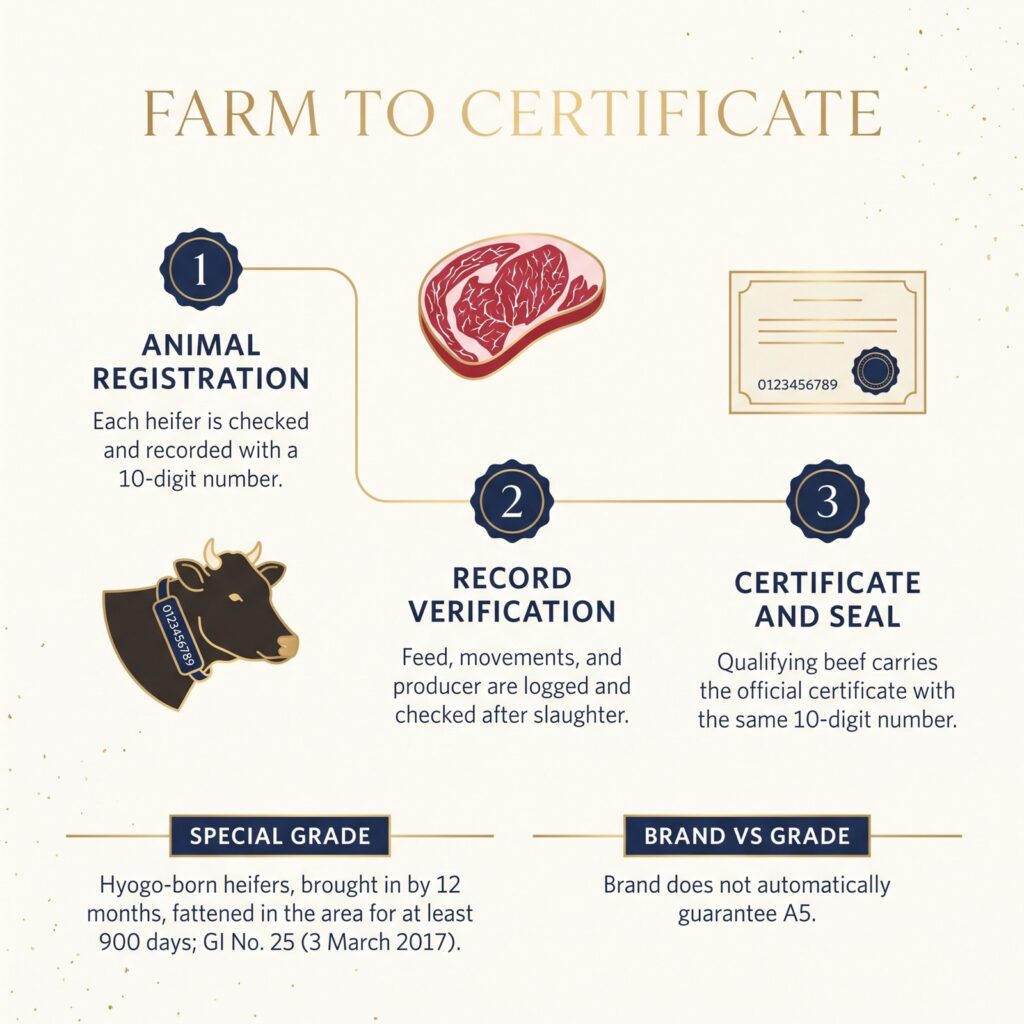
To begin with, registered producers select young heifers and enter each animal in the individual identification system. Registration includes an on-site inspection: staff visit the barn and match the animal’s 10-digit ear-tag number with its documents. After that, the animal may only move within the production area, so its record stays intact.
Fattening then runs long and slow. Producers adjust roughage and grain by growth stage, and the Special Grade tier requires at least 900 days of fattening. Some farms also give beer or massages in hot months to keep appetite up. However, those are practices of certain producers, not brand requirements.
How Is Matsusaka Beef Certified?
- Animal registration. First, staff check each heifer on site and record it under a 10-digit identification number.
- Production and carcass record verification. Next, feed, movements, and the producer are logged. After slaughter, graders assess the carcass and inspectors check its production record.
- Certificate and seal. Finally, qualifying beef can carry the official certificate and seal, which show the same 10-digit number buyers can search online.
The individual identification system began in August 2002 amid heightened concern about BSE and beef labeling. Then the council itself formed in November 2004. As of 31 March 2026, it counted 68 fattening farms, three cities and six towns, and 16,772 head in fattening. Note that the last figure is the herd on hand, not an annual shipment count.
Special Grade Matsusaka Beef
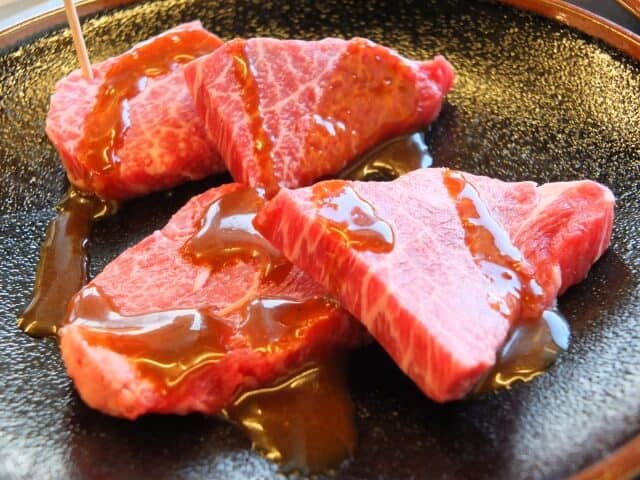
Special Grade Matsusaka Beef, or Tokusan Matsusaka Ushi, is a narrower category inside the brand. It is not Japan’s standard meat-quality grade. Instead, it applies to heifers born in Hyogo Prefecture, brought in by 12 months, and fattened in the area for at least 900 days. Importantly, this tier, and only this tier, received national Geographical Indication registration No. 25 on 3 March 2017.
Matsusaka eligibility describes origin and management. The Japanese carcass grade, on the other hand, describes something else: the letter (A to C) is yield, and the number (1 to 5) is meat quality. Therefore, the brand does not automatically guarantee A5, and an A5 stamp alone says nothing about origin. See the Japanese wagyu grading guide for the full scale.
A Short History of Matsusaka Beef
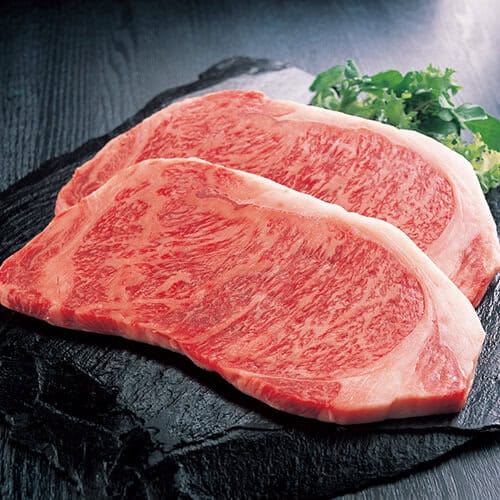
For centuries, Japanese farmers kept cattle mainly for work, and meat eating stayed limited. That changed in the Meiji period, when beef hot pot became a symbol of a new era. Matsusaka’s own story, meanwhile, runs through those decades.
According to Matsusaka City, heifers from the Tajima district of Hyogo reached the Matsusaka area via Kishu in the Edo period, first as working cattle. Later, from the 1870s, local dealers drove cattle overland to Tokyo. That journey is called the ushioi dochu, literally “cattle-driving trip.” The city says groups of more than 100 animals set out about every two months and walked almost three weeks. Those details come from one municipal source, though, and we could not trace them to an older record.
In 1935, Matsusaka cattle won top honors at a national livestock exposition in Tokyo. The city credits that award with spreading the name nationwide. The Matsusaka Beef Cattle Show then began in 1949. Finally, modern traceability closed the loop with the 2002 identification system and the 2004 council.
- Edo periodTajima heifers reach the Matsusaka area as working cattle (Matsusaka City)
- 1870sCattle are driven on foot to Tokyo (Matsusaka City)
- 1935Top award at a national livestock exposition in Tokyo (Matsusaka City)
- 1949The Matsusaka Beef Cattle Show begins (Matsusaka City)
- August 2002Individual identification management system starts (Matsusaka Beef Council)
- November 2004Matsusaka Beef Council founded
- March 2017Special Grade Matsusaka Beef registered as GI No. 25 (MAFF)
Matsusaka Beef vs Kobe Beef vs Omi Beef
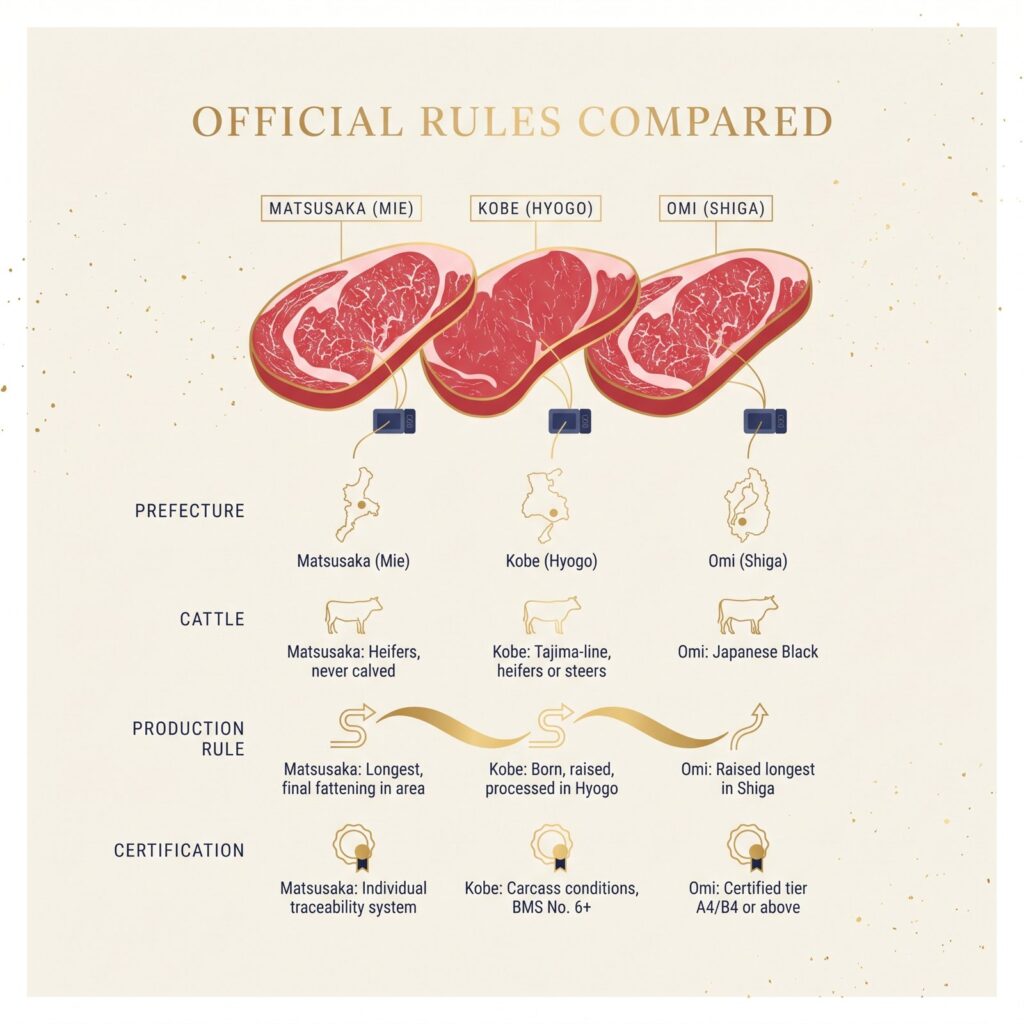
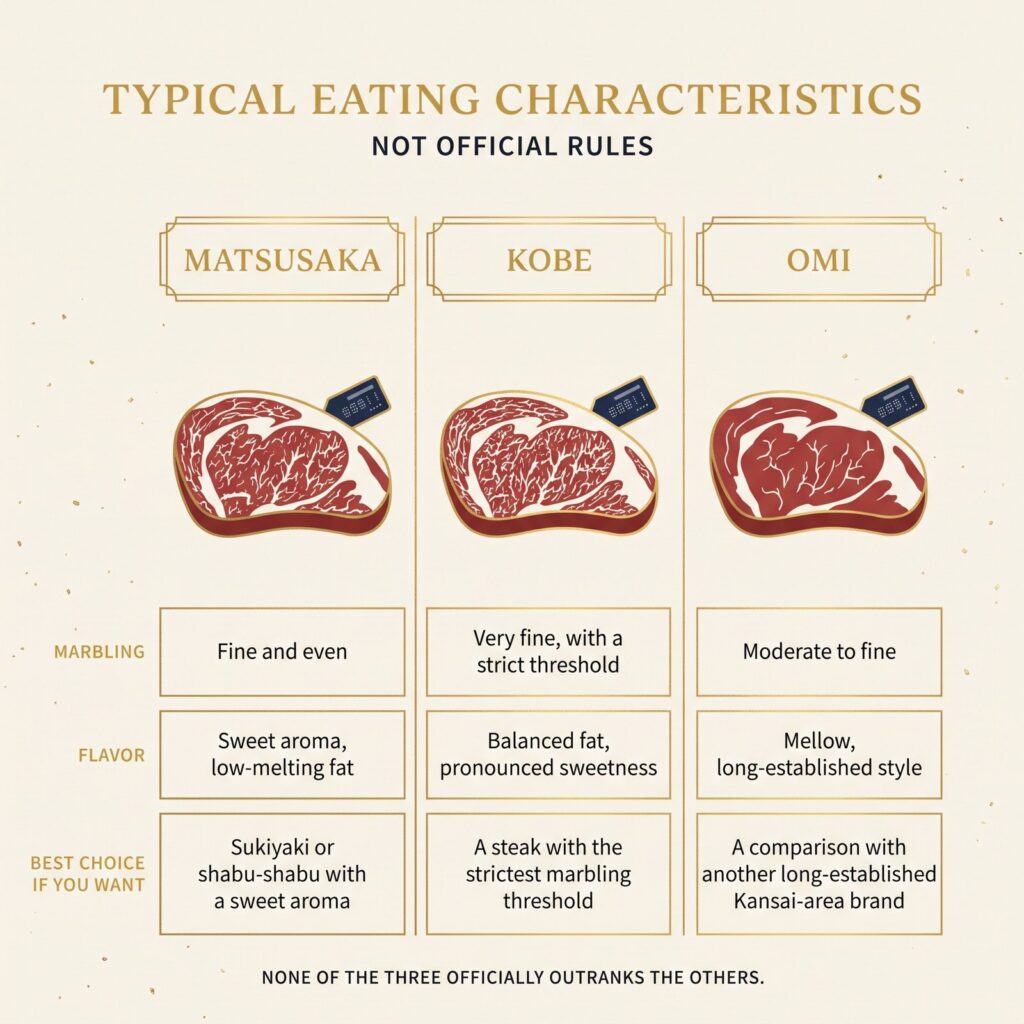
These three names appear together constantly as the “three great wagyu.” That grouping is a convention, though, and Yonezawa beef often takes Omi’s place. More importantly, their rulebooks differ. The upper rows below are official eligibility rules, while the lower rows are typical eating characteristics that vary by animal and cut.
| Point | Matsusaka beef | Kobe beef | Omi beef |
|---|---|---|---|
| Official eligibility rules | |||
| Prefecture | Mie | Hyogo | Shiga |
| Cattle | Japanese Black heifers, never calved | Tajima-line Japanese Black, heifers or steers | Japanese Black |
| Production rule | Longest and final fattening in the designated area | Born, raised, and processed in Hyogo | Raised longest in Shiga |
| Certification | Individual registration and traceability system | Carcass conditions including BMS No. 6 or higher | Certified tier at A4 or B4 and above |
| Typical eating characteristics (not official rules) | |||
| Marbling | Fine and even | Very fine, with a strict threshold | Moderate to fine |
| Flavor | Sweet aroma, low-melting fat | Balanced fat, pronounced sweetness | Mellow, long-established style |
| Best choice if you want | Sukiyaki or shabu-shabu with a sweet aroma | A steak with the strictest marbling threshold | A comparison with another long-established Kansai-area brand |
For the other two brands in detail, read our guides to Kobe beef and Omi beef. In short, none of the three officially outranks the others.
Why Is Matsusaka Beef So Expensive?
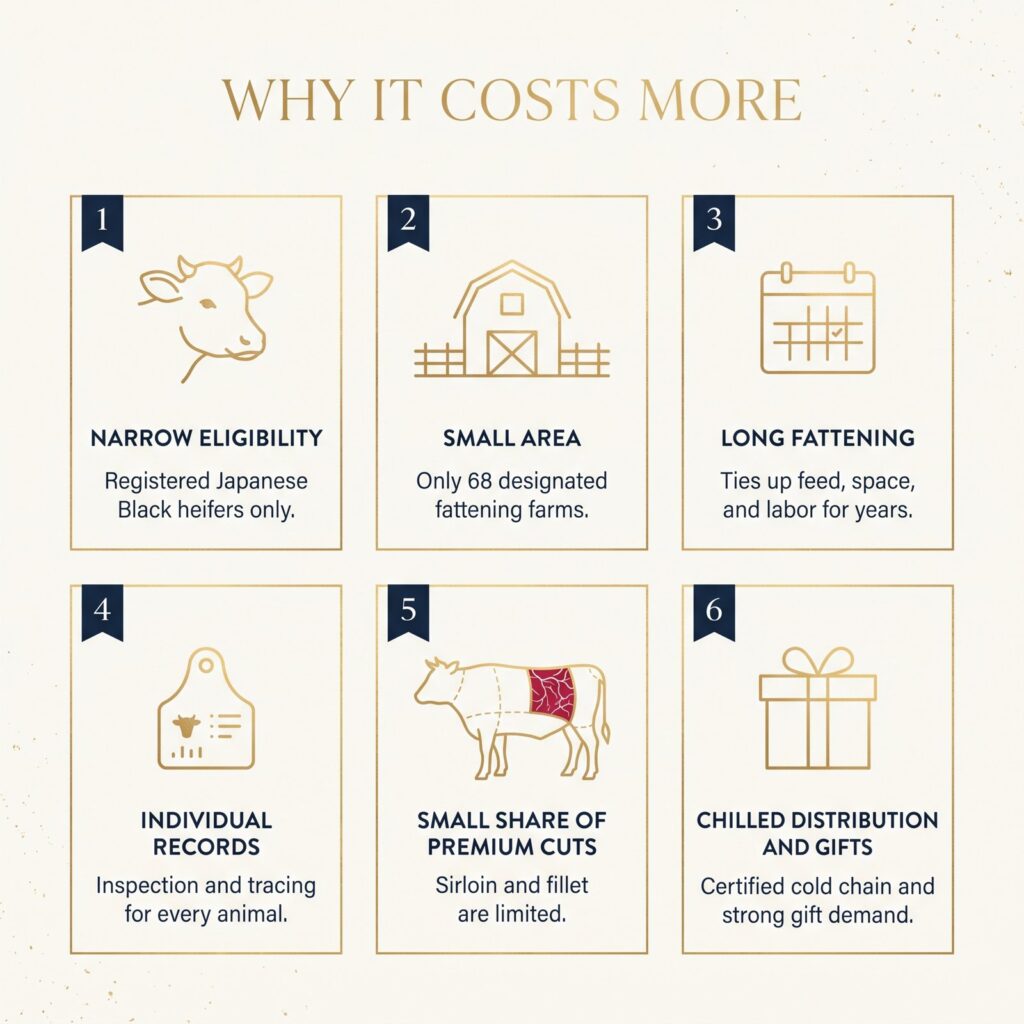
Matsusaka beef is expensive because supply is small and production is slow. Only registered heifers that have never calved qualify, and the designated area limits how many farms take part. Moreover, each animal spends years in the region and is traced individually. Premium cuts then form a small share of every carcass.
Limited supply is one major reason for the high price, but not the only one. Labour, feed, record-keeping, chilled distribution, and restaurant positioning also add to the final bill.
- Narrow eligibility: registered Japanese Black heifers only
- A small designated area with 68 fattening farms
- Long fattening that ties up feed, barn space, and labor for years
- Individual inspection and record-keeping for every animal
- Premium cuts such as sirloin and fillet are only a small share of each carcass
- Finally, chilled, certified distribution and strong gift demand
Matsusaka Beef Price Guide
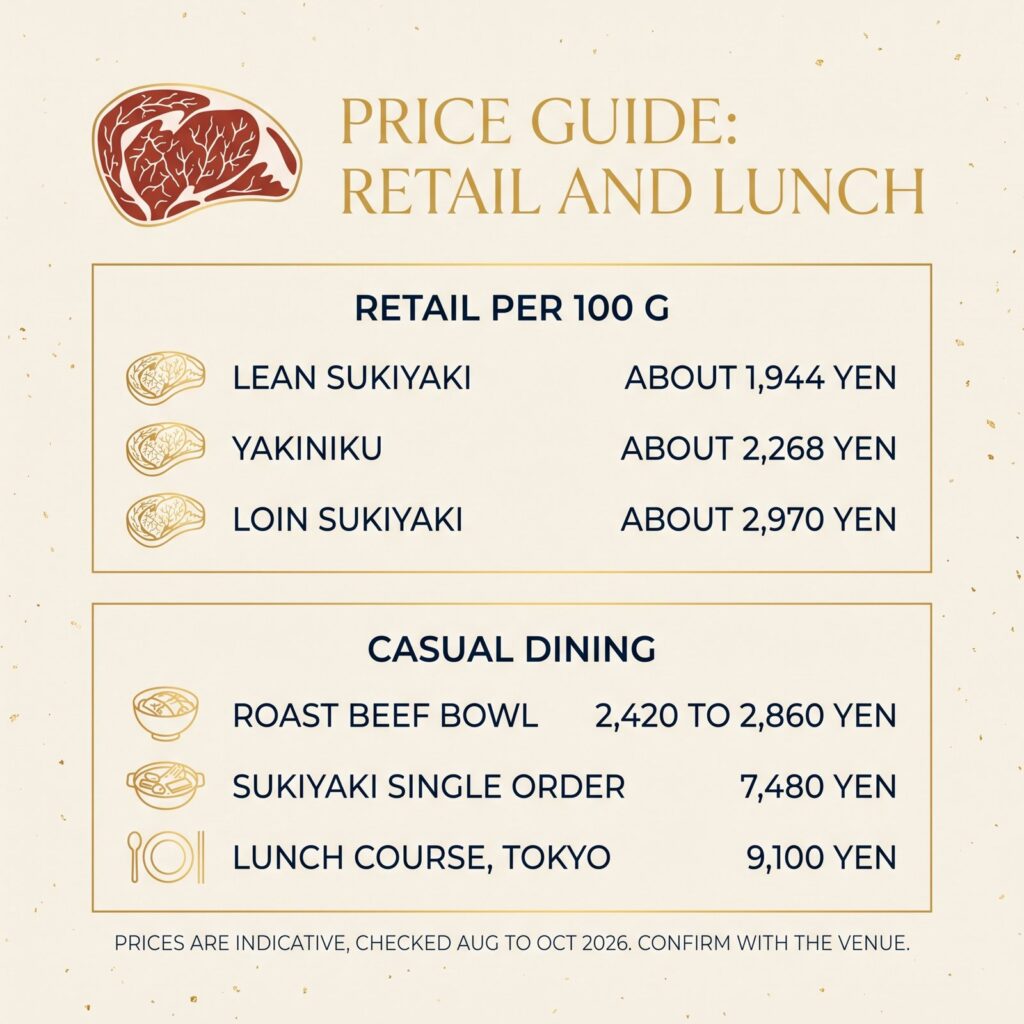
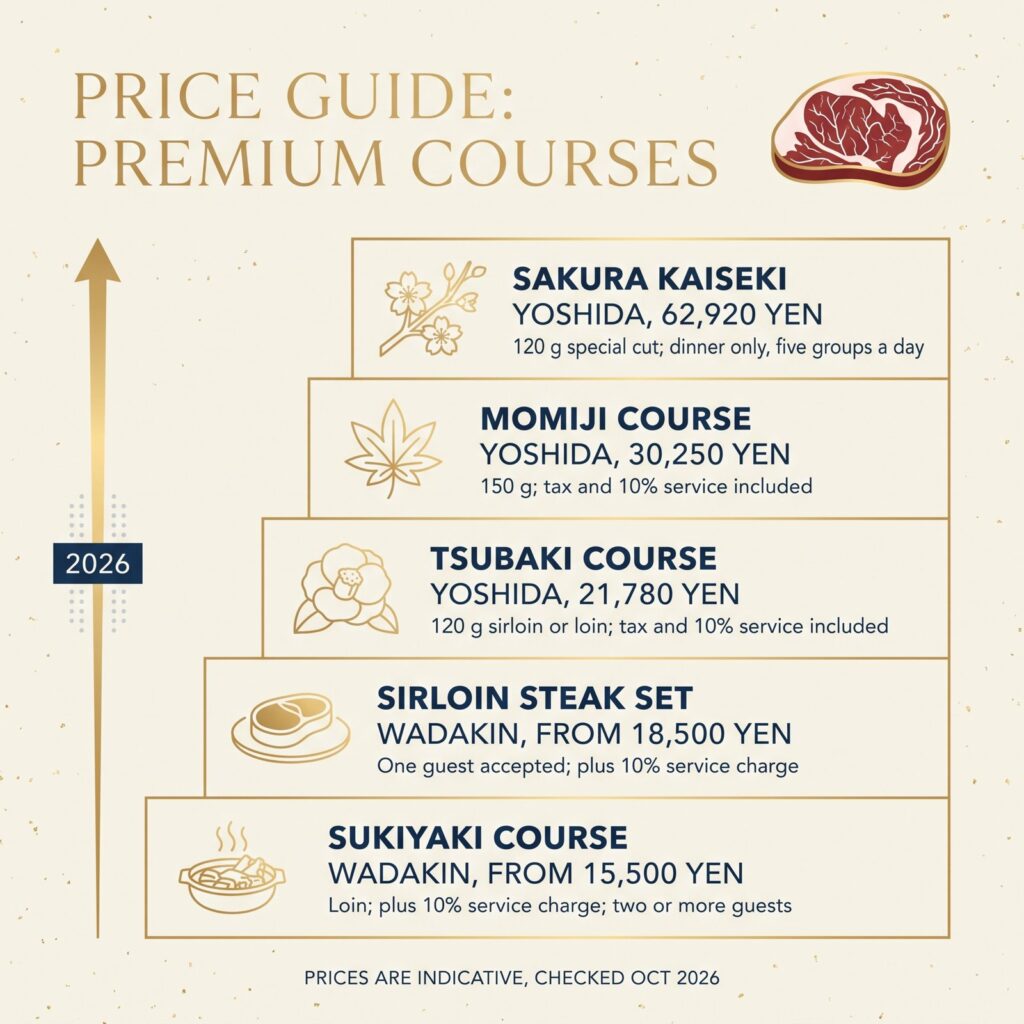
The prices below come from official shop and restaurant pages, and each row carries its own check date. Where a venue lists “from” pricing, drinks, private rooms, and service charges can raise the final bill. So the notes say which apply.
Retail
| Item | Price | Source | Last checked |
|---|---|---|---|
| Sukiyaki slices, lean cuts | About 1,944 yen | Matsusaka Maruyoshi online shop | Aug 2026 |
| Yakiniku cuts | About 2,268 yen | Matsusaka Maruyoshi online shop | Aug 2026 |
| Sukiyaki slices, loin and chuck loin | About 2,970 yen | Matsusaka Maruyoshi online shop | Aug 2026 |
Casual Dining and Lunch
| Item | Price | Portion and notes | Last checked |
|---|---|---|---|
| Roast beef bowl, Maruyoshi Kamada Honten | 2,420 to 2,860 yen | Limited quantity; portion weight not listed | Aug 2026 |
| Sukiyaki, single order, Maruyoshi | 7,480 yen | Portion weight not listed | Aug 2026 |
| Matsusaka beef lunch course, Yoshida (Tokyo) | 9,100 yen | Steak, sukiyaki, or shabu-shabu main; the menu applies a 10% service charge only outside the lunch menu | Oct 2026 |
Premium Courses
| Item | Price | Portion and notes | Last checked |
|---|---|---|---|
| Sukiyaki course, Wadakin (Matsusaka) | From 15,500 yen | Loin; plus 10% service charge; two or more guests | Oct 2026 |
| Sirloin steak set, Wadakin | From 18,500 yen | Plus 10% service charge; one guest accepted | Oct 2026 |
| Tsubaki course, Yoshida (Tokyo) | 21,780 yen | 120 g sirloin or loin; tax and 10% service included | Oct 2026 |
| Momiji course, Yoshida | 30,250 yen | 150 g; tax and 10% service included | Oct 2026 |
| Sakura kaiseki course, Yoshida | 62,920 yen | 120 g special cut; dinner only, five groups a day | Oct 2026 |
Prices are indicative, not citywide averages. Confirm with the venue before you book.
Where to Eat Matsusaka Beef
Matsusaka City publishes member listings of shops and restaurants that handle the brand. Those listings are a useful first check, because the city compiles them from registered businesses. Even so, they cannot guarantee that a venue serves the brand every day, so call ahead when the meal matters.
| City | Travel convenience | Typical dining style | Expected budget |
|---|---|---|---|
| Matsusaka | Limited express from Nagoya or Osaka; venues near the station | Sukiyaki courses, butcher-run restaurants, beef bowls | 2,500 to 30,000 yen |
| Tokyo | Easy for most itineraries | Teppanyaki, sukiyaki, kaiseki | 9,000 to 63,000 yen |
| Osaka | Easy; Namba and Umeda | Yakiniku specialists | 10,000 to 15,000 yen |
| Nagoya | Inside or beside the station | Yakiniku, stopover meals | Varies by set; check the branch menu |
We selected the five venues below for a mix of reasons. They offer a traceable supply or official membership, a useful location, a range of budgets, and different cooking styles. Each card also shows its own check date.
Matsusaka: Wadakin (和田金)
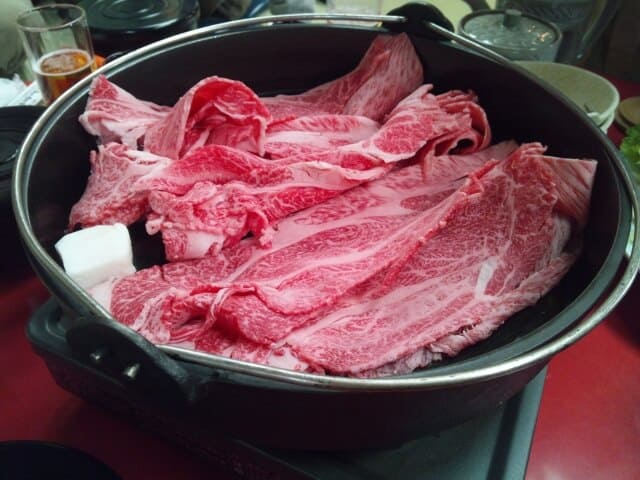
Wadakin was founded in 1878, according to the restaurant, and it describes itself as the original Matsusaka meat restaurant. Sukiyaki, cooked at the table in an iron pan, is the signature here. Notably, the steak set accepts solo diners, while sukiyaki and grilled courses require two guests.
Matsusaka: Maruyoshi Kamada Honten (松阪まるよし 鎌田本店)
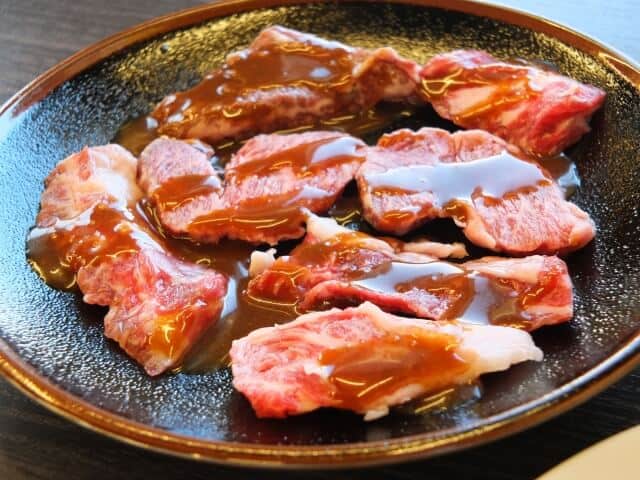
Maruyoshi pairs a butcher shop with a restaurant, so it makes an easy first stop and sells meat and croquettes to take home. Menus also come in English and Chinese. Meanwhile, the limited roast beef bowl keeps the entry price low.
Tokyo: Matsusaka Ushi Yoshida (松阪牛 よし田)
Yoshida sits on the 53rd floor of Tokyo Opera City Tower, just one minute from Hatsudai Station. Here, teppanyaki, sukiyaki, and shabu-shabu courses all use the brand. Read course names carefully, though, because the cheaper “Japanese Black” courses at the same restaurant are not Matsusaka beef.
Osaka: Matsusakagyu Yakiniku M, Namba (松阪牛焼肉M)
This yakiniku specialist buys whole Matsusaka cattle, so the menu runs from lean cuts to premium ones. As a result, it suits diners who want to compare cuts in one sitting. Course content changes over time, so confirm prices when you reserve.
Nagoya: Yakiniku Isshobin, JR Nagoya Station (一升びん)
Isshobin began in Matsusaka and buys A5 cattle whole. Its branch in the Umaimon Dori arcade at JR Nagoya Station suits a stopover. Helpfully, the chain states openly that a few items, such as tongue, are not Matsusaka beef.
Getting There and Booking
Matsusaka Station is served by both JR Central and Kintetsu, with limited express trains from Nagoya and Osaka. Both local venues above also sit within a ten-minute walk of the station. Allow about two hours for a full sukiyaki or steak course. Likewise, book premium courses several days ahead. A few English phrases also help when you call or arrive, though no phrase guarantees availability.
- “Does this course use certified Matsusaka beef?”
- “Can I see the identification number or certificate?”
- “Is there a service charge or table charge?”
- “Also, can one person order this course?”
Dietary note: sauces, broths, and side dishes may contain soy, wheat, egg, alcohol, or other allergens. Because preparation varies by venue, ask before ordering.
How to Identify Authentic Matsusaka Beef
Marbling alone cannot prove authenticity. Check the official seal or certificate and verify the 10-digit identification number. In practice, genuine products carry that number, and the Matsusaka Beef Council’s lookup tool shows the animal’s record. If a seller cannot provide a valid number or certificate, then treat the product as unverified.
- First, look for the official seal or certificate, not just wording on a sign
- Then confirm the 10-digit identification number and search it in the council’s lookup tool
- Also, prefer shops and restaurants listed by Matsusaka City
- Ask about the cut and weight, since both change the price sharply
- Finally, treat “Matsusaka-style,” the misspelling “Matsuzaka,” and a bare A5 stamp as no proof at all
Where to Buy Matsusaka Beef
Certified butchers in Matsusaka, department-store counters, and official online shops all sell the brand. However, products fall into four groups, and they are not interchangeable.
| Type | Shelf life and shipping | Eating quality |
|---|---|---|
| Chilled meat | Short; follow the seller’s use-by date; chilled delivery only | Best texture, especially for sukiyaki and steak |
| Frozen meat | Longer; thaw in the refrigerator and cook promptly | Good when thawed slowly; avoid countertop thawing |
| Prepared foods | Croquettes, curry, shigure-ni; varies by product | Convenient; smaller beef share |
| Gift sets | Fixed delivery dates; check the recipient can receive chilled goods | Usually premium cuts with a certificate copy |
Storage rules differ by product. So follow the use-by date and instructions printed by the certified seller rather than a single universal period. Also, importing beef into another country is often prohibited, so check your own rules before carrying any home.
- Cut and weight, and how many servings that gives
- Chilled or frozen
- Shipping area and delivery date
- Whether a certificate or identification number is included
- Gift wrapping, and also whether the recipient can accept a chilled delivery
Cooking Matsusaka Beef at Home
Different cuts need different heat. Thin sukiyaki slices cook in seconds, whereas thick steaks need moderate heat plus resting. This optional section ends with a Kansai-style sukiyaki recipe and food-safety notes.
| Cut | Heat | Guidance |
|---|---|---|
| Thin slices, about 2 mm (sukiyaki, shabu-shabu) | Moderate pan or simmering broth | Seconds per side; eat immediately |
| Yakiniku cuts, 5 to 8 mm | Hot grill | Turn once when the edges brown; do not crowd the grill |
| Steak, 2 cm or thicker | Medium heat, heavy pan | Judge by thickness and a thermometer, not the clock; rest for five minutes |
Kansai-Style Matsusaka Beef Sukiyaki
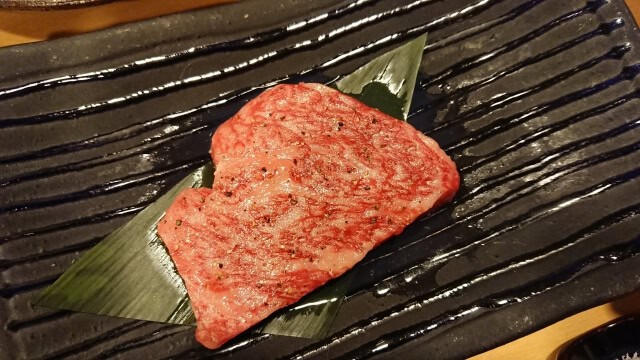
Kansai-style sukiyaki sears the beef first, then seasons it directly with sugar, soy sauce, and sake. Since no premixed warishita is involved, you adjust the balance as you cook. Taking the beef out of the refrigerator about 15 minutes ahead is a practical preparation window, not a safety rule.
Ingredients
- 220 g Matsusaka beef, thinly sliced loin (about 2 mm)
- 1 piece beef fat, or 1 tsp neutral oil
- 2 tbsp sugar
- 3 tbsp soy sauce
- 2 tbsp sake (or 2 tbsp water plus a pinch of sugar, an approximation)
- 60 ml dashi or water
- 1 stalk negi (Japanese leek), cut diagonally
- 60 g shungiku or spinach
- 4 shiitake mushrooms
- 150 g grilled or firm tofu
- 2 eggs for dipping, if suitable (see safety notes)
Method
- First, prepare the vegetables and tofu, and set the seasonings within reach.
- Heat the pan over medium heat and melt the beef fat across the surface.
- Next, lay two or three slices flat and sear briefly on each side, until they color but do not curl tightly.
- Sprinkle sugar over the beef, then add soy sauce and sake. Keep the heat moderate so that the sugar does not burn.
- Eat the first slices at once, dipped in beaten egg if you are using it.
- Afterward, add negi, shiitake, and tofu to the juices, with a little dashi if the pan looks dry. Simmer until soft, add the greens last, and then cook the remaining beef in small batches.
If You Prefer Steak
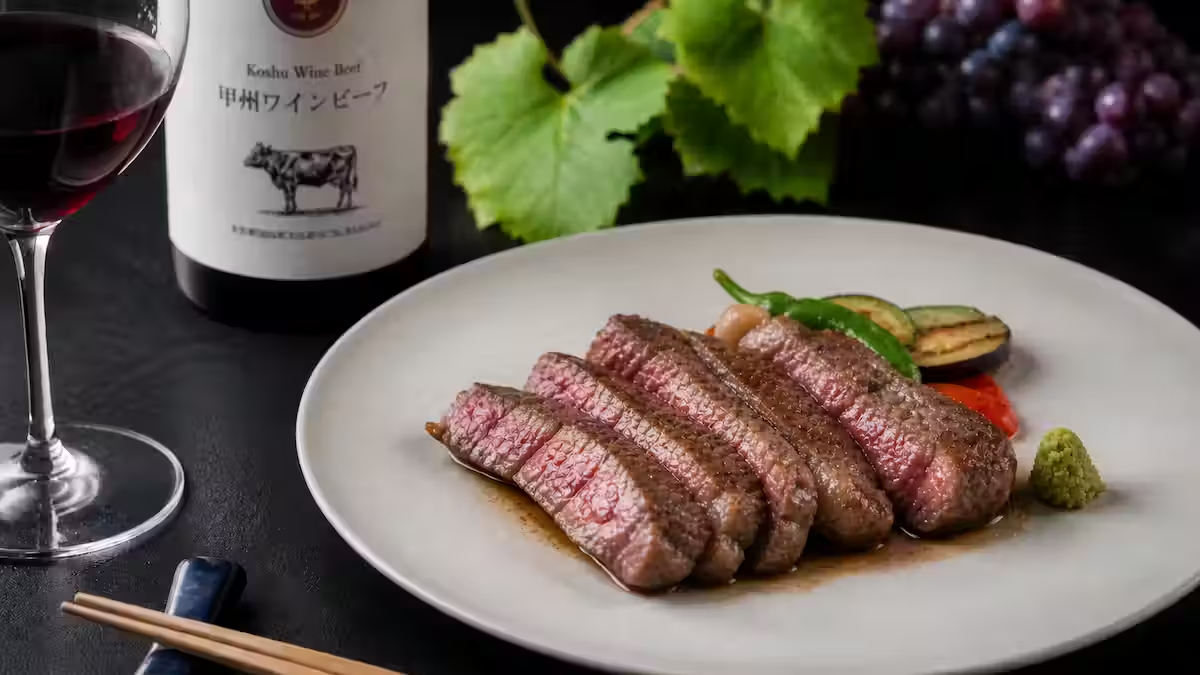
Steak highlights the aroma and texture of thicker cuts, while sukiyaki and shabu-shabu suit thinly sliced meat. First, pat the surface dry, heat a heavy pan to medium, and sear each side until well browned. For a 2 cm sirloin that often means two to three minutes per side. However, pan material and starting temperature change the result, so use a thermometer and rest the meat for five minutes.
Food Safety Notes
Japan’s Ministry of Health, Labour and Welfare advises cooking meat thoroughly to the center. It gives 75°C for one minute as a general example for ground and processed meat. Meanwhile, the U.S. Food Safety and Inspection Service adds cut-specific figures, shown here as supplementary guidance.
| Product | Guidance | Source |
|---|---|---|
| Whole cuts (steak, slices) | 63°C (145°F) with a three-minute rest | USDA FSIS (supplementary) |
| Mechanically tenderized beef | Same as whole cuts, because blades can carry bacteria inward | USDA FSIS (supplementary) |
| Ground beef | 75°C for one minute (Japan); 71°C (160°F) (USDA) | MHLW; USDA FSIS |
Raw egg depends on the product label and local guidance. In Japan, eggs sold for raw eating carry a use-by date set for that purpose. Even there, not every egg is intended for raw use. Elsewhere, use pasteurized eggs or simply skip the dip. In any case, children, older adults, pregnant people, and anyone immunocompromised should avoid raw egg.
Matsusaka Beef: Final Thoughts
Four steps make a Matsusaka beef meal go well. First, choose a preparation: sukiyaki for aroma, steak for texture, yakiniku to compare cuts, or a beef bowl to start cheaply. Second, check the current price, since menus move. Third, reserve if the course needs it, and ask whether solo diners are accepted. Finally, verify the identification number, which is the one thing marbling cannot tell you.
Matsusaka Beef FAQ
- What is Matsusaka beef?
-
Matsusaka beef is a regional wagyu brand from Mie Prefecture, not a breed. It applies to registered Japanese Black heifers that have never calved and that spend their longest and final fattening in a designated area around Matsusaka City. In addition, every eligible animal carries a 10-digit identification number.
- How do you pronounce Matsusaka beef?
-
Both Matsusaka-ushi and Matsusaka-gyu are correct readings of 松阪牛, and the trademark registers both. The English spelling is Matsusaka. By contrast, “Matsuzaka” is a misspelling.
- What does Matsusaka beef taste like?
-
It tastes sweet and rich, with a soft texture and a clean finish. Producers credit a high share of unsaturated fat, which softens at a low temperature. Also, a sweet wagyu aroma develops as the meat warms, so gentle cooking suits it.
- How much does Matsusaka beef cost?
-
Retail slices ran about 1,900 to 3,000 yen per 100 g in August 2026. Meanwhile, a beef bowl in Matsusaka costs under 3,000 yen and a Tokyo lunch course 9,100 yen. Premium dinner courses run 21,780 to 62,920 yen as of October 2026.
- How can I identify authentic Matsusaka beef?
-
Look for the official certificate or seal with a 10-digit identification number, then search that number in the council’s lookup tool. Also, prefer shops and restaurants listed by Matsusaka City. “Matsusaka-style,” the misspelling “Matsuzaka,” and a bare A5 label prove nothing on their own.
- How is Matsusaka beef different from Kobe beef?
-
Matsusaka requires registered heifers that have never calved and regional fattening in Mie. Kobe, by contrast, applies carcass conditions to Tajima-line cattle born, raised, and processed in Hyogo. Neither brand officially outranks the other, so the choice comes down to style and the dish you want.
References
Definition and Certification
- Matsusaka City / Matsusaka Beef Council – What Is Matsusaka Beef (official definition) (Accessed October 2026)
- City of Matsusaka – Matsusaka Beef Production Area (Accessed October 2026)
- Matsusaka City / Matsusaka Beef Council – About the Council: membership and herd figures as of 31 March 2026 (Accessed October 2026)
- Ministry of Agriculture, Forestry and Fisheries – GI Registration No. 25: Tokusan Matsusaka Ushi (Accessed October 2026)
- Ministry of Agriculture, Forestry and Fisheries – GI Register No. 25: Tokusan Matsusaka Ushi, specification (PDF) (Accessed October 2026)
- Japan Patent Office – Regional Collective Trademark No. 5022671: Matsusaka Ushi (Accessed October 2026)
- Kobe Beef Marketing and Distribution Promotion Association – Certification Criteria (Accessed August 2026)
- Omi Beef Production and Distribution Promotion Council – Definition and Certification (Accessed August 2026)
Taste Research
- Matsusaka City – Fatty Acid Composition (research data, 2006) (Accessed October 2026)
- City of Matsusaka – The Secret of Matsusaka Beef’s Deliciousness (Accessed October 2026)
- J-STAGE – Matsuishi, M., Fujimori, M. and Okitani, A. (2001), Wagyu Beef Aroma in Wagyu (Japanese Black Cattle) Beef, Nihon Chikusan Gakkaiho 72(6) (Accessed August 2026)
- J-STAGE – Irie, M. (2021), Fat Quality and Palatability of Wagyu Beef, review, Nihon Chikusan Gakkaiho 92(1) (Accessed August 2026)
History
- Matsusaka City – History of Matsusaka Beef (Accessed October 2026)
- City of Matsusaka – Matsusaka Beef Chronology (Accessed August 2026)
Prices and Restaurants
- Wadakin – Menu, hours and reservation conditions (Accessed October 2026)
- Matsusaka Maruyoshi Kamada Honten – Official restaurant page: hours, payment, access (Accessed October 2026)
- Online shop of Matsusaka Maruyoshi – Retail price list (Accessed August 2026)
- Matsusaka Ushi Yoshida – Menu and hours (Accessed October 2026)
- Matsusaka City – Member businesses in the Kinki region (Accessed August 2026)
- Isshobin – JR Nagoya Station Umaimon Dori branch (Accessed August 2026)
Food Safety
- Ministry of Health, Labour and Welfare – Cook meat thoroughly (Accessed October 2026)
- U.S. Food Safety and Inspection Service – Safe Minimum Internal Temperatures (PDF) (Accessed August 2026)
- U.S. Food Safety and Inspection Service – Mechanically Tenderized Beef (Accessed August 2026)
- Ministry of Health, Labour and Welfare – Prevention of Salmonella food poisoning from eggs (Accessed August 2026)
Related Articles
- Japanese Wagyu Grading Guide (Surveyed: October 2026)
- Kobe Beef (神戸牛) (Surveyed: October 2026)
- Omi Beef (近江牛) (Surveyed: October 2026)
- Sukiyaki Cooking Guide (Surveyed: October 2026)
- Regional Foods from Mie Prefecture (Surveyed: October 2026)



Comments