




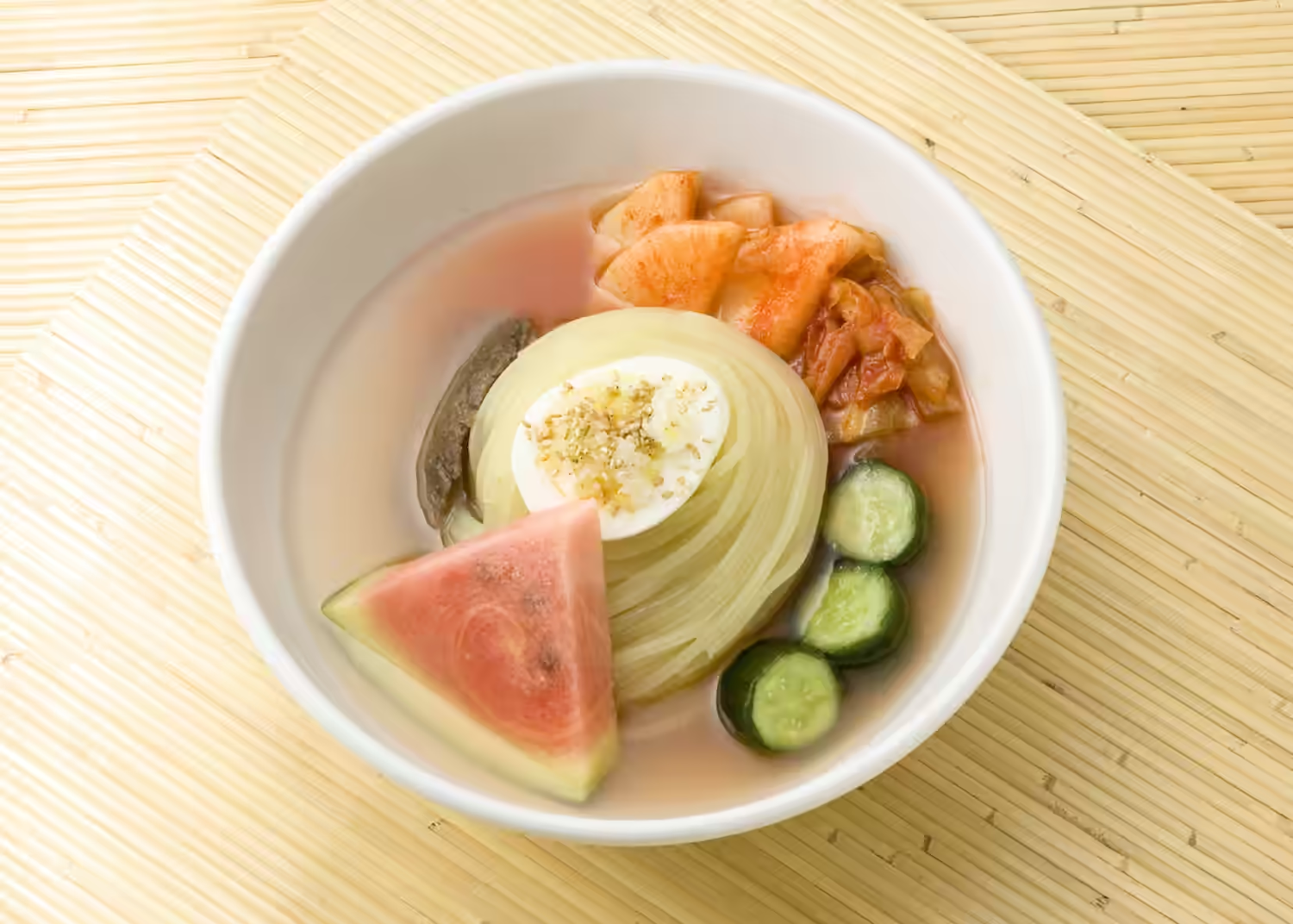
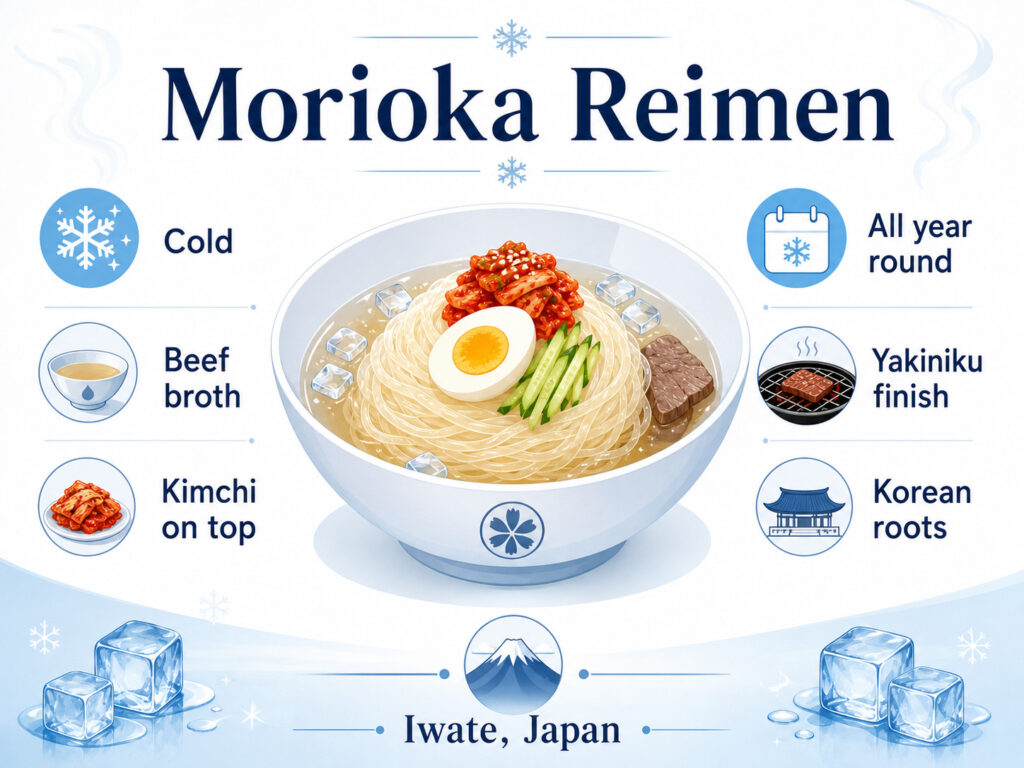
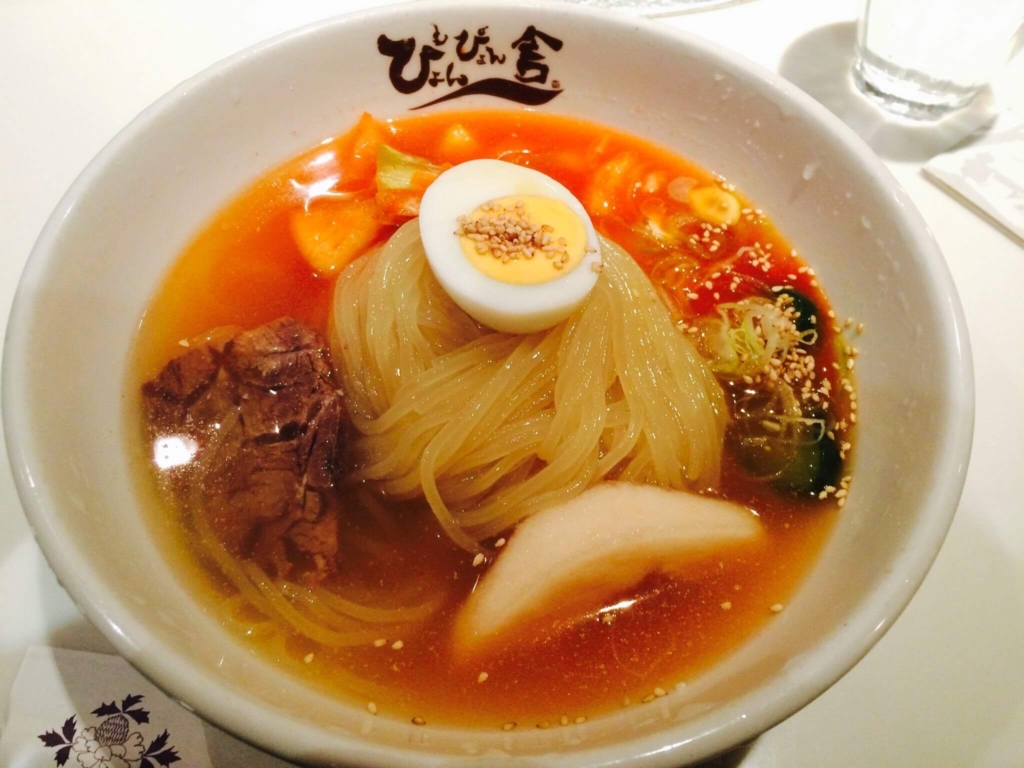
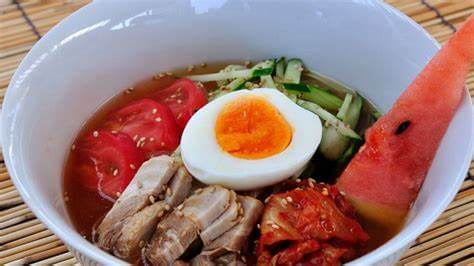
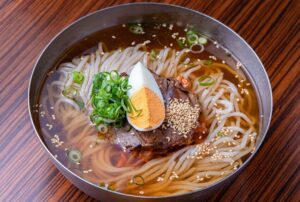
Morioka reimen is a cold noodle dish from Morioka, the capital of Iwate Prefecture. It pairs chewy, semi-translucent noodles made from wheat flour and potato starch with a chilled beef broth. Kimchi, a boiled egg, cucumber, sliced beef, and a piece of seasonal fruit usually sit on top.
The first bowl can feel strange, because the noodles fight back. Still, that surprise is part of the appeal. This guide covers its history, a home recipe, ordering tips, allergies, and the best Morioka reimen restaurants.
What Is Morioka Reimen and Why Is It Famous?
It is one of Morioka’s Three Great Noodles, next to wanko soba and jajamen. Yet its fame rests on something simpler. According to Pyonpyonsha, a Morioka yakiniku and reimen company, locals see yakiniku restaurants as places to eat reimen, not just meat. In fact, Iwate’s official tourism site counts about 30 reimen restaurants in the city.
Quick Facts
- Japanese name
- 盛岡冷麺 (Morioka reimen)
- Birthplace
- Shokudoen, Morioka, 1954
- Roots
- Cold-noodle traditions of Hamhung and Pyongyang in northern Korea
- Noodles
- Wheat flour and potato starch; thick, springy, semi-translucent
- Broth
- Chilled beef stock, often with chicken
- Toppings
- Kimchi, boiled egg, cucumber, sliced beef, pear or watermelon
- Spice
- Set by the amount of kimchi; many shops offer spice levels
- Where to eat
- Yakiniku restaurants and reimen specialists
- Price
- 1,089 yen at Daidoen and 1,500 yen at Seirokaku for a standard bowl (Last checked: September 2026)
Is Morioka Reimen Korean or Japanese?
It is a Japanese regional dish with Korean roots. A Hamhung-born restaurateur created it in Morioka in 1954, drawing on the cold noodles of his homeland. Local cooks then adapted the noodles, broth, and kimchi for Morioka diners. It also appears on the list of 100 rural local dishes selected by Japan’s farm ministry.
History of Morioka Reimen
The story begins with one man and one small restaurant. Shokudoen’s founder, Aoki (青木輝人), was born in Hamhung in 1914, according to a 2013 family interview in the Choson Sinbo newspaper. His Korean name was 楊龍哲, romanized as Yang Yong-cheol, and he loved the fiery, chewy cold noodles of his hometown.
In 1954, Aoki opened Shokudoen in Morioka. Iwate’s official tourism site says he blended mild Pyongyang-style noodles with the spicy style of Hamhung. The early reception was rough, though. Indeed, Pyonpyonsha records that some customers called the noodles rubbery and impossible to bite through.
- 1954: Aoki opens Shokudoen and first serves his cold noodles.
- Mid-1960s to mid-1970s: More restaurants in and around Morioka start serving reimen, each with its own recipe.
- 1986: Pyonpyon-tei, forerunner of Pyonpyonsha, brings a bowl to the Nippon Men Summit in Morioka. Soon after, the name “Morioka reimen” gains wide attention.
- Mid to late 1980s: A national gourmet boom then carries the dish across Japan.
- 1990: Pyonpyonsha launches take-home reimen, so the taste reaches kitchens far from Iwate.
How Korean Cold Noodles Became a Yakiniku Finale
Aoki was not alone. Many Korean residents lived in Morioka at the time, and several opened their own restaurants after his success, Pyonpyonsha explains. Reimen then settled into the city’s yakiniku restaurants, so grilled beef and cold noodles ended up on the same menu.
That pairing made practical sense. A rich, smoky meal needs a clean, cold finish, and the tangy broth does the job. Over time, the habit turned into local custom. The Morioka Station building’s own guide even notes that some locals go mainly for the noodles, not the meat.
What Does Morioka Reimen Taste Like?
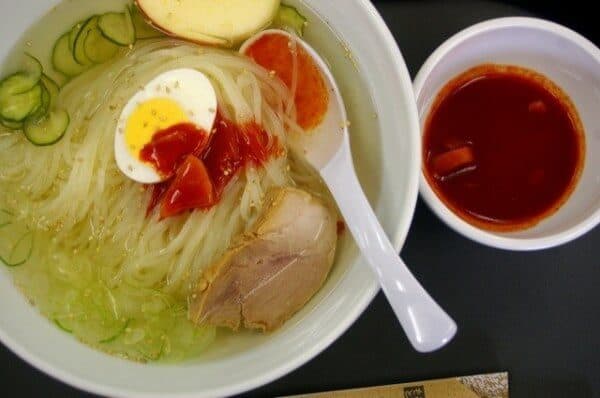
Start with the noodles. The thick noodles resist the first bite, then turn smooth and springy as you chew. This distinctive texture makes the dish memorable, although it takes getting used to. Some first-timers are unsure at first, and that is fair.
The broth tastes cleaner than you might expect. Shokudoen, for example, uses roughly 80 percent beef bone and 20 percent chicken, according to Iwate’s tourism site. As a result, you get a clean beef aroma with gentle acidity, while the cold keeps it light.
Then the toppings change each bite. Tangy kimchi brings heat and crunch, while crisp cucumber cools things down. A slice of pear or watermelon adds sweetness near the end. It sounds odd on paper, but in the bowl it works.
Morioka Reimen Ingredients
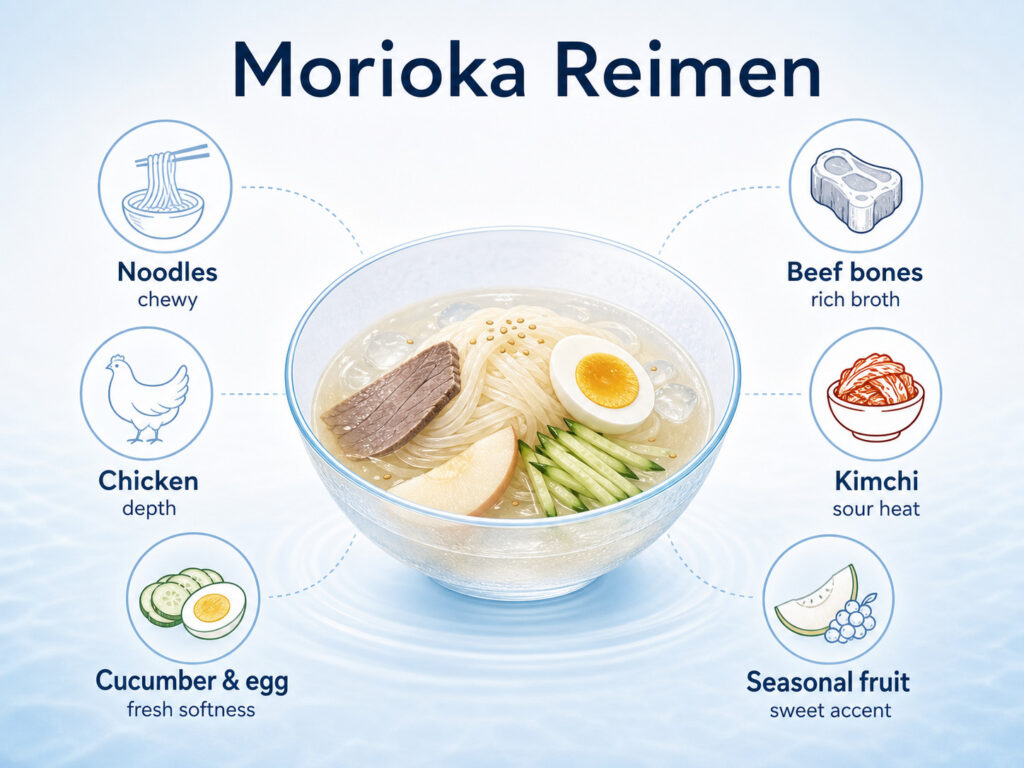
The noodles decide everything. Makers blend wheat flour with potato starch and knead a very firm dough. First, wheat protein forms gluten, which gives the strands structure and stretch. Potato starch, meanwhile, swells and turns clear in boiling water, so the noodles look semi-translucent and bounce back when you bite.
An ice-water rinse then tightens the surface. According to Pyonpyonsha, Aoki also swapped the buckwheat of Pyongyang noodles for wheat flour. That change also gave Morioka noodles their semi-translucent look.
- Broth: Beef, beef bones, and often chicken bones, simmered and then chilled.
- Kimchi: Often cabbage and daikon radish, made especially for reimen.
- Toppings: Boiled egg, sweet-pickled cucumber, sliced beef, green onion, and sesame.
- Fruit: Pear or watermelon, depending on the season.
- Vinegar: An optional splash at the table, which Daidoen’s menu recommends.
How to Order Morioka Reimen
Ordering is easy, but the spice question catches people off guard. Staff may ask how hot you want it before you have even opened the menu. Here is what to expect.
- Spice levels: Shokudoen offers extra hot (four times standard), hot (twice), regular, and betsukara. Daidoen, similarly, uses four levels, from slightly hot to extra hot. Seirokaku, on the other hand, keeps it to three: kimchi on the side, regular, or hot.
- Betsukara (別辛): The kimchi arrives on a separate plate. This is the safest first choice, because you add the heat yourself.
- Half bowls: Some shops sell a smaller portion. For example, Daidoen lists a half bowl at 902 yen.
- Large bowls: Some shops offer extra noodles (ōmori), such as Seirokaku at 1,750 yen. Ask staff first, though, since not every restaurant does.
- Sets: Some restaurants, including Pyonpyonsha’s station store, pair reimen with a small yakiniku platter.
Not sure what to say? “Betsukara de” is enough, and pointing at the menu works too.
How to Eat Morioka Reimen
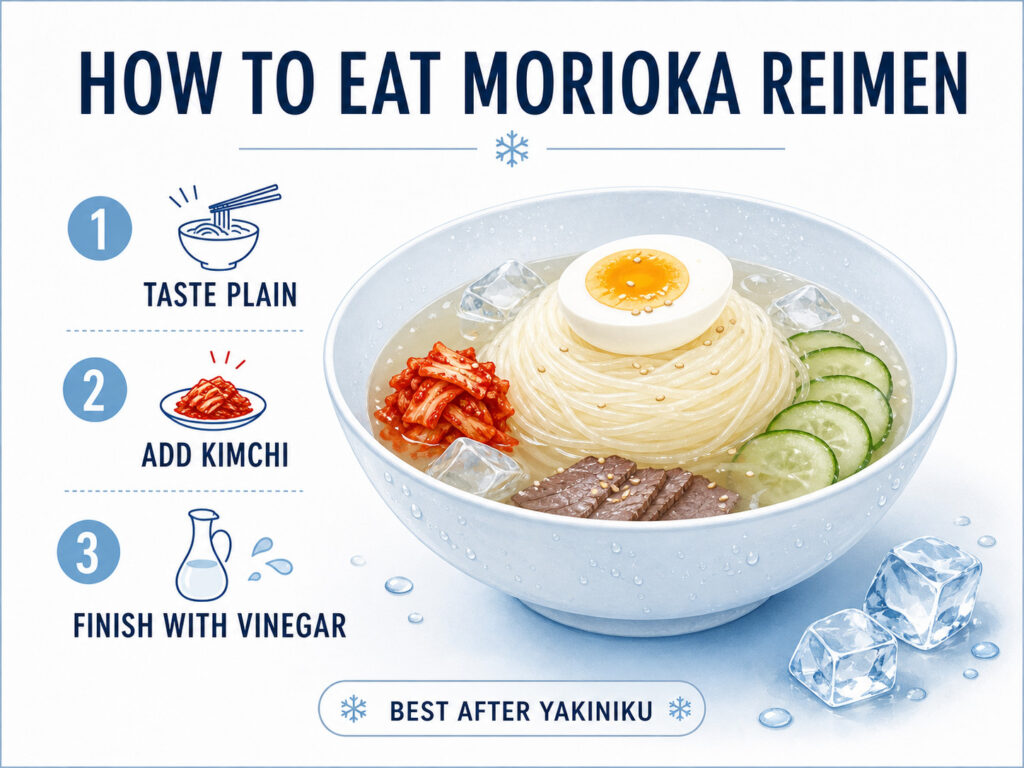
- Taste the broth first. A sip before anything else shows you the base flavor.
- Loosen the noodles. Stir them gently so they separate and pick up broth.
- Ask about cutting. If the strands feel too long, ask staff whether they can cut them for you.
- Add kimchi little by little. With betsukara, stir in a spoonful, taste, and repeat.
- Try vinegar last. A small splash near the end brightens the broth.
Should you drink the broth? Nobody will mind if you do. It is cold and clean, so it goes down surprisingly easily.
Is Morioka Reimen Only for Summer?
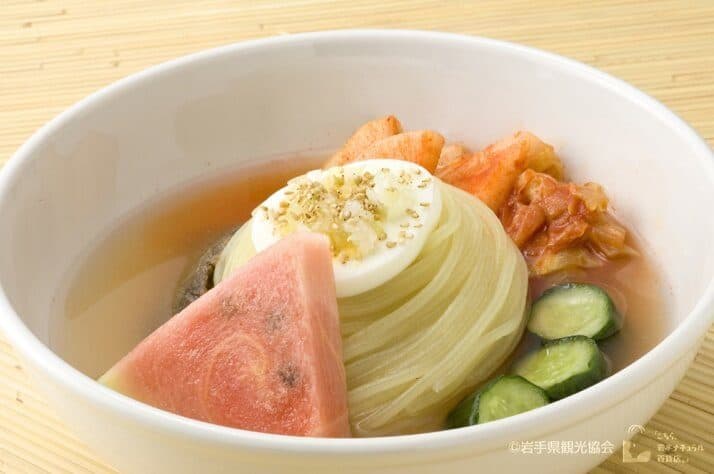
No. The name suggests a summer dish, yet Morioka eats it in every season. The reason is cultural rather than purely culinary. Because reimen closes a yakiniku meal, people order it whenever they grill meat, and that happens all winter too.
After a hot grill, a cold bowl can feel welcome even in January. Still worried about the chill? Some shops, such as Daidoen and Seirokaku, also sell onmen, a hot version.
Morioka’s Three Great Noodles
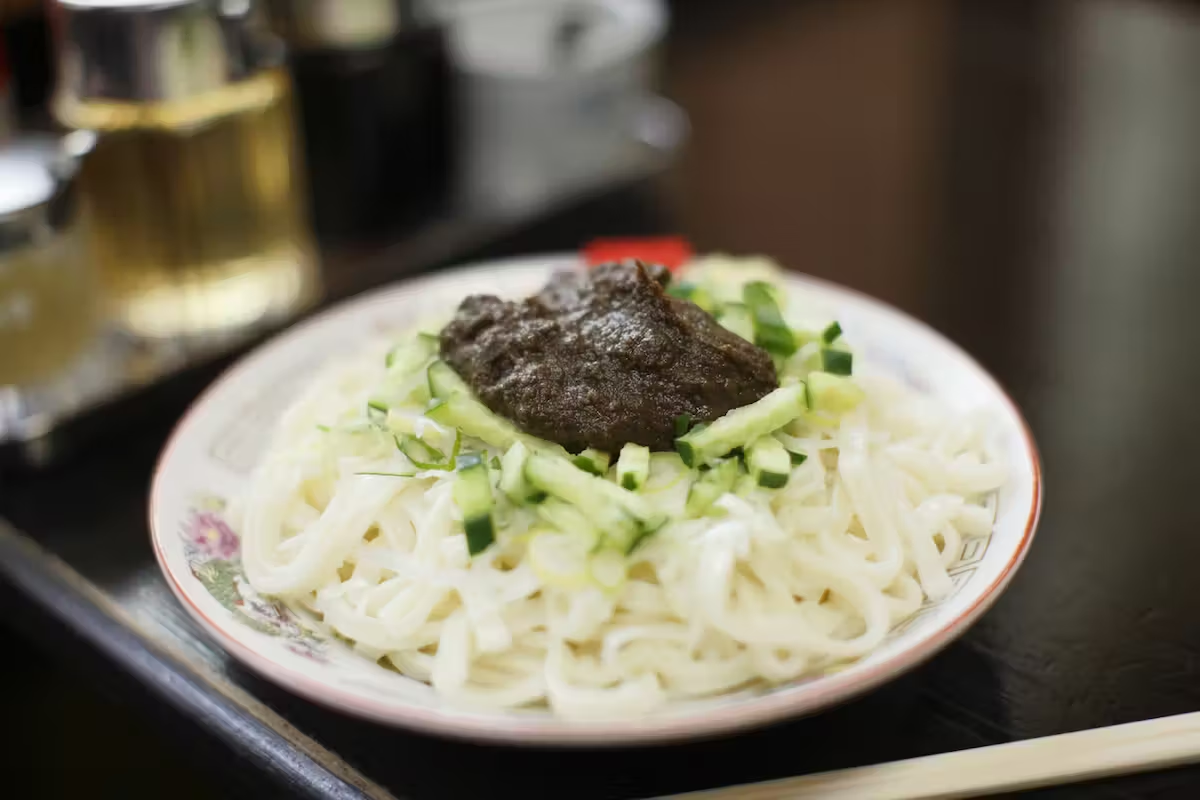
Morioka promotes three noodle dishes as a set, and the city has funded a council to spread them. Each one feels completely different. For example, our Morioka jajamen guide covers flat noodles with a savory meat-and-miso sauce.
Our Wanko soba guide, meanwhile, explains the refill-style meal of tiny buckwheat servings. Reimen, then, is the cold, chewy one of the trio. So many travelers save it for a hot afternoon or a late dinner after yakiniku.
Morioka Reimen vs Naengmyeon vs Beppu Reimen
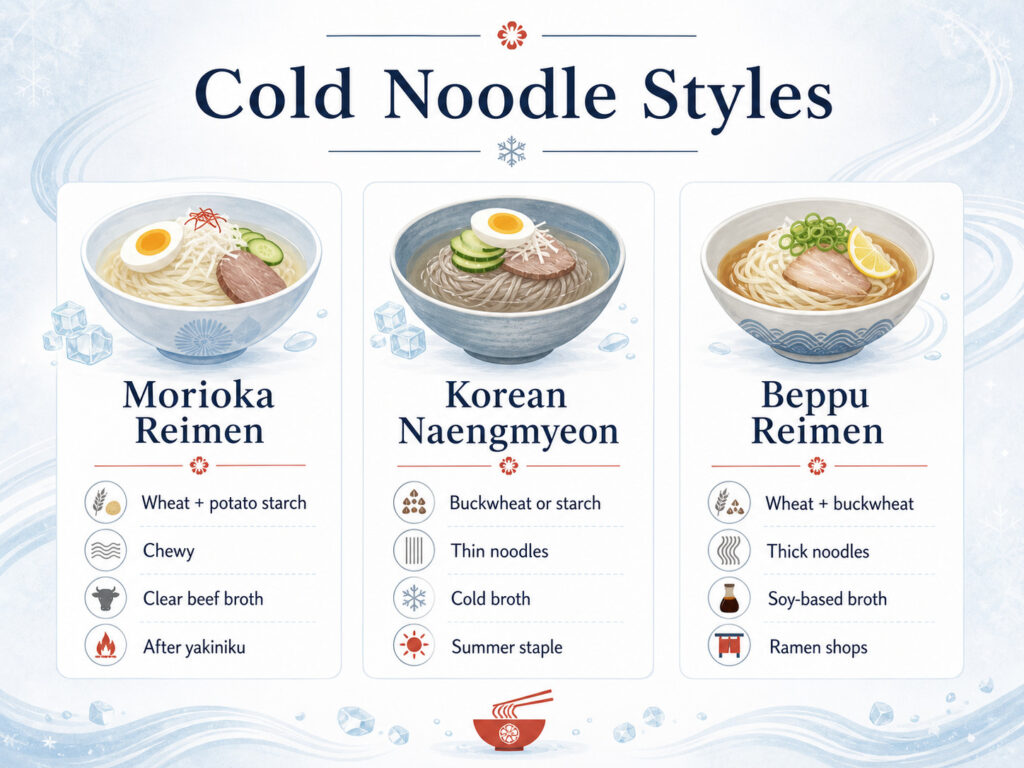
These four styles share a family tree, but they are not interchangeable. So the table below compares them on seven points.
| Point | Morioka reimen | Pyongyang naengmyeon | Hamhung naengmyeon | Beppu reimen |
|---|---|---|---|---|
| Noodle base | Wheat flour and potato starch | Mostly buckwheat | Potato or sweet potato starch | Wheat flour, often with buckwheat |
| Thickness | Thick | Thin to medium | Thin | Medium to thick |
| Texture | Springy, semi-translucent | Softer and nutty | Very chewy | Firm and chewy |
| Broth | Chilled beef, often with chicken | Light meat or radish water kimchi broth | Often little or none, since it is mixed with sauce | Japanese-style stock, often beef with kelp or bonito |
| Spice | Set by kimchi | Usually mild | Spicy chili sauce | Mild, with kimchi on top |
| Typical toppings | Kimchi, egg, cucumber, beef, fruit | Radish, beef, egg | Raw fish or beef, cucumber, egg | Cabbage kimchi, beef, egg, sesame |
| Where served | Yakiniku restaurants and specialists | Specialist restaurants | Specialist restaurants | Reimen specialists and yakiniku restaurants |
Morioka Reimen vs Beppu Reimen
Morioka reimen uses a clear, chilled beef broth with gentle acidity. Its semi-translucent noodles deliver a firm, springy bite. Beppu reimen, by contrast, often adds buckwheat to the noodles and seafood stock to the broth. Beppu’s tourism site describes a wide range of shop styles, so no single bowl defines it. Our Beppu reimen guide covers those shops in detail.
How to Make Morioka Reimen at Home
Can you make it from scratch? You can, but restaurant broth takes hours, and the firm dough is hard to shape by hand. Pyonpyonsha notes that supermarkets carry many home-use kits, so a kit is the practical route. Instead, the recipe below follows Pyonpyonsha’s method for its take-home reimen, scaled to two servings.
Ingredients
- Morioka reimen noodles: 340 g (2 portions)
- Reimen soup: 400 ml (2 packets), well chilled
- Rice vinegar: 12 ml (about 2½ tsp)
- Boiled egg: 1, halved
- Sweet-pickled cucumber: 6 thin slices (about 12 g)
- Green onion: 10 g, finely chopped
- Ground sesame: 2 g
- Pear or watermelon: about 40 g
- Sliced beef chashu: about 14 g
- Kimchi: up to 100 g, to taste
Scaled from a one-serving recipe by Pyonpyonsha. Kit sizes vary, so follow your package where it differs.
Instructions
- Prepare toppings. Boil and halve the egg, then slice the cucumber and fruit. Chop the green onion and chill two bowls.
- Cook noodles. Loosen them by hand and drop them into plenty of boiling water. Cook for the time on the label, stirring so they stay apart. They turn from white to a pale, semi-translucent yellow.
- Chill noodles. Rinse them under cold running water, then plunge them into ice water. Drain well, because leftover water dilutes the soup.
- Assemble. Toss the noodles with vinegar in the chilled bowls. Arrange the egg, cucumber, onion, sesame, fruit, and beef on top. Shake the soup packets, then pour.
- Adjust spice. Add kimchi a little at a time until the heat suits you. Eat right away, since the noodles soften quickly.
A note on timing: the source recipe boils Pyonpyonsha’s fresh noodles for about 4 minutes 20 seconds. However, that figure applies only to those noodles. For any other brand, cook packaged noodles for the time stated on the label.
Choosing Packaged Reimen and Souvenirs
Japanese supermarkets, station shops, and online stores sell reimen kits with noodles and soup. Pyonpyonsha has sold take-home reimen since 1990, and Daidoen also runs an online shop. A few checks help you pick well.
- Noodle type: Kits come with fresh, semi-fresh, or dried noodles, and shelf life varies by type.
- Kimchi: Some kits include only noodles and soup, so check before you buy.
- Dates: Check the best-before date if you are flying home.
- Boiling time: Follow the label exactly, because times differ a lot between brands.
Allergies and Dietary Notes
No single allergen list covers every shop or kit. Still, these ingredients appear often, so check each label and ask staff if you have a serious allergy.
- Wheat: In the noodles.
- Egg: The boiled egg topping, and possibly some noodle products.
- Beef and chicken: In the broth and meat topping.
- Soy: In soy sauce and other seasonings.
- Sesame: A common garnish.
- Seafood: Some kimchi uses fish sauce, shrimp, or squid.
- Buckwheat: Standard Morioka reimen usually omits it, but some Beppu-style products contain it.
Is Morioka Reimen Vegetarian?
Standard reimen is not vegetarian, because the broth uses beef bones and often chicken. At home, though, you can build a plant-based bowl. We suggest a chilled kombu and dried shiitake stock seasoned with soy sauce and a little vinegar. Pair it with egg-free noodles and a vegan kimchi made without fish sauce. It will not taste like Morioka, but it keeps the spirit of the dish.
How Much Does Morioka Reimen Cost?
Among the official menus we could check, a standard bowl costs 1,089 yen at Daidoen and 1,500 yen at Seirokaku. Daidoen also sells a half bowl for 902 yen, while Seirokaku lists a large bowl at 1,750 yen (Last checked: September 2026). Other shops publish menus only as images or in store, so we have not listed their prices.
Prices also shift with the order. Half bowls cost less, large bowls cost more, and yakiniku sets cost more again. Treat any figure as a guide rather than a promise.
Best Morioka Reimen Restaurants
All the restaurants below are in Morioka City. Yakiniku restaurants elsewhere in Iwate also serve reimen, but this list focuses on the city, where most visitors stay. We chose them for history, access from the station, and clear spice options.
Last checked: September 2026, on each restaurant’s official page unless noted. Hours change, so confirm before you go.
| Restaurant | Area | Broth | Spice choice | Price | Access |
|---|---|---|---|---|---|
| Shokudoen | Odori, city center | Mostly beef bone, some chicken | Four options, including betsukara | Check in store | Bus 10 min, then a 5-min walk |
| Pyonpyonsha Morioka Ekimae | Station front | Beef, beef bone, chicken bones | Adjust with kimchi | Check in store | Near Morioka Station |
| Daidoen Morioka Sohonten | Saien | Beef tendon, beef bone, chicken | Four levels, mild to very hot | 1,089 yen | 8-min walk |
| Daidoen Fezan | Inside the station building | Same as the main store | Same as the main store | See store menu | 1-min walk |
| Seirokaku | Station front | Beef-based | Three: kimchi on the side, regular, hot | 1,500 yen | About 3-min walk |
Shokudoen (Where It Began)
Recommended for history. Aoki served his first bowls here in 1954. Even now, the shop blends its flour on site and kneads the noodles by hand. Its kalbi and loin come with beaten egg for dipping, a house habit since opening.
Pyonpyonsha
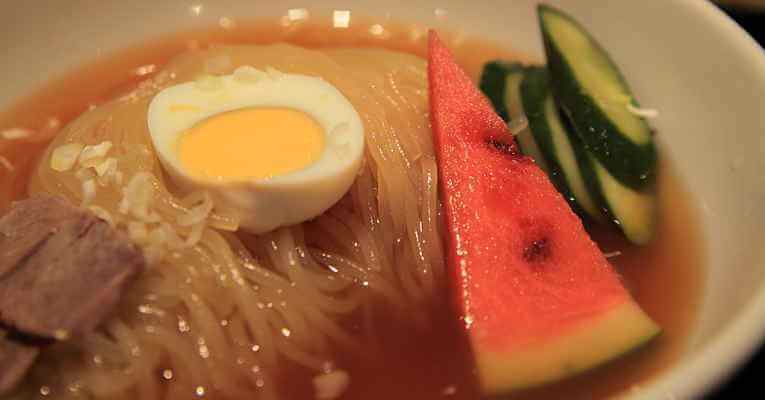
Recommended for an easy first bowl. Pyonpyonsha’s forerunner took reimen to the 1986 Nippon Men Summit. Since then, the company has built its bowls around noodles, soup, and kimchi in balance. The station store has 250 seats over three floors. The Inaricho main store, by contrast, sits on the city’s west side with a courtyard garden.
Daidoen
Recommended for clear spice choices and a quick bowl before a train. Daidoen dates to 1965 and kneads its noodles after you order. The Fezan branch sits inside the station building. Note that Fezan serves no yakiniku, only noodles and rice dishes.
Seirokaku
Recommended for late dining near the station. Seirokaku stays open until midnight, and its menu keeps the spice choice simple. The restaurant sits on the second floor of the GEN Plaza building, directly across from the station.
Final Thoughts on Morioka Reimen
Morioka reimen began as one man’s memory of home and grew into a city’s everyday comfort food. The springy noodles, clean beef broth, and tangy kimchi still tell that story in every bowl.
For a first visit, order betsukara and add kimchi slowly. Start near Morioka Station, where Pyonpyonsha, Daidoen’s Fezan branch, and Seirokaku are all close by. Then keep going with jajamen and wanko soba. Our Iwate food guide and Tohoku food guide can help you plan the rest of the trip.
Written by Ryo Iwa, founder and editor of Food in Japan. We checked history against Iwate’s official tourism pages and restaurant records, and restaurant details against official pages in September 2026. Next review of hours and prices: March 2027.
Morioka Reimen FAQ
Ingredients and Diet
- Does Morioka reimen contain buckwheat?
-
Usually not. The standard noodles use wheat flour and potato starch instead. Some Korean-style and Beppu-style noodles do contain buckwheat, though. If you have a buckwheat allergy, check the label or ask staff.
- Why do shops add fruit?
-
The fruit adds a sweet, cooling accent. Shops typically use pear or watermelon, depending on the season. Its sweetness softens the kimchi heat and the savory broth.
- Is it suitable for vegetarians?
-
Not in its standard form. The broth uses beef bones and often chicken, and some kimchi contains fish sauce. At home, you can swap in a kombu and shiitake stock with vegan kimchi. The result is a different dish, but still refreshing.
Ordering, Eating, and Buying
- How spicy is Morioka reimen?
-
That depends entirely on the kimchi. Hot and extra hot levels can be fierce, while a regular bowl is milder. For a first visit, order betsukara, so the kimchi comes on the side. Then add it a spoonful at a time.
- Can children eat it?
-
Yes, most children can enjoy it. Order betsukara so the kimchi stays off the noodles. These noodles are very chewy, however, so small children should eat slowly. Ask staff about cutting them, and check allergens first.
- Where can I try it in Morioka?
-
Start near Morioka Station for easy access. Pyonpyonsha, Daidoen’s Fezan branch, and Seirokaku are all close by. For history, visit Shokudoen in the Odori area. Check hours first, since they change.
- Can I buy it as a souvenir?
-
Yes. Station shops and supermarkets sell kits with noodles and soup, and Pyonpyonsha and Daidoen run online shops. Check the best-before date before a long trip. Also note that some kits leave out the kimchi.
References
- Iwate Official Tourism Site (Iwate no Tabi) – Morioka Reimen (Japanese) (Accessed September 2026)
- Iwate Official Tourism Site (Iwate no Tabi) – Shokudoen (Japanese) (Accessed September 2026)
- Morioka Hachimantai Wide-Area Tourism – Morioka Reimen (Japanese) (Accessed September 2026)
- Morioka City – Morioka Three Great Noodles Promotion Project, Administrative Evaluation Sheet (PDF, Japanese) (Accessed September 2026)
- National Diet Library Search – Konishi, M. (2007). Morioka Reimen Monogatari. Liaison Publishing. ISBN 978-4-903165-01-1 (Japanese) (Accessed September 2026)
- Choson Sinbo – Cold Noodle Story (5): The First-Generation Creator from Hamhung (2013, Japanese) (Accessed September 2026)
- Shokudoen – The Birthplace of Morioka Reimen (Japanese) (Accessed September 2026)
- Shokudoen – Menu and Store Information (Japanese) (Accessed September 2026)
- Pyonpyonsha – What Is Morioka Reimen? (Japanese) (Accessed September 2026)
- Pyonpyonsha – Morioka Ekimae Store (Japanese) (Accessed September 2026)
- Pyonpyonsha Inaricho Main Store – Official Site (Japanese) (Accessed September 2026)
- Daidoen – Menu (Japanese) (Accessed September 2026)
- Daidoen – Morioka Sohonten (Japanese) (Accessed September 2026)
- Daidoen – Morioka Fezan Store (Japanese) (Accessed September 2026)
- World in GEN Plaza (Seirokaku) – Menu (Japanese) (Accessed September 2026)
- World in GEN Plaza (Seirokaku) – Opening Hours (Japanese) (Accessed September 2026)
- Fezan (Morioka Station Building) – Morioka’s Three Great Noodles (Japanese) (Accessed September 2026)
- Kyodo Ryori 100 (MAFF-Selected Local Dishes) – Morioka Reimen Recipe by Pyonpyonsha (Japanese) (Accessed September 2026)
- VisitKorea (Korea Tourism Organization) – Hamheung Cold Buckwheat Noodles (Accessed September 2026)
- Beppu Tabi (Beppu Tourism) – Beppu Reimen Feature (Japanese) (Accessed September 2026)
Related Articles
- Morioka Jajamen (盛岡じゃじゃ麺) (Surveyed: September 2026)
- Wanko Soba (わんこそば) (Surveyed: September 2026)
- Beppu Reimen (別府冷麺) (Surveyed: September 2026)
- Iwate Food Guide (Surveyed: September 2026)
- Tohoku Food Guide (Surveyed: September 2026)




Comments