



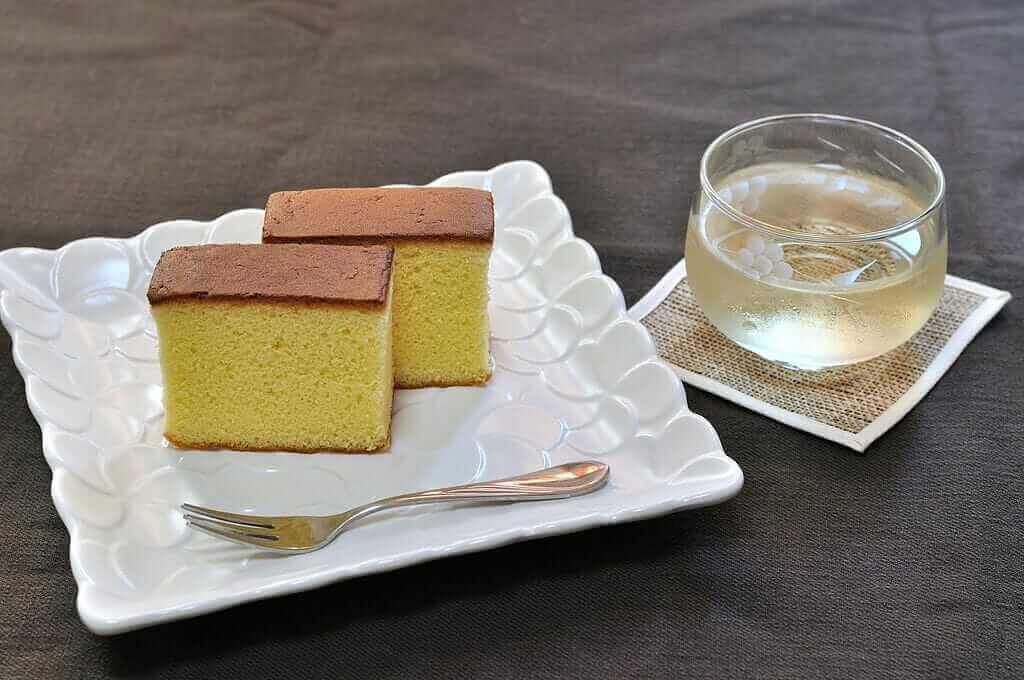
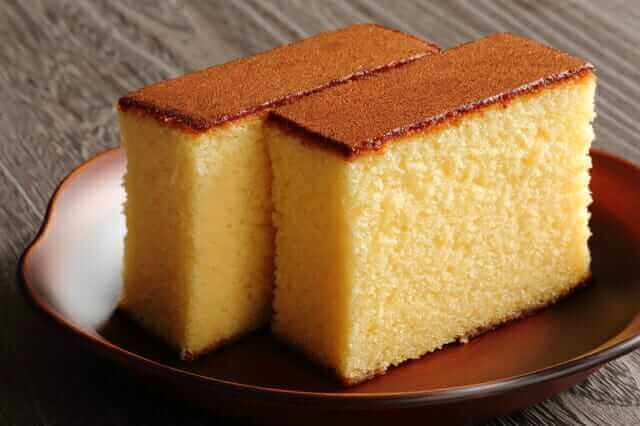
Castella is a rectangular sponge cake made mainly from eggs, sugar, wheat flour, and syrup. Nagasaki Castella is the version most closely tied to Japan’s old trading port. Portuguese contact in the 16th century brought related European baking traditions, and local confectioners then reshaped them over several centuries. As a result, the cake has a moist, fine crumb and browned top and bottom crusts.
Many loaves also have a thin layer of crunchy coarse sugar along the base. This guide covers the cake’s history, a home recipe, storage, and where to buy it in Nagasaki.
What Is Castella?
In Japanese, the name is カステラ, pronounced kasutera. Generally, Japan files it under wagashi (和菓子), the country’s traditional confectionery. Yet it grew out of Nanban confectionery, the sweets that arrived with Portuguese and Spanish traders. So is it Japanese or Portuguese? Its roots are Iberian, but the Castella eaten today is the result of centuries of development in Japan.
Quick Facts
- Japanese name
- カステラ (kasutera)
- Pronunciation
- kah-soo-teh-rah
- Food category
- Baked confection that grew from Nanban sweets; commonly grouped with wagashi
- Most associated with
- Nagasaki City, Nagasaki Prefecture
- Core ingredients
- Eggs, sugar, wheat flour, and syrup such as mizuame; some makers add honey or coarse sugar
- Texture
- Fine, moist, springy crumb with browned top and bottom
- Shape
- Rectangular loaf, usually sold pre-sliced in a long box
- Common allergens
- Eggs and wheat; check each label for others
- Common uses
- Souvenirs, formal gifts, and tea-time snacks
- Price
- Varies by maker and box size; see each maker’s official shop
What Does Nagasaki Castella Taste Like?
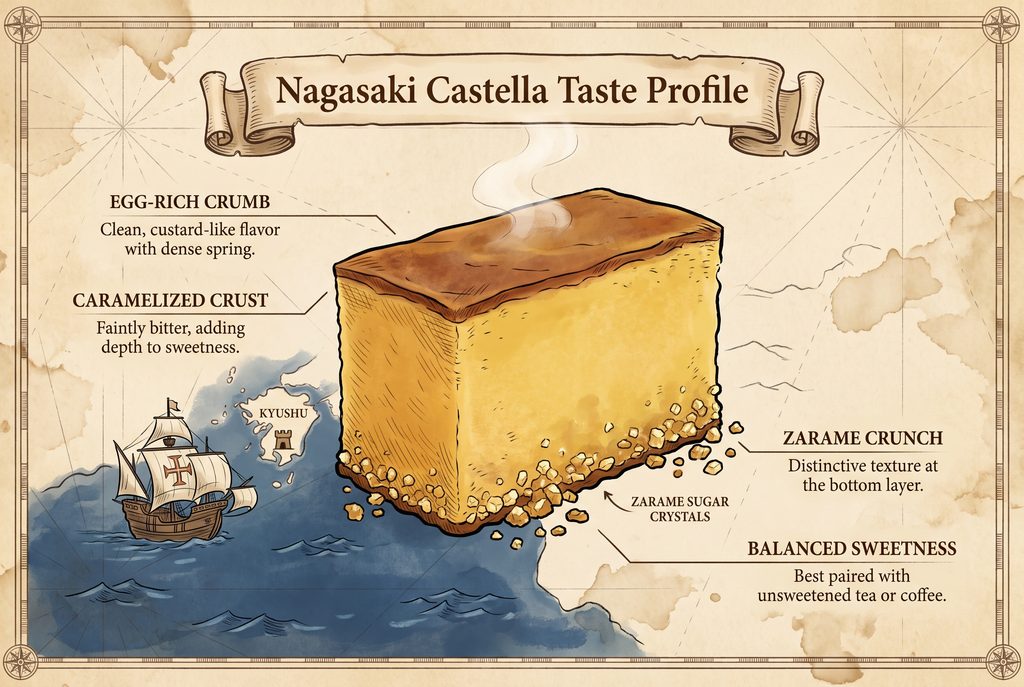
The first thing you notice is the egg. It tastes clean and gently sweet, rather like custard without the cream. For a sponge, the crumb feels dense, but it springs back when you press it.
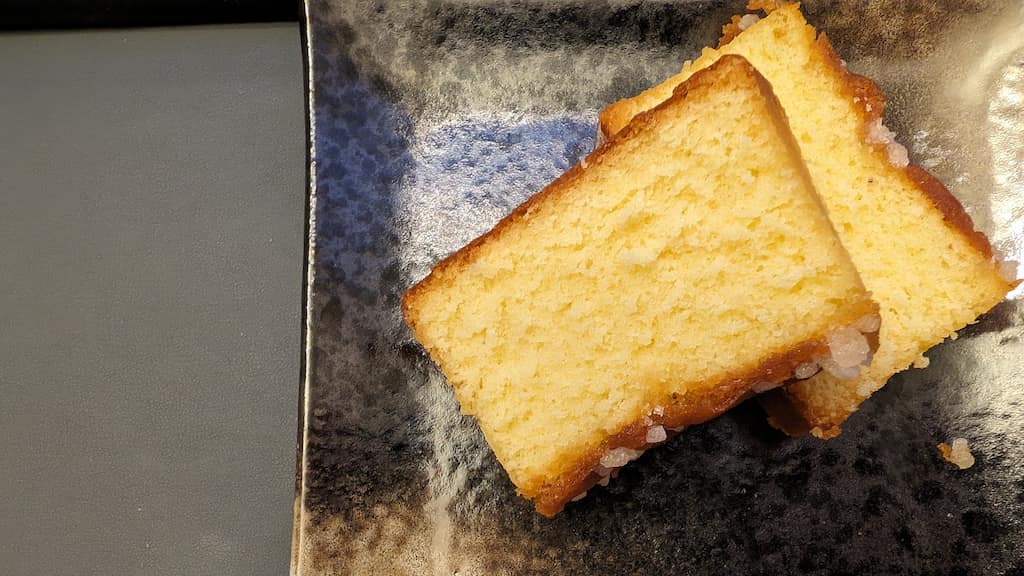
The browned crust adds another layer of flavor. The dark top brings a faint bitterness, close to caramel. In many Nagasaki loaves, undissolved zarame crystals also give a light crunch at the bottom. Some people love that contrast at once, while others need a second slice to decide.
Is it too sweet? That depends on the maker and on your drink. When you pair it with unsweetened green tea or black coffee, the sweetness feels balanced. On its own, however, one thick slice is usually plenty.
Nagasaki Castella and Its History
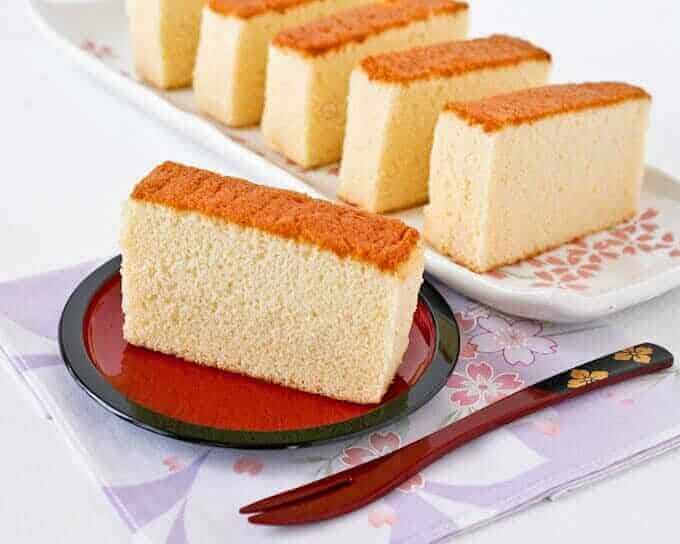
The story runs across three periods. None of them produced today’s loaf in one step, so it helps to take them in order.
Portuguese Contact and Nanban Sweets (16th Century)
Portuguese traders first arrived in Japan in 1543. Later, in 1571, Nagasaki opened as a port for Portuguese trade. Merchants and missionaries also brought sugar, biscuits, konpeitō candy, and baking methods that Japanese cooks had never seen. Together, these became Nanban confectionery.
Nagasaki City’s official tourism site dates the arrival of the Castella method to the Tensho era (1573 to 1592). It also notes that those early cakes differed a great deal from the modern version. Picture a drier, bread-like bake rather than the moist loaf in today’s gift boxes.
Adaptation During the Edo Period
In the 17th century, the shogunate tightly restricted overseas exchange. Nagasaki nevertheless kept authorized trade with the Dutch at Dejima and with Chinese merchants. Sugar soon became a major import, and yearly volumes peaked at over 1,500 tons, according to a 2022 ALIC report. Most of it, however, went on to Osaka by sea.
Even so, the Nagasaki Kaido highway earned the nickname “Sugar Road,” because sweet-making skills spread along it. In 2020, the route also became a Japan Heritage story. Meanwhile, Castella makers such as Fukusaya and Shooken opened their doors in the city.
During the Edo period, confectioners baked Castella in charcoal-heated ovens that cooked the batter from above and below. A 1720 local guide, Nagasaki Yawagusa, lists 39 local specialties, and Nanban sweets appear among them. Over time, cooks raised the sugar so the cake would suit Japanese taste.
From Meiji Gift to Modern Souvenir
After 1868, Castella moved from luxury toward national favorite. Shooken says its eighth head created a chocolate version during the Meiji period. Bunmeido opened in Nagasaki in 1900 and later spread its name nationwide. Its branches in other regions eventually became separate companies, a point worth knowing when you shop.
Syrup changed the texture too. According to Nagasaki Prefecture, makers added mizuame and coarse sugar to soften the harder early cake. Pre-sliced loaves in long paper boxes then turned it into the gift most visitors carry home.
Where Does the Name Come From?
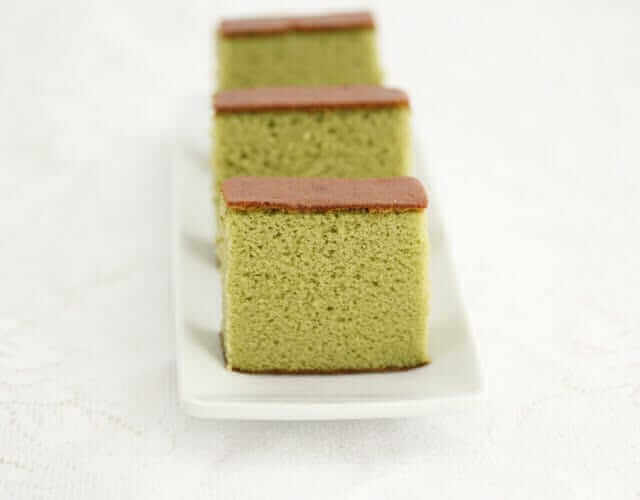
Nagasaki City’s official page connects the word to the Kingdom of Castile, once a powerful state in central Spain. The most commonly cited explanation links kasutera to a Portuguese expression referring to bread or cake from Castile. You will often see pão de Castela quoted, but historical accounts differ on the exact wording. The popular idea that Castella simply means “castle” skips a step, since the link runs through the name Castile.
Why Nagasaki?
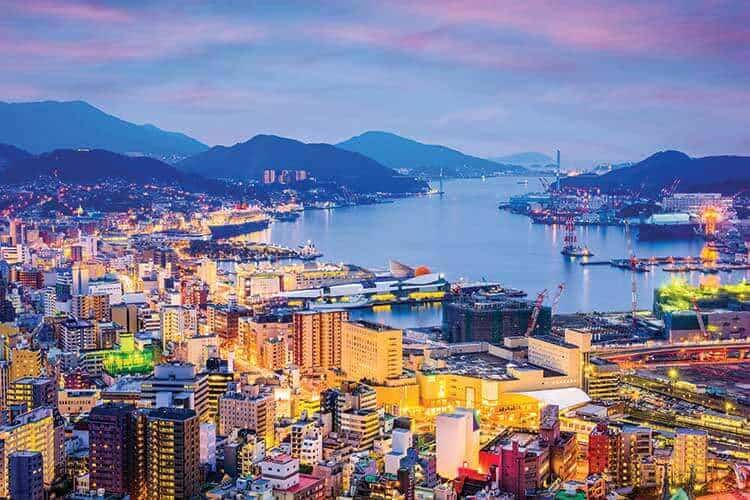
Nagasaki is an attractive port city with a long history of international exchange. During much of the Edo period, it served as Japan’s principal authorized port for trade with Dutch and Chinese merchants. That access mattered for baking, because it gave local confectioners early contact with imported sugar and foreign baking techniques.
The same crossroads also shaped savory food, from Shippoku Ryori banquets to champon noodles. You can explore more local dishes in our guide to Nagasaki food.
Castella vs Sponge Cake
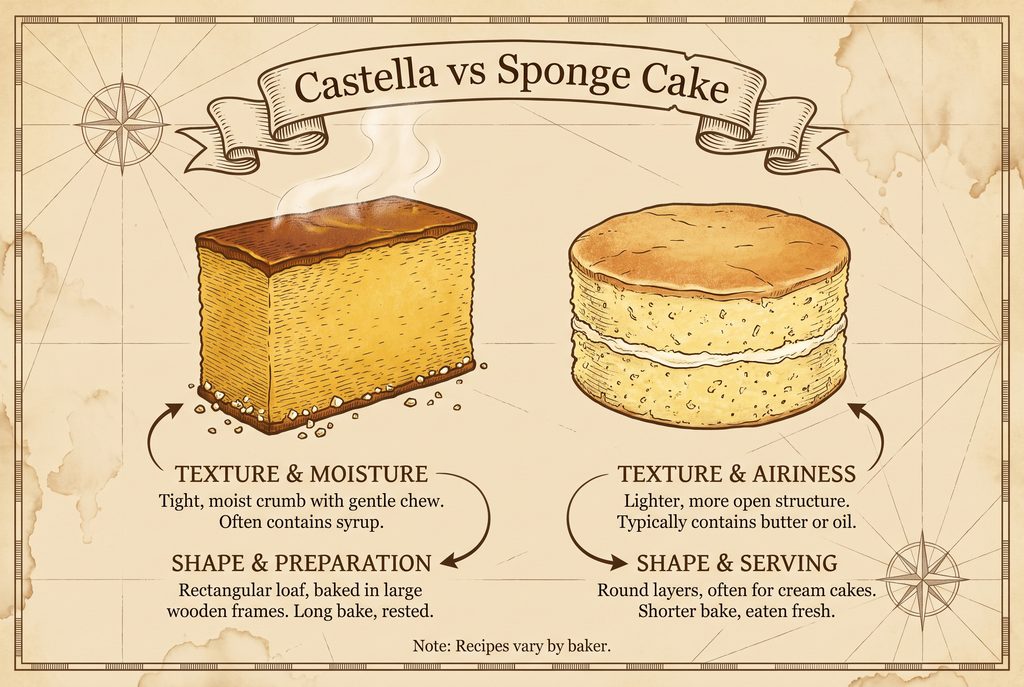
At a glance, the two look like cousins. Once you slice them, though, the differences show. Castella generally has a tighter, moister crumb and a gentle chew. Butter is rare, although that alone does not set it apart. Instead, many recipes add syrup, which holds water and slows drying.
The shape differs too. Nagasaki makers bake large sheets in wooden frames, then cut rectangular loaves with browned surfaces. Sponge cake, in contrast, often goes into round tins for layering with cream. Still, formulas vary, and Japanese cookery researchers have even compared commercial loaves for texture and taster preference.
| Feature | Nagasaki Castella | Ordinary sponge cake | Taiwan Castella | Baby Castella |
|---|---|---|---|---|
| Texture | Fine, moist, and springy | Lighter and more open than Castella | Airier than Castella, soufflé-like | Soft and slightly chewy while hot |
| Common ingredients | Eggs, sugar, flour, and syrup; often zarame | Flour, eggs, and sugar; some styles also use butter or oil | Milk, oil, eggs, and flour | Pancake-like batter, often with baking powder |
| Shape | Rectangular loaf, sliced | Round layers or sheets | Tall square block | Small bite-size pieces |
| Sweetness | Fairly sweet | Moderate | Mild | Mild to moderate |
| Preparation | Whipped eggs, a long bake, then a day of rest | Whipped eggs and a shorter bake | Folded meringue, often a water bath | Cooked in molded iron plates |
| Serving style | Room-temperature slices with tea | Layered with cream or fruit | Often eaten warm and fresh | Sold hot in bags at festivals |
Note that Taiwan Castella is not simply another flavor of Nagasaki Castella. Instead, it rises higher and has a lighter, more soufflé-like texture. Despite the shared name, bakers generally treat it as a separate cake, not a regional variety. Baby Castella differs again, because vendors cook it in molded plates rather than slicing a loaf.
Castella Varieties and Related Sweets
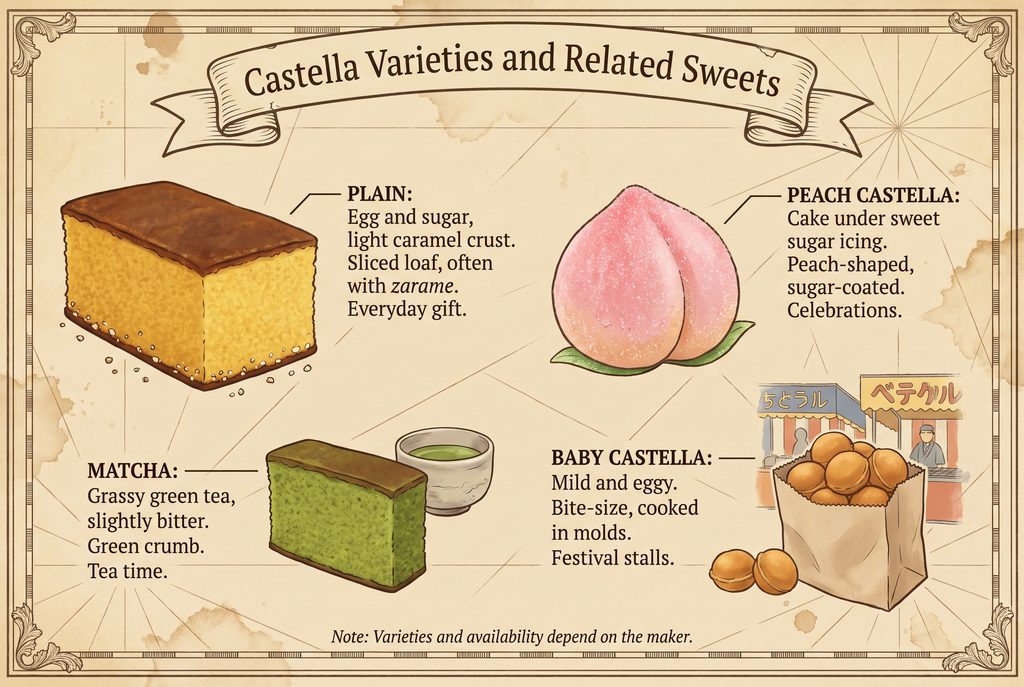
Nagasaki shops keep the plain loaf at the center, but their shelves hold more than one style. Here is what you are likely to see.
| Variety | Flavor | Form and texture | Common occasion |
|---|---|---|---|
| Plain | Egg and sugar, light caramel crust | Sliced loaf, often with zarame | Everyday gift |
| Honey | Softer, floral sweetness | Sliced loaf | Gift or home snack |
| Matcha | Grassy green tea, slightly bitter | Green crumb | Tea time |
| Brown sugar (kokutō) | Deeper, molasses-like | Darker crumb | Gifts for those who prefer deeper flavors |
| Chocolate | Cocoa with egg notes | Brown crumb | Souvenirs |
| Gosanyaki | Richer and eggier | Moister, denser loaf | Formal gifts |
| Peach Castella (momo kasutera) | Cake under sweet sugar icing | Peach-shaped, sugar-coated | Celebrations |
| Baby Castella | Mild and eggy | Bite-size, cooked in molds | Festival stalls |
Gosanyaki and Peach Castella
Gosanyaki is a premium style with more eggs and sugar and less flour. Fukusaya, for example, describes its version this way. Similarly, Bunmeido Sohonten sells an equivalent called Tokusen Castella, made with extra yolk. Because the formula runs richer, bakers need more skill to get an even rise. Although some explain the name through a fixed numerical ratio, recipes and interpretations differ among makers.
Peach Castella is a different idea altogether. It is a peach-shaped cake under a coat of sugar icing, not a loaf flavored with peach. Nagasaki families give it for celebrations, especially around the Peach Festival in March.
Related Japanese Sweets
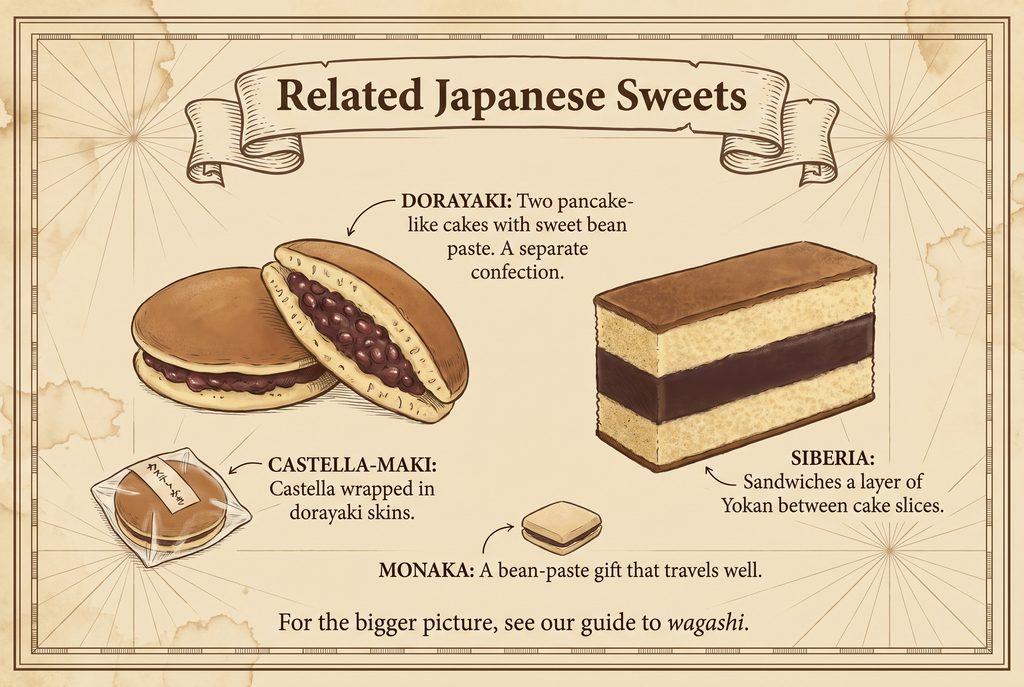
Two sweets often get mixed up with Castella. Dorayaki pairs two pancake-like cakes with sweet bean paste, so it is a separate confection. In fact, Bunmeido Sohonten wraps Castella in dorayaki skins for a snack called Castella-maki. Siberia, meanwhile, sandwiches a layer of Yokan between cake slices.
Want a bean-paste gift that travels well? Monaka is worth a look too. For the bigger picture, see our guide to wagashi.
Castella Ingredients and What Each One Does
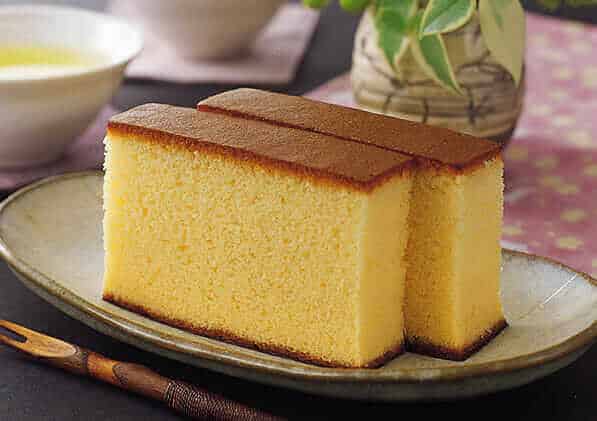
Traditional Castella uses only a few ingredients. Achieving its fine, moist crumb still requires careful mixing and temperature control. So each ingredient has a clear job.
- Eggs: They provide lift, color, and flavor. Traditional methods rely on whipped eggs, and the home recipe below uses no baking powder.
- Wheat flour: Types vary by maker. Shooken uses a special water-retaining flour and says ordinary cake flour cannot produce Nagasaki Castella.
- Sugar: It sweetens the cake, browns the crust, and holds moisture.
- Syrup: Mizuame or rice syrup keeps the crumb moist and slows staling. Shooken, for instance, uses syrup from domestic glutinous rice.
- Honey: Some recipes use it, but it is not universal. In fact, Fukusaya and Bunmeido Sohonten both say their Castella contains no honey.
- Zarame: These coarse sugar crystals create the crunchy base in many Nagasaki products. At Shooken, the crystals go into the batter and sink as it bakes, rather than lining the pan.
How to Make Castella at Home
Do you need a special pan? Not really, but size matters. For consistent results, use the 18 × 18 cm square pan specified below. A loaf pan may also work, but the different batter depth will change the baking time. This formula uses honey because it is easy to find. You can substitute mizuame by weight, although the sweetness, color, and texture may differ slightly. Oven performance varies too, so begin checking the cake early.
Why rest it overnight? While the cake sits wrapped, moisture moves from the center into the crust, so the texture turns more even. Rest it in a cool room. If the room is hot or humid, refrigerate the wrapped cake once it has cooled, then bring it back to room temperature before serving.
Total time: about 13 hours 30 minutes, mostly resting.
Ingredients
- Whole eggs without shells: 250 g (about 5 large), at room temperature
- Granulated sugar: 150 g
- Honey or mizuame: 40 g
- Warm water: 20 g (20 ml)
- Bread flour: 120 g, sifted twice
- Zarame or other coarse sugar: 15 g (optional)
- Glaze: 10 g honey mixed with 5 g (5 ml) warm water
Pan: 18 × 18 cm (7 × 7 in) square pan, at least 6 cm (2.5 in) deep. Line it with parchment that stands 3 cm above the rim. Oven: conventional, without fan.
Instructions
- Prepare the pan. Grease it lightly and line it with parchment. Then scatter the zarame over the base.
- Warm the eggs. Whisk eggs and sugar over hot water until the mix reaches about 40°C (104°F).
- Whip. Beat on high for 6 to 8 minutes. Stop when the batter turns pale and a ribbon holds for about 3 seconds.
- Refine the bubbles. Then switch to low speed for 2 minutes.
- Add the syrup. Warm the honey and water together, then beat them in on low speed for 30 seconds.
- Fold in the flour. Sift it over in three parts. Fold with a large spatula until no dry streaks remain and the batter looks glossy.
- Remove large bubbles. Pour the batter in from a low height. Run a skewer through it in a zigzag, then tap the pan twice on the counter.
- Bake. Bake at 170°C (340°F) for 10 minutes. Then lower to 160°C (320°F) for 35 to 45 minutes more. A skewer should come out clean, and the top should spring back.
- Glaze and release. Drop the pan once from about 10 cm. Brush on the glaze, then lift the cake out and peel off the side paper. Finally, set it top-side down on clean parchment.
- Wrap and rest. Wait about 10 minutes, until steam stops rising. Then wrap it snugly in food-safe plastic wrap and rest it for 12 hours in a cool spot.
- Slice. Peel off the base paper and trim the edges if you like. Then cut with a long, sharp knife, wiping the blade between slices.
Castella Troubleshooting
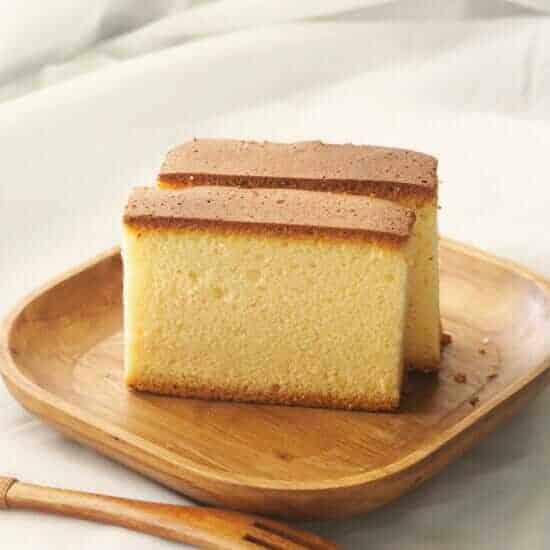
Even careful bakers run into trouble with this cake. Here are the most common problems, with one likely cause and one practical fix for each.
| Problem | Likely cause | Practical fix |
|---|---|---|
| Collapsed center | Underbaked cake | Bake until a skewer comes out clean, and keep the door shut for 20 minutes. |
| Dry crumb | Overbaking | Check 5 minutes early, then wrap the cake once the steam stops. |
| Large air pockets | Big bubbles left in the batter | Mix on low for 2 minutes, then zigzag a skewer through the pan. |
| Dense streaks | Flour not fully folded in | Fold until the batter looks smooth and glossy, scraping the bottom. |
| Wrinkled crust | Shrinking as it cools | Drop the pan once from about 10 cm right after baking. |
| Sticking paper | No grease under the paper | Grease the pan lightly, and peel the side paper while the cake is warm. |
How to Store Castella
Keep unopened boxes at room temperature, away from sun and humidity. Fukusaya gives this advice for its own cakes, but it suits most loaves. Because the zarame slowly melts, find a cool spot in summer.
- Room temperature: Keep the cake tightly wrapped. Once opened, eat it soon, because the cut surface dries fast.
- Refrigerator: Wrap slices airtight. Before serving, let them warm up still wrapped, so condensation does not form on the cake.
- Freezer: Wrap each slice, then seal them in a freezer bag. For the best texture, we suggest eating them within about a month.
- Thawing: Thaw wrapped slices at room temperature for about an hour. If the crumb still feels firm, a few seconds in the microwave helps.
- Shelf life: Follow the best-before date on the package. Fukusaya says its dates change with the season, and Bunmeido Sohonten says they vary by product.
Fukusaya states that it uses no preservatives. That statement covers Fukusaya only, so check other brands’ labels.
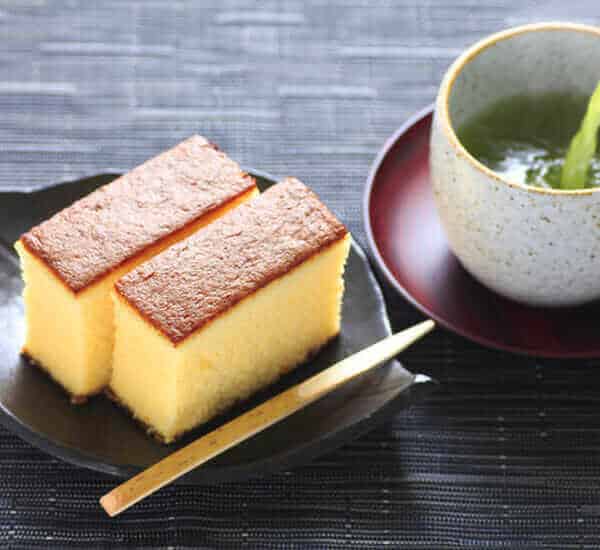
How to Choose a Castella Souvenir
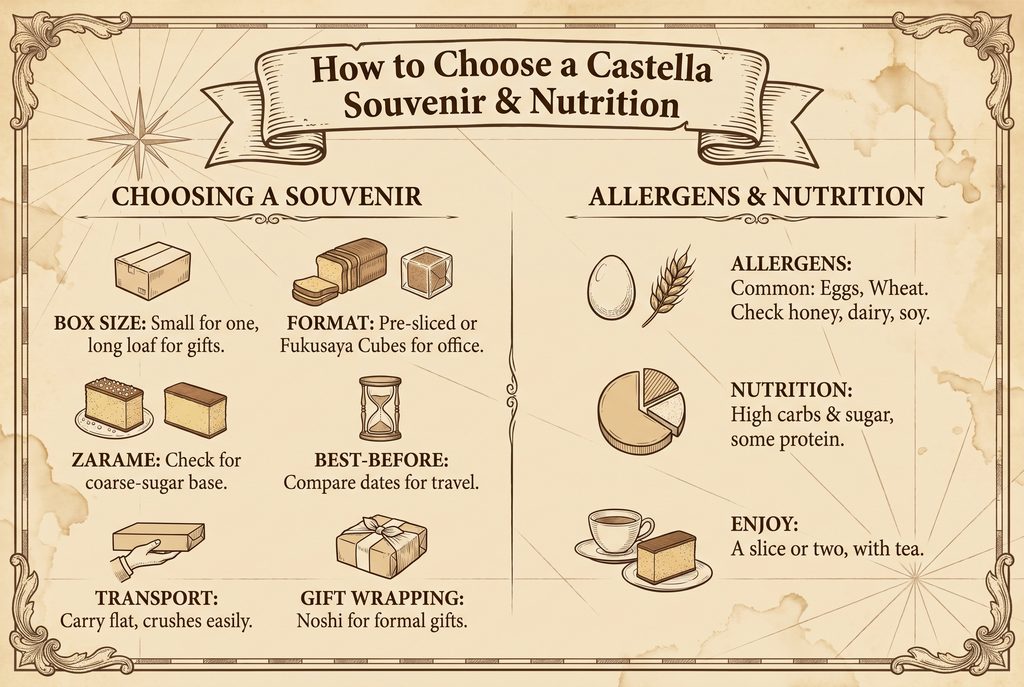
At first, a wall of paper boxes can feel overwhelming. A few questions narrow it down fast.
- Box size: Small boxes suit one household, while long loaves make better formal gifts.
- Format: Pre-sliced loaves are easy to share. Individually wrapped pieces, such as Fukusaya Cubes, suit office gifts.
- Zarame: Check whether the product has the coarse-sugar base. For example, Bunmeido Sohonten’s chocolate and matcha cut Castella come without it.
- Best-before date: Compare dates if your trip home is long.
- Transport: Carry boxes flat in hand luggage when you can, since the cake crushes easily.
- Gift wrapping: Many shops offer noshi paper for formal gifts, and Bunmeido Sohonten provides it free.
Allergens and Nutrition
Eggs and wheat are the common allergens, and Fukusaya and Bunmeido Sohonten both list them. Check every label for honey, dairy, soy, and cross-contact, because formulas differ. Never assume a Castella is vegan, gluten-free, or dairy-free. Also note that honey is unsuitable for babies under one year old.
Nutritionally, Castella supplies carbohydrates and some protein from the eggs. It is also high in added sugar. So enjoy it the way many people in Nagasaki do: a slice or two, with tea.
Best Castella Shops in Nagasaki
Each shop below earns its place for a clear reason: long history, a signature texture, or easy access for travelers. We have no affiliate or sponsored relationship with any of them. Also, all details come from each company’s official pages.
Shop details verified on 26 September 2026. Hours can change, so check the official page before you go.
Fukusaya Nagasaki Main Store
Recommended for a classic zarame crunch. Fukusaya dates itself to 1624, and one craftsman still handles each batch from cracking eggs to baking. Its Castella uses rice syrup instead of honey. The Meiji-era shop building is worth a look even if you buy nothing.
Shooken Main Store
Recommended for chocolate Castella and a café break. Shooken traces its founding to 1681. Here, each craftsman bakes in a separate oven and stirs the batter partway through to even out the zarame and bubbles. Upstairs, Café Sevilla serves Castella, coffee, and Nagasaki Milk Shake.
Bunmeido Sohonten Main Store
Recommended for gift sets and Castella-maki. Bunmeido first opened in Nagasaki in 1900, and Bunmeido Sohonten runs the Nagasaki business from this store near Dejima. Stores using the Bunmeido name in Tokyo and elsewhere operate separately, so products and flavors differ. Its standard Castella also has zarame on the base but contains no honey.
Nagasaki Station and Nagasaki Airport
Short on time? Nagasaki Kaido Kamome Ichiba, the shopping area at Nagasaki Station, has counters for Fukusaya, Shooken, and Bunmeido Sohonten. That makes a side-by-side comparison easy before your train. The shop on the second floor of Nagasaki Airport also stocks several local brands.
Beyond the City: Nagasaki Castella Land
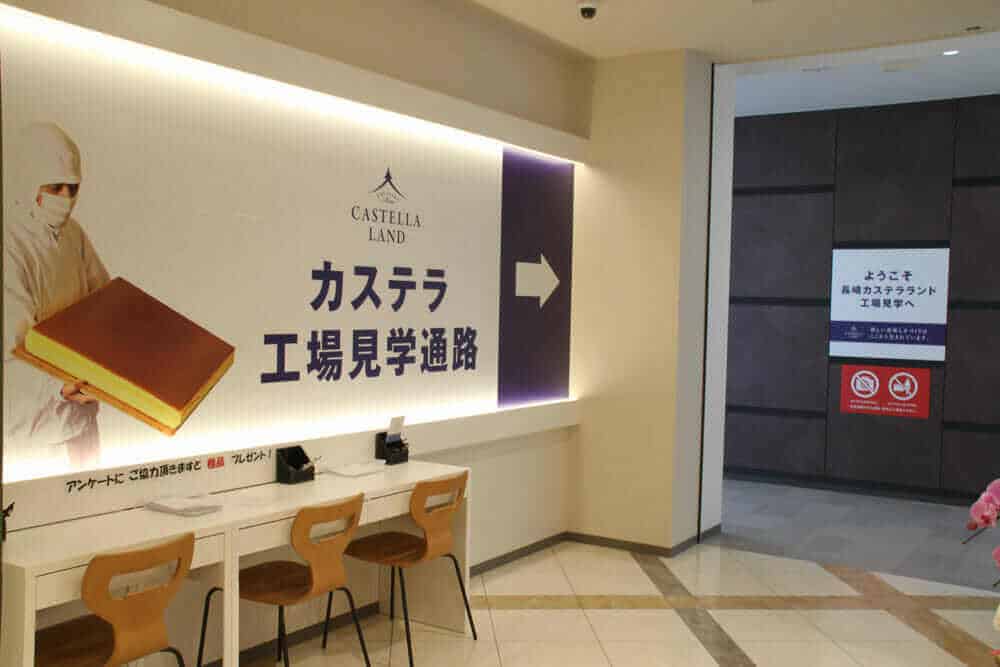
This one is a roadside attraction rather than a city shop. Izumiya runs the large souvenir shop and restaurant facing the sea in Unzen. We could not confirm current hours on an official page, so check before you drive out.
Planning Your Visit
Getting to Nagasaki (verified September 2026): From Hakata, travelers take the Relay Kamome limited express to Takeo-Onsen. There, they cross the same platform to the Nishi Kyushu Shinkansen Kamome for Nagasaki. Fares and timetables change, so check JR Kyushu before you travel.
Where to Buy Castella in Tokyo
You do not need to fly to Nagasaki for a good loaf. Instead, Tokyo department-store food halls often carry Nagasaki makers, including Fukusaya. Our Depachika guide explains how these food basements work.
One caution: Bunmeido stores in Tokyo belong to a separate company from Bunmeido Sohonten in Nagasaki. Both make good cake, but not the same cake. Osaka-based Ginso also sells its own softer style at Takashimaya. Check each maker’s official store list for current counters.
Online Buying Options in Japan
Several Nagasaki makers run official online shops for delivery within Japan. Bunmeido Sohonten sells through its own store, and Shooken does too. Fukusaya, meanwhile, links to its online store from its official site. Neither Fukusaya nor Bunmeido Sohonten ships overseas, so plan to buy in person if you live abroad.
Final Thoughts on Nagasaki Castella
Nagasaki Castella began with Portuguese contact, but Nagasaki made it what it is. Centuries of sugar trade, local syrup, and patient baking turned a dry Nanban bake into a fine, moist loaf with a sweet crunch underneath. It shows how East and West can meet in something very small.
And because it travels in a neat box, it remains one of the easiest ways to take the city home. Try a slice with plain green tea, and eat it slowly.
Written by Ryo Iwa, founder and editor of Food in Japan. We checked history against official Nagasaki sources and a 1720 primary text. We checked shop, ingredient, and access details against official company and JR Kyushu pages on 26 September 2026. Next review of shop hours, prices, and access: March 2027.
Nagasaki Castella FAQ
About the Cake
- What is Castella?
-
Castella is a Japanese sponge cake with a fine, moist crumb and browned crusts. It developed in Japan from European-influenced Nanban confectionery introduced in the 16th century. Today, most people in Japan treat it as a traditional sweet.
- Why is Nagasaki famous for Castella?
-
Nagasaki was the main gateway for Portuguese trade in the 16th century, and later the authorized port for Dutch and Chinese merchants. Imported sugar and baking ideas therefore reached the city early. Local makers then refined the recipe over centuries, and several still operate today.
- How is Castella different from sponge cake?
-
It usually has a moister, tighter crumb, and many recipes add syrup to keep it soft. Bakers cut it into rectangular loaves, and many Nagasaki versions have a coarse-sugar base. Recipes vary, though, so these are common features rather than fixed rules.
Ingredients and Storage
- Does every Castella contain honey?
-
Not always. Some recipes use honey, but Fukusaya and Bunmeido Sohonten say their Castella contains none. So check the ingredient label, since formulas differ among makers.
- How long does Castella keep?
-
That depends on the product and the season. Follow the best-before date and the maker’s storage advice. Once you open it, eat it soon.
- Is Castella gluten-free or dairy-free?
-
Standard Castella contains wheat and eggs, so it is not gluten-free. Many recipes skip butter, but some add milk. So always read the label for the specific product.
Buying Castella
- Where can visitors buy Castella?
-
The easiest place is Nagasaki Station, where several major makers have counters. You can also visit the main stores of Fukusaya, Shooken, and Bunmeido Sohonten in the city center. Outside Nagasaki, major department-store food halls are another reliable place to look.
- Can I ship Castella overseas?
-
According to their official information, Fukusaya and Bunmeido Sohonten do not ship overseas. If you live abroad, buy boxes in person and carry them home. Before you fly, check your country’s rules on bringing in food.
References
- Nagasaki City – What Is the Origin of the Name of Nagasaki’s Castella? (Japanese) (Accessed September 2026)
- Discover Nagasaki (Nagasaki City Tourism) – Castella (カステラ) (Accessed September 2026)
- Nagasaki City – Nagasaki Kaido Sugar Road Recognized as Japan Heritage (Japanese) (Accessed September 2026)
- Agriculture and Livestock Industries Corporation (ALIC) – Sugar Road Liaison Council (2022). The Sugar Road and Sugar Culture. Sugar and Starch Information, July 2022 (Japanese) (Accessed September 2026)
- Nagasaki Prefecture – Prefectural Public Relations Magazine, Castella Feature (PDF, Japanese) (Accessed September 2026)
- The University of Tokyo Digital Archives – Nishikawa Joken (1720). Nagasaki Yawagusa, Vol. 5, Appendix: 39 Local Products (Accessed September 2026)
- J-STAGE – Kukino, M., Miura, S., Miyake, N., Sakai, K., and Numata, K. (2009). Characteristics and Preference of Commercial Castella. Annual Meeting of the Japan Society of Cookery Science, Abstracts, 21 (Japanese) (Accessed September 2026)
- Castella Honke Fukusaya – Official English Site (Accessed September 2026)
- Shooken – Our Commitment to Castella (Japanese) (Accessed September 2026)
- Shooken – Shooken Main Store (Japanese) (Accessed September 2026)
- Bunmeido Sohonten – Frequently Asked Questions (Japanese) (Accessed September 2026)
- Bunmeido Sohonten – Store Information (Japanese) (Accessed September 2026)
- JR Kyushu – Relay KAMOME (Accessed September 2026)
Related Articles
- Wagashi: Its History, Aesthetics, and Cultural Significance (Surveyed: September 2026)
- Dorayaki (どら焼き) (Surveyed: September 2026)
- Youkan (羊羹) (Surveyed: September 2026)
- Monaka (最中) (Surveyed: September 2026)
- Nagasaki Milk Shake (Surveyed: September 2026)
- Shippoku Ryori: Nagasaki’s Historic Fusion Cuisine (Surveyed: September 2026)
- Sara Udon (皿うどん) (Surveyed: September 2026)
- Nagasaki Tempura (Surveyed: September 2026)
- Depachika Guide: Exploring the Food Basements of Japanese Department Stores (Surveyed: September 2026)




Comments