






Bekko sushi is a local specialty of Izu Oshima, an island in Tokyo. Cooks marinate slices of fresh fish in soy sauce flavored with island chili pepper, then place them on vinegared rice. The marinade gives the fish a glossy amber color resembling tortoiseshell.
You may also see it written as bekko-zushi or bekkō sushi. This guide covers the name, the fish, the island chili, the method, and where to try it.
What Is Bekko Sushi?
Bekko sushi is nigiri made with fish that has soaked in chili soy sauce. On Izu Oshima, locals call the marinated fish itself bekko. Once it goes on vinegared rice, it becomes Bekko sushi. However, recipes, heat, and fish choice vary from home to home, and from shop to shop.
Bekko Sushi Quick Facts
- Origin Izu Oshima, Tokyo; related marinated-fish sushi traditions exist on other Tokyo islands
- Main ingredients Seasonal fish, island chili soy sauce, and vinegared rice
- Flavor Salty and savory, with a fresh chili heat
- Typical serving Nigiri, often as a set meal; also served as bekko don, a rice bowl
- Japanese name べっこう寿司 (bekko-zushi)

Why Is It Called Bekko Sushi?
Islanders named the dish for the fish’s glossy, tortoiseshell-like color. “Bekko” means tortoiseshell, and “zushi” is the form “sushi” takes in compound words. Of course, the dish contains no tortoiseshell at all.
Bekko, Bekko Sushi, and Bekko Don
These three names come up often, so it helps to separate them. On its own, bekko refers to the marinated fish, often served as a side dish. Bekko sushi, meanwhile, places that fish on shaped vinegared rice. Bekko don, by contrast, spreads the slices over a bowl of rice.
History and Island Food Culture
Bekko sushi is closely tied to Izu Oshima, although available sources do not show an exact date of origin. For that reason, this guide does not give a founding year.

The island’s own sources describe a food culture shaped by fishing, isolation, and the seasonal catch. The Oshima Tourism Association describes bekko as a traditional preparation developed to help preserve fish in a remote island environment. Modern raw-fish versions, however, still require refrigeration and prompt consumption.
Wasabi, however, was hard to get on the islands. So people mashed a little green island chili into soy sauce for sashimi. The practice continues on the island today.
Over time, that habit carried into the marinade. Each family and restaurant keeps its own balance of soy sauce, chili, and sometimes sake or mirin. The mix also shifts with what the boats bring in. No single version counts as the only authentic one.
Does the Chili Keep the Fish Safe?
Not on its own, and this point matters. The chili mainly adds heat and island character. Food science reviews describe the antimicrobial effect of spices as condition-dependent and generally weaker than preservatives. In practice, raw fish still needs cold storage and clean handling, chili or no chili.
Ingredients: Fish, Island Chili, and Rice
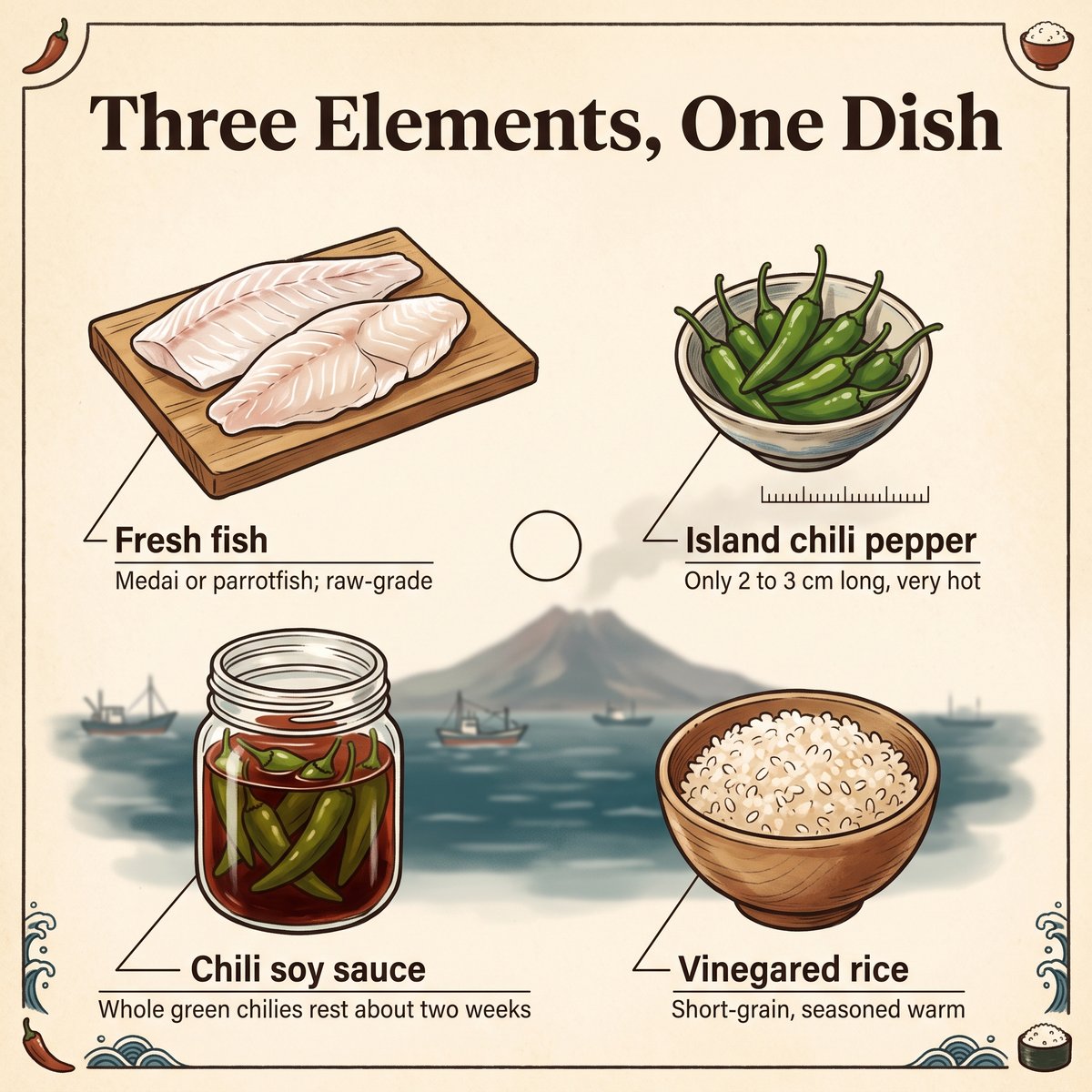
Only three elements really matter here: fresh fish, chili soy sauce, and vinegared rice. Even so, each one changes the result more than you might expect.

Which Fish Works Best for Bekko Sushi?
Choose fish intended for raw consumption, with a clean flavor and firm texture. On Izu Oshima, the tourism association’s gourmet page names seasonal catch such as medai and parrotfish. Many versions use white-fleshed fish, although the choice depends on the season and the day’s catch. For a wider look at Japan’s fish dishes, also see our Japanese seafood guide.
- Local favorites: medai and parrotfish, according to the Oshima Tourism Association.
- Other white-fleshed fish: sea bream or similar firm fish work well at home.
- Red-fleshed fish: some cooks also marinate tuna or bonito, but these are not white fish.
- Freshness: buy fish that a reputable seller identifies as suitable for raw eating. Labels such as sashimi-grade follow different standards in different markets.
What Is Island Chili Pepper?
Island chili pepper (shima togarashi) grows across the Izu and Ogasawara islands. Although it is tiny, only about 2 to 3 cm long, it is very hot. Traditionally, islanders use it green, mashing it into soy sauce or steeping it for a chili soy sauce.
Bekko Sushi Recipe: How to Make It at Home
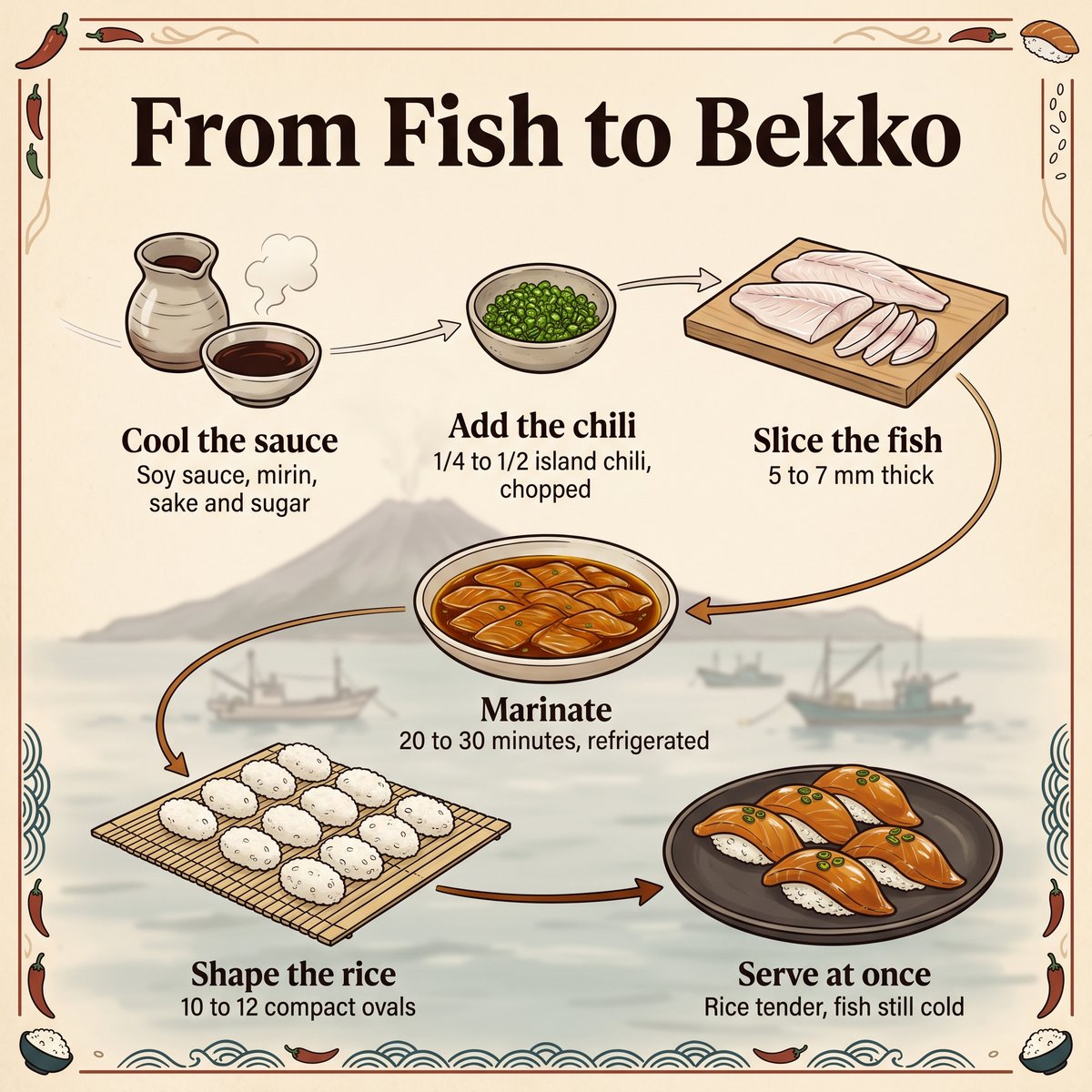
To make Bekko sushi, marinate thin slices of fresh fish in island chili soy sauce. Then place them over vinegared rice. However, families and restaurants on Izu Oshima vary the fish, chili level, and seasoning with the season. This measured version is a practical starting point, not the island’s only authentic formula.

Ingredients and Steps
Difficulty: Easy. Keep the fish refrigerated while it marinates.
Fish and marinade
- 200 g fish suitable for raw consumption
- 4 tbsp soy sauce
- 2 tbsp mirin
- 1 tbsp sake
- 1 tsp sugar
- 1/4 to 1/2 fresh island chili pepper, finely chopped
- A small pinch of salt, if needed
Sushi rice
- 330 g warm cooked Japanese short-grain rice
- 2 tbsp rice vinegar
- 1 tbsp sugar
- 1/2 tsp salt
Instructions
- Simmer the soy sauce, mirin, sake, and sugar gently for about one minute to cook off some alcohol. Let the sauce cool completely.
- Next, stir the chopped chili into the cooled sauce. Wait five minutes, then taste before adding more.
- Mix the vinegar, sugar, and salt until the sugar dissolves. Fold it into the warm rice with a cutting motion, then cool the rice to about body temperature.
- Then cut the fish across the grain into 10 to 12 even slices, each about 5 to 7 mm thick.
- Pour the cooled sauce over the slices in a shallow container. Cover and refrigerate for 20 to 30 minutes, checking thinner slices at 20 minutes.
- Meanwhile, with lightly moistened hands, shape the rice into 10 to 12 compact ovals.
- Let excess marinade drip off the fish. Place one slice on each portion of rice and press it gently into place.
- Finally, serve right away, while the rice is tender and the fish is still cold.
Substitutions and a Milder Version
If island chili pepper is unavailable, use a small fresh green chili. Start with about 1/4 tsp, finely chopped, and add more only if needed. For a milder version, however, reduce the chili rather than switching to wasabi or mustard.
Optional Two-Week Chili Soy Sauce
The traditional island method skips the measuring. According to the Oshima Tourism Association, cooks drop whole green chilies into soy sauce. Then they let it rest for about two weeks. This gives a deeper chili flavor. Even so, the quick marinade above does not need it. If you try it, keep the sauce refrigerated in a clean, sealed container. Also discard it if its smell or color changes unexpectedly.
Food Safety Tips
Before you start
- Buy fish that a reputable seller identifies as suitable for raw consumption.
- Keep the fish refrigerated before slicing and throughout marinating.
- Also use clean hands, knives, containers, and cutting boards.
- Cool the heated marinade completely before the raw fish goes in.
- Never reuse marinade that touched raw fish as a dipping sauce, unless you boil it first.
- Eat the sushi promptly, and do not leave it at room temperature for long.
- Raw seafood carries extra risk for pregnant people, older adults, young children, and anyone with a weakened immune system.
What Does Bekko Sushi Taste Like?
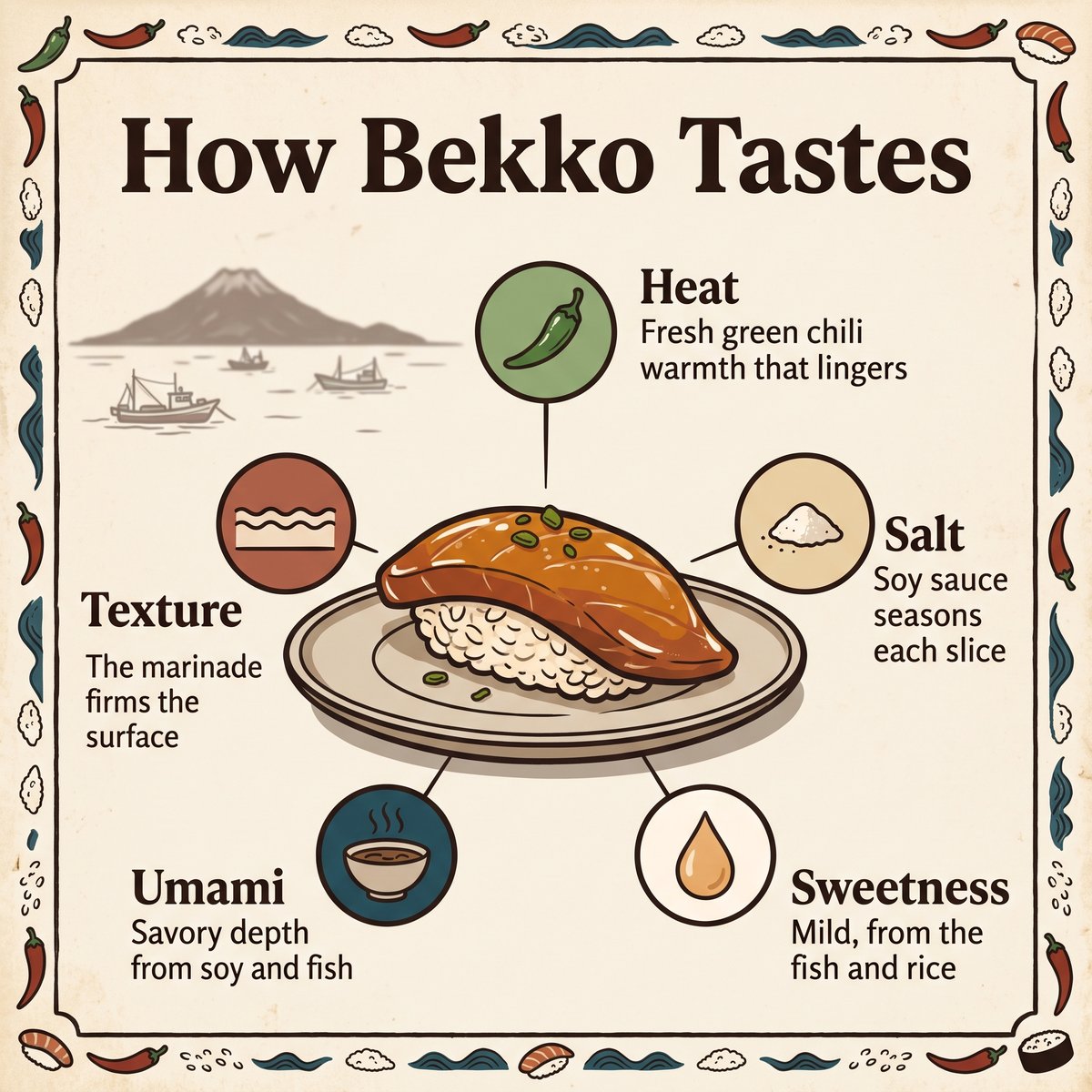
Bekko sushi tastes salty and savory first, then the chili heat builds. Meanwhile, the fish retains its mild flavor and natural sweetness, while the vinegared rice adds a gentle tang.

- Heat A fresh, green chili warmth that lingers.
- Salt Soy sauce seasons each slice.
- Sweetness Mild sweetness from the fish and rice.
- Umami Savory depth from soy sauce and fresh fish.
- Texture The marinade firms the surface slightly.
Is Bekko Sushi Spicy?
Usually a little, but not always much. In general, the heat depends on the chili variety, how much goes in, and how long the fish marinates. Some shops keep it gentle, while others make it sharp. If you are unsure, ask the staff before ordering.
Chili Pepper vs Wasabi
The two kinds of heat feel different. For example, chili pepper produces a warm, lingering heat. Wasabi, by contrast, creates a sharper sensation in the nose that usually fades more quickly.
How Is Bekko Sushi Different from Other Island Sushi?
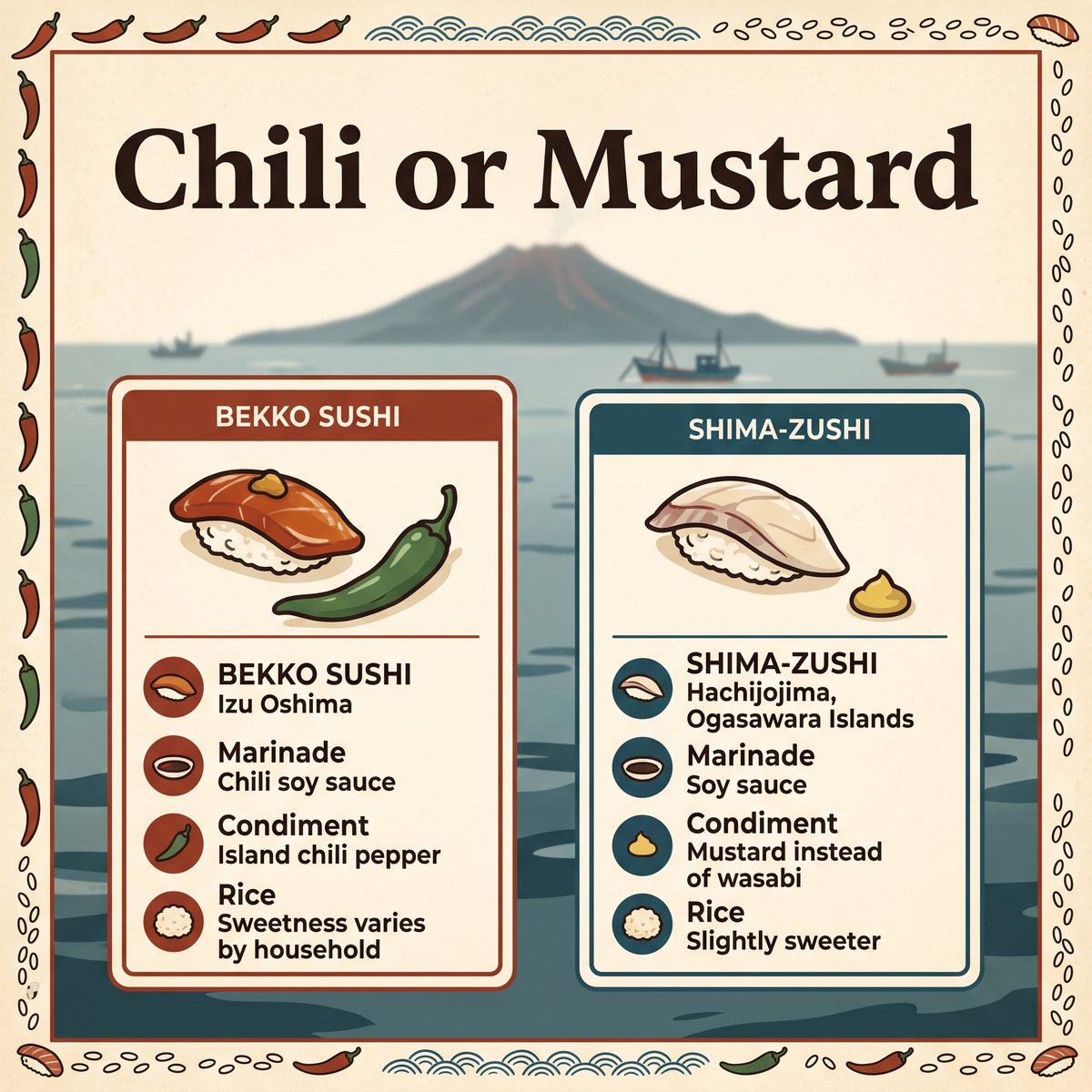
The chili sets it apart. Several Tokyo islands make sushi with soy-marinated local fish, but each island seasons it in its own way. Bekko sushi uses island chili soy sauce, whereas many island sushi traditions pair the fish with mustard instead of wasabi.

Where Is Island Sushi Commonly Found?
Island sushi, or shima-zushi, is best known on Hachijojima and the Ogasawara Islands. According to Tokyo’s official tourism site, it uses soy-marinated local fish and slightly sweeter rice, with mustard rather than wasabi. Fish, marinade, and sweetness still vary from island to island. Izu Oshima, meanwhile, is home to Bekko sushi. Further south, Okinawa’s Daito Islands have their own Daito sushi.
Bekko Sushi vs Island Sushi, Edomae, and Zuke
| Style | Place | Usual fish | Preparation | Condiment | Rice sweetness |
|---|---|---|---|---|---|
| Bekko sushi | Izu Oshima | Seasonal catch such as medai or parrotfish | Marinated in chili soy sauce | Island chili pepper | Varies by household |
| Shima-zushi | Hachijojima, Ogasawara Islands | Local catch; varies by island | Marinated in soy sauce | Mustard | Slightly sweeter |
| Edomae sushi | Tokyo (Edo) | Wide range of seafood | Raw, cured, simmered, or marinated | Usually wasabi | Varies by shop; often less sweet than island-style sushi |
| Zuke sushi | Many regions | Often tuna | Marinated in soy-based sauce | Varies | Varies |
Unlike classic Edomae sushi, Bekko sushi features fish marinated in chili-infused soy sauce. For the wider picture, also browse our Japanese sushi collection.
Where to Eat Bekko Sushi in Izu Oshima
Izu Oshima is the primary place to try it, ideally near Motomachi or Okata port. The four restaurants below are practical, well-documented options rather than a definitive ranking of the best Bekko sushi restaurants. Hours and menus change, so confirm before you go.
Travel tip: ports and ferries
Takeshiba Passenger Ship Terminal is the departure point in central Tokyo, while the restaurants below are on Izu Oshima itself. Ships arrive at Motomachi or Okata port depending on the weather, and some restaurants change their hours to match. Check the day’s arrival port before choosing where to eat.
Kaisen Chaya Sushikou (海鮮茶屋 寿し光), Motomachi

Sushikou sits about two minutes on foot from Motomachi Port. Notably, its official site lists bekko nigiri among its recommended dishes, alongside fish from the waters around Oshima.
- Area Motomachi, about 2 minutes from Motomachi Port
- Typical offering Bekko nigiri
- Listed price Not listed on the official page; check the menu or call
- Hours 11:00 to 15:00 (last order 14:00); 17:00 to 22:00 (last order 21:00); closed Wednesdays
- Reservations Accepted, including groups (official page)
- Address 1-4-7 Motomachi, Oshima-machi, Tokyo
- Phone 04992-2-0888
- Source Sushikou official page
Minato Sushi (港鮨), Habu Port

Minato Sushi serves nigiri made with local fish, along with house-made side dishes. It stands in the Habu Port area on the island’s southern tip. The tourism association’s gourmet map also lists Bekko sushi on its recommended menu.
- Area Habu Port, southern Izu Oshima
- Typical offering Bekko sushi
- Listed price ¥1,750 on the tourism association page; confirm before visiting
- Hours 11:30 to 14:00; 17:00 to 21:00; closed Tuesdays
- Reservations Not verified; call to confirm
- Address Map of Minato Sushi
- Phone 04992-4-0002
- Source Izu Oshima Navi gourmet map
Zakoya Kiyomaru (雑魚や紀洋丸), Motomachi

Zakoya Kiyomaru focuses on local seafood and island home cooking. According to the tourism association, it won the island’s C-class gourmet contest in its first and second editions. Besides Bekko sushi, the menu includes bekko chazuke, a rice dish with tea poured over it.
- Area Motomachi area
- Typical offering Bekko sushi or bekko chazuke
- Listed price Bekko sushi ¥870, bekko chazuke ¥400 on the tourism association page; confirm before visiting
- Hours 11:30 to 13:30; 17:30 to 20:00; closing days vary by listing
- Reservations Accepted (Tokyo Metropolitan Government listing)
- Address 262-26 Umanose, Motomachi, Oshima-machi, Tokyo
- Phone 04992-2-1414
- Source Izu Oshima Navi gourmet map
Ichimine (一峰), Okata Port

Ichimine stands close to the ferry waiting area at Okata Port. It mainly serves set meals, while a sweets workshop next door sells pudding made with Oshima milk. Here the local dish comes as bekko don, a rice bowl, rather than nigiri.
- Area Okata Port
- Typical offering Bekko don
- Listed price ¥1,200 on the tourism association page; confirm before visiting
- Hours 10:00 to 15:00; may close when ships use Motomachi Port
- Reservations Not verified; call to confirm
- Address Okata, Oshima-machi, Tokyo (second floor)
- Phone 04992-2-8524
- Source Izu Oshima Navi gourmet map
Online information last checked: October 15, 2026. Because the source pages do not always show an update date, treat listed prices as a guide. Contact each restaurant before visiting.
How Much Does Bekko Sushi Cost?
In short, prices vary with the fish, portion size, restaurant, and whether the dish comes in a set meal. The examples above range from ¥870 at one restaurant to ¥1,750 at another, although portions and meal formats may differ. Confirm current menus before you go.

Bekko Sushi: A Taste of Izu Oshima
Bekko sushi brings together Izu Oshima’s seasonal catch, island chili pepper, and vinegared rice in one distinctive local dish. The fish changes with the season, and every restaurant sets its own level of heat. When visiting, consider a restaurant near the port where your ferry arrives, and ask how spicy the house version is. Check the day’s arrival port first, since some shops follow the ferry schedule.
The dish also comes in three forms: nigiri, bekko don over rice, and bekko on its own as a side. If you enjoy one, try another. Back in Tokyo, Fukagawa Meshi offers another taste of the city’s regional rice dishes.

Bekko Sushi FAQ
About the Dish
- What is Bekko sushi?
-
It is a local sushi from Izu Oshima, an island that belongs to Tokyo. Cooks marinate fresh fish in soy sauce flavored with island chili pepper. They then place the slices on vinegared rice. The result tastes savory, a little spicy, and clean.
- Why is it called Bekko sushi?
-
“Bekko” means tortoiseshell in Japanese. After marinating, the fish turns a glossy amber that resembles tortoiseshell, so islanders named the dish after that color. It contains no tortoiseshell.
- What is the difference between Bekko sushi and shima-zushi?
-
Both use soy-marinated local fish, but the seasoning differs. Izu Oshima’s version gets its heat from island chili pepper. Shima-zushi from Hachijojima and the Ogasawara Islands usually comes with mustard and slightly sweeter rice. Each island keeps its own style.
- Is Bekko sushi spicy?
-
Usually it is mildly spicy. The heat depends on the chili, the amount used, and the marinating time. Some shops keep it gentle, while others make it sharper. Ask the staff if you prefer less heat.
Making and Finding It
- Which fish do cooks use for it?
-
Island cooks use seasonal fish, such as medai and parrotfish. Many versions use white-fleshed fish, though the choice follows the catch. At home, buy fish sold for raw consumption. Keep it cold until you slice and marinate it.
- How long should the fish marinate?
-
Local guidance suggests about 20 to 30 minutes. Thin slices absorb the flavor faster, so check one piece early. Always marinate the fish in the refrigerator. Times vary by household, so treat this range as a starting point.
- Can I make it without island chili pepper?
-
Yes. A small, fresh green chili works as a stand-in. Start with about 1/4 tsp, finely chopped, and taste the cooled sauce before the fish goes in. For a milder version, use less chili rather than switching to wasabi.
- Where can I eat it?
-
Izu Oshima is the primary destination for trying the dish in its local setting. Restaurants near Motomachi Port, Okata Port, and Habu Port serve it as sushi or as bekko don. Check current hours before visiting, because some shops change their schedules with the ferries.
References
- Izu Oshima Navi (Oshima Tourism Association) – Bekko: A Feast of Izu Oshima [editor’s translation] (Accessed October 2026)
- Oshima Tourism Association – Eat (Gourmet) (Accessed October 2026)
- Tokyo Islands (Tokyo Metropolitan Islands Promotion Corporation) – Island Chili Pepper, a Specialty of the Izu and Ogasawara Islands [editor’s translation] (Accessed October 2026)
- GO TOKYO (Tokyo Convention & Visitors Bureau) – Tokyo Local Food [editor’s translation] (Accessed October 2026)
- Journal of Cookery Science of Japan (J-STAGE) – Miyamoto, T. (1992). Antimicrobial properties of spices and their application to food preservation, 25(2), 159 [editor’s translation] (Accessed October 2026)
- Consumer Affairs Agency – Food Poisoning Caused by Bacteria and Viruses [editor’s translation] (Accessed October 2026)
- Oshima Bussan – Kaisen Chaya Sushikou (Accessed October 2026)
- Izu Oshima Navi (Oshima Tourism Association) – Izu Oshima Gourmet Map [editor’s translation] (Accessed October 2026)
- Tokyo Metropolitan Government – Tokyo Shimajiman Ingredient Restaurants: Kiyomaru [editor’s translation] (Accessed October 2026)
Related Articles
- Edomae Sushi (江戸前寿司) (Surveyed: October 2026)
- Fukagawa Meshi (深川めし) (Surveyed: October 2026)
- Kusaya (くさや) (Surveyed: October 2026)
- Sashimi (刺身) (Surveyed: October 2026)
- Japanese Sushi (Surveyed: October 2026)
- Japanese Seafood (Surveyed: October 2026)



Comments