





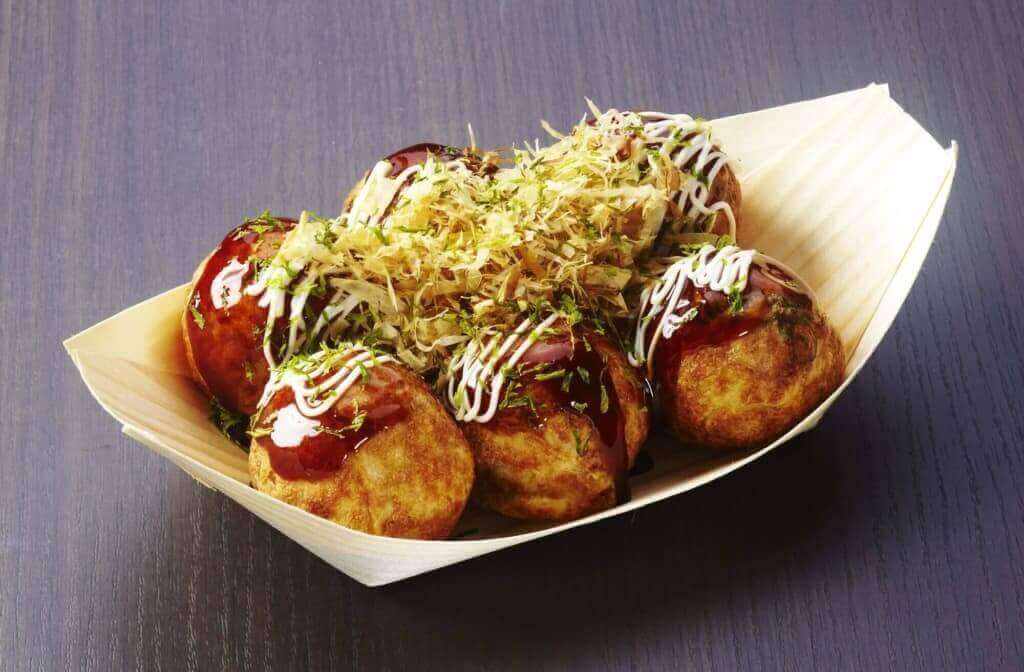
Takoyaki is classic Osaka street food: round Japanese octopus balls with a lightly browned exterior and a soft center. Cooks fill dashi-flavored batter with diced octopus and shape it in a pan with round molds. Shops commonly finish the hot balls with sauce, mayonnaise, aonori, and bonito flakes that flutter in the rising heat.
This guide covers what takoyaki is, how it tastes, and where the dish came from. It also includes our home takoyaki recipe, safety tips for that very hot first bite, and five Osaka shops with different styles.
What Is Takoyaki?
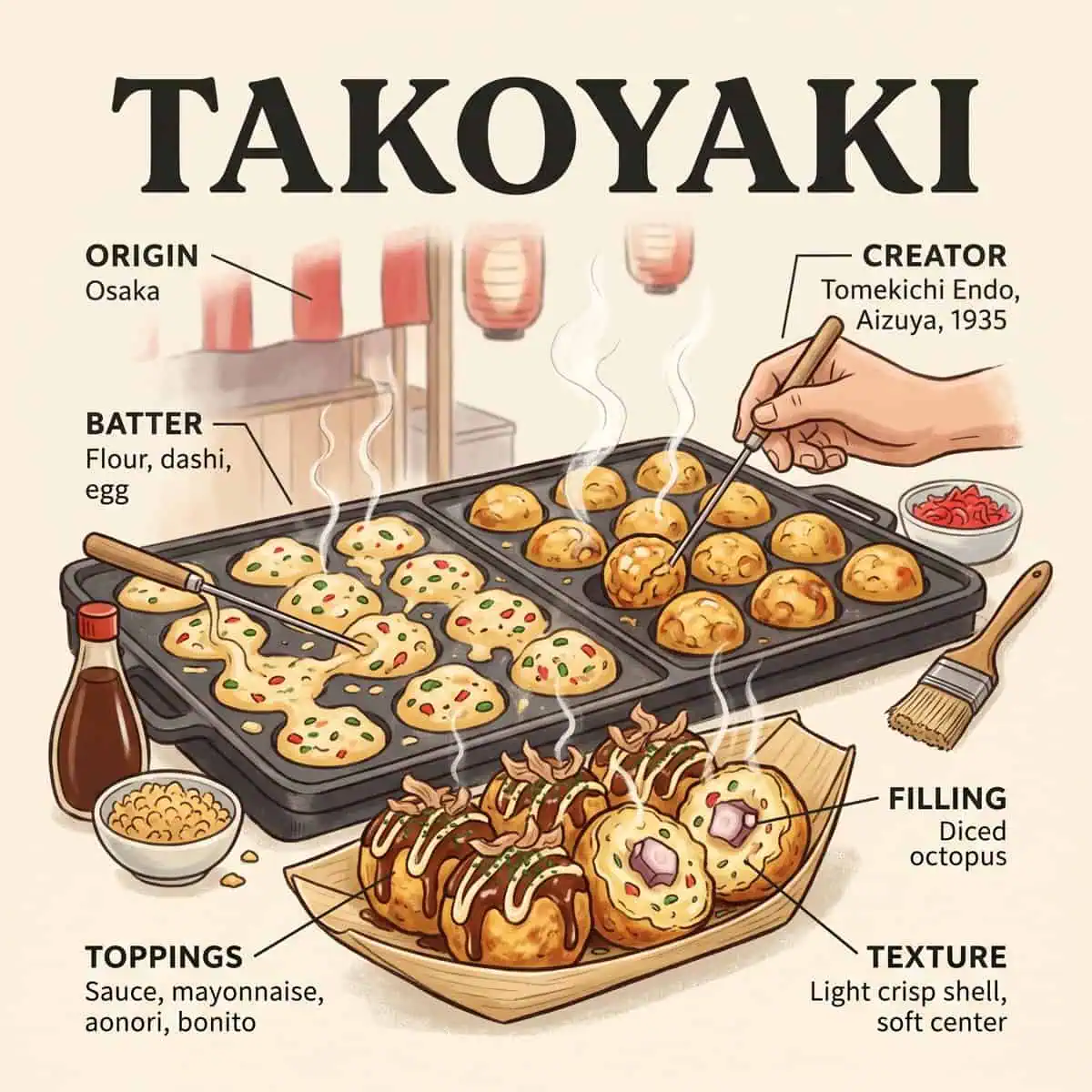
Takoyaki is an Osaka street food made from dashi-flavored wheat batter and diced octopus. Cooks prepare it in a heated pan with round molds, turning each ball until it browns. Many versions have a thin, lightly crisp exterior and a soft center, although texture varies by shop. Most shops serve it with sauce, mayonnaise, aonori seaweed, and bonito flakes.
Quick Facts
- Japanese name
- たこ焼き (takoyaki)
- Origin
- Osaka
- Widely credited creator
- Tomekichi Endo of Aizuya, 1935
- Main ingredients
- Wheat flour, dashi, egg, boiled octopus, tenkasu
- Texture
- Lightly crisp exterior, soft center (varies by shop)
- Cooking tool
- A takoyaki pan with half-sphere molds
- Typical toppings
- Takoyaki sauce, mayonnaise, aonori, bonito flakes
- Food group
- Konamon, Osaka’s flour-based dishes
Where the Name Comes From
Japanese speakers write takoyaki as たこ焼き. “Tako” means octopus, while “yaki” refers to cooking with heat, such as grilling or pan-frying. The same “yaki” appears in teppanyaki and yakitori. English menus often translate the whole name as “octopus balls.”
Part of Osaka’s Konamon Culture
Takoyaki belongs to konamon, a broad category of flour-based foods closely associated with Osaka. Another familiar example is okonomiyaki, a savory pancake. Takoyaki also lives at home, not only at stalls. According to Japan’s Ministry of Agriculture, Forestry and Fisheries (MAFF), many Osaka households own their own takoyaki pan.
What Does Takoyaki Taste Like?
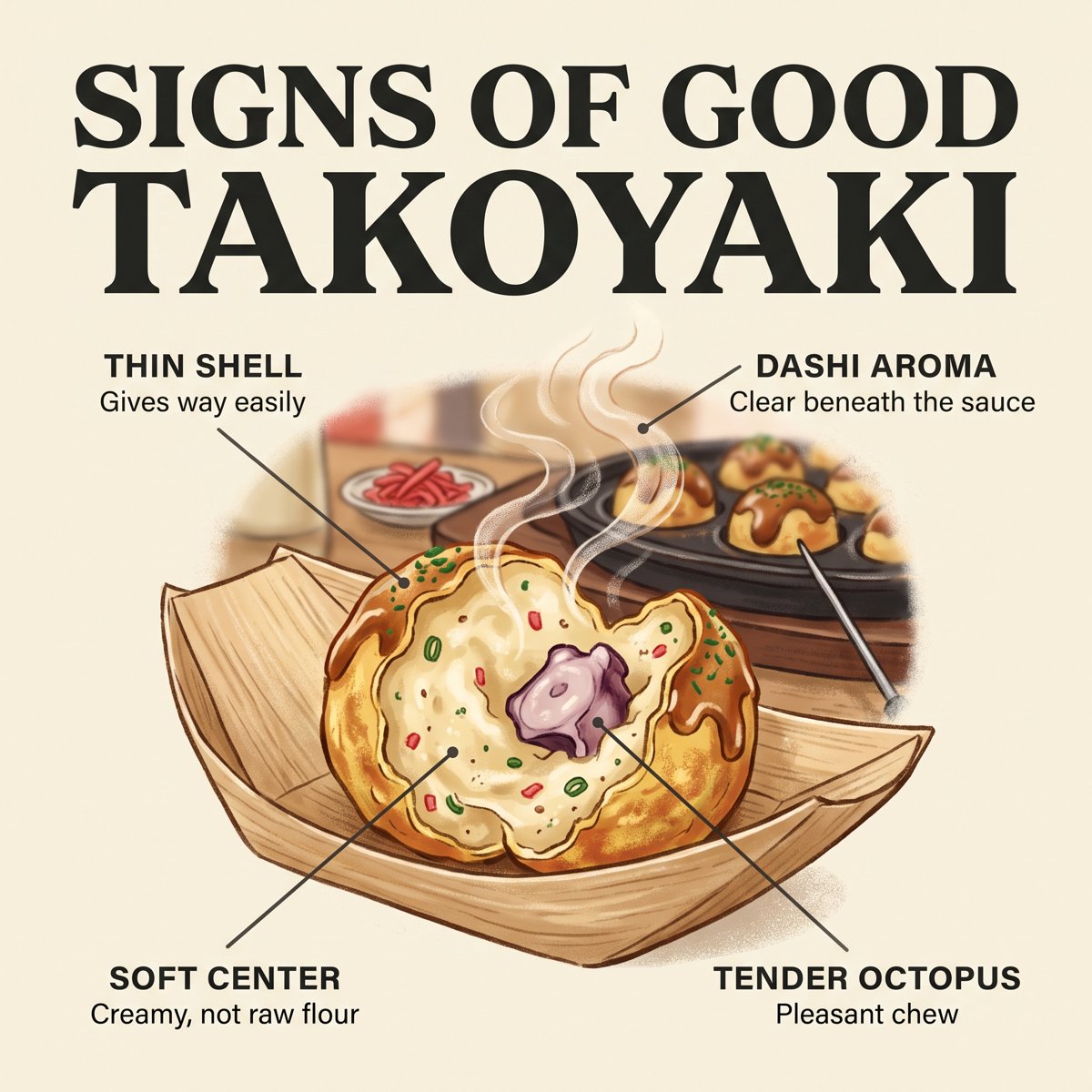
It tastes savory, rich, and slightly sweet. Dashi gives the batter a deep savory flavor without necessarily making it taste strongly of fish. Diced octopus adds a springy, chewy bite against the creamy middle.
On top, sweet-savory sauce meets rich Japanese mayonnaise. Then smoky katsuobushi adds one more savory layer. Many people prize the contrast between a crisp outside and a soft inside, though texture varies from shop to shop.
What to Look for in Takoyaki
There is no single official standard. Still, many diners value the following qualities.
- A thin shell: It should give way easily rather than feel thick or doughy.
- A soft, cooked center: Creamy is good. Raw-tasting flour is not.
- Dashi aroma: Many diners value a clear dashi aroma beneath the sauce.
- Tender octopus: A pleasant chew rather than a rubbery one.
Seasoning Styles You Will See in Osaka
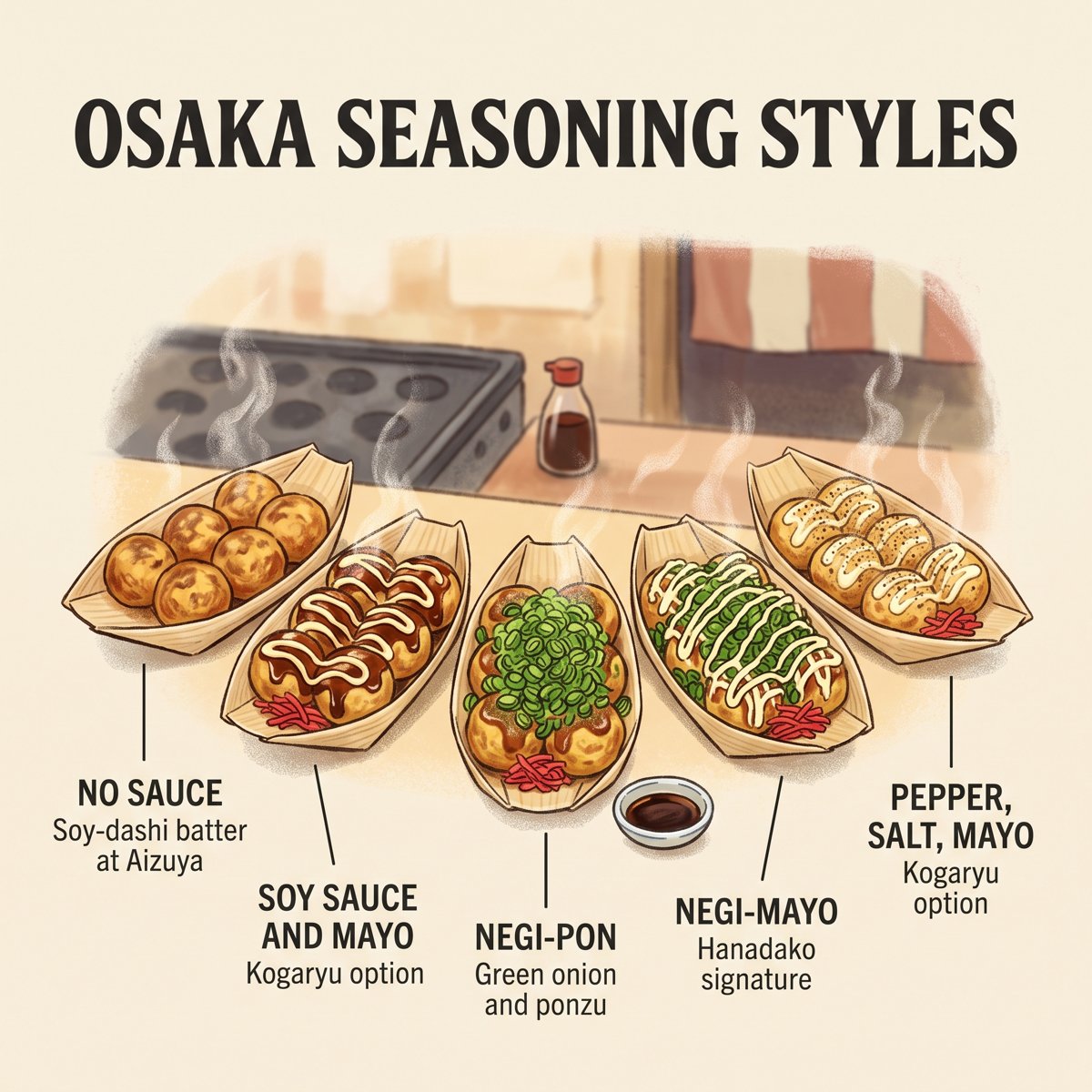
Sauce and mayonnaise are the most familiar combination, but they are not the only option. The shops in this guide show how wide the range is.
- No sauce at all: Aizuya’s original style relies on a soy-flavored dashi batter.
- Soy sauce and mayonnaise: One of several options at Kogaryu.
- Negi-pon: Green onion with citrusy ponzu, also at Kogaryu.
- Negi-mayo: Green onion and mayonnaise, a signature item at Hanadako.
- Black pepper, salt, and mayonnaise: Another option on Kogaryu’s menu.
The History of Takoyaki in Osaka
History at a Glance
- Who invented takoyaki?
- The standard account credits Tomekichi Endo, founder of Aizuya in Osaka.
- When was it invented?
- The standard account dates Endo’s octopus version to October 1935. Aizuya introduced a takoyaki curtain in 1936.
- What came before it?
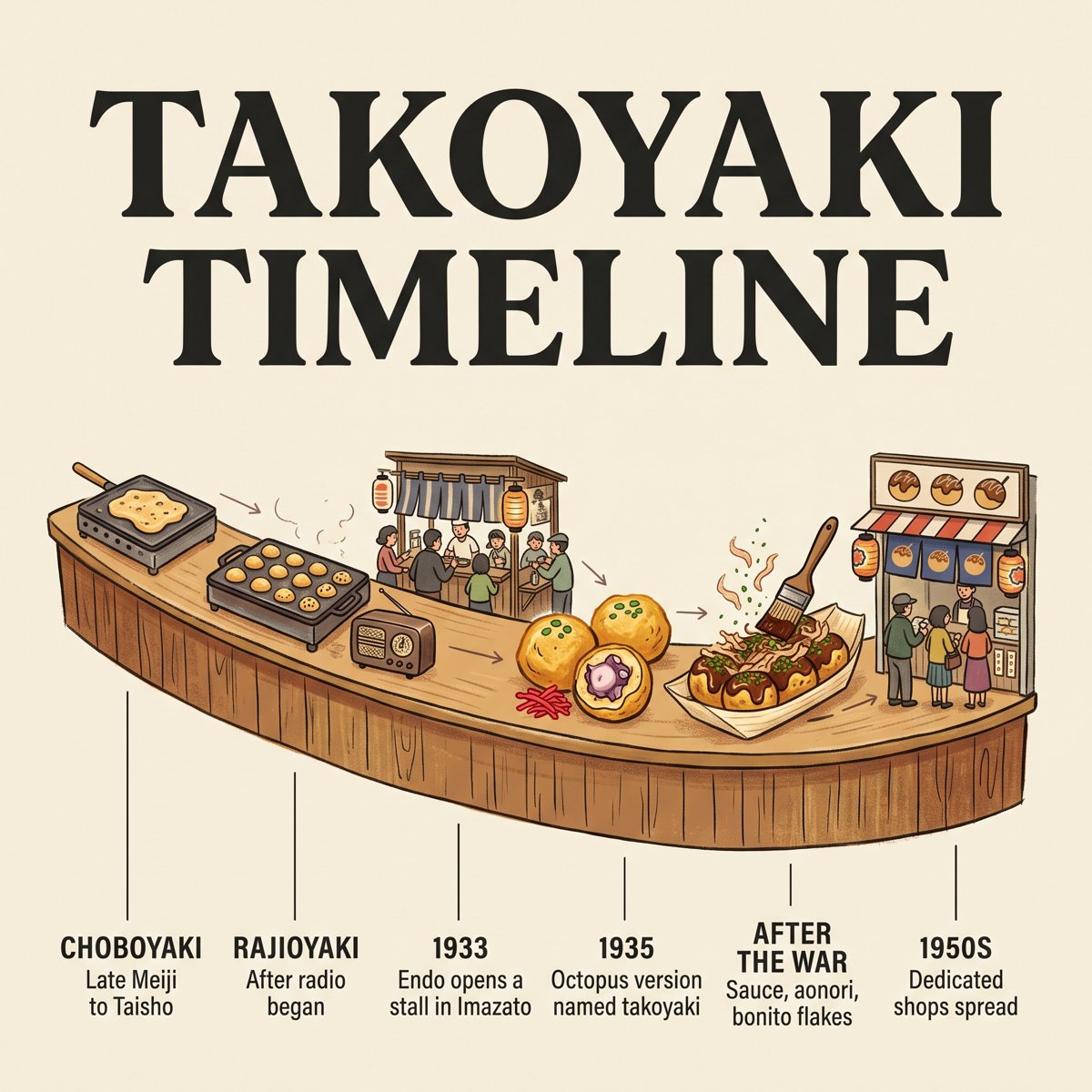
- Molded batter snacks called choboyaki and rajioyaki.
Historical sources differ on the dish’s exact development. This article follows the explanation cited most often, and it notes the main alternatives along the way.
From Choboyaki to Rajioyaki
According to MAFF, takoyaki is said to derive from choboyaki, sold from the late Meiji through the Taisho era. It notes that rajioyaki (“radio-yaki”) appeared after radio broadcasting began in Japan. Then, in the early Showa era, Osaka street stalls began adding octopus. Other historical sources describe some rajioyaki as ball-shaped, with fillings such as beef or konjac, but accounts of its form and fillings differ.
The order is not perfectly settled, though. A reference survey by the Osaka Prefectural Central Library notes that books disagree on how choboyaki and rajioyaki relate. It also records testimony that some rajioyaki already held octopus before 1935.
Tomekichi Endo and the Akashi Connection
Endo opened a rajioyaki stall in Imazato in 1933. According to Aizuya, a customer remarked that in Akashi, cooks put octopus in theirs rather than meat. Endo tried octopus and, by the shop’s account, named the result takoyaki in 1935. He also mixed the flour with soy-flavored dashi.
Akashi City presents a related local account. It says Osaka vendors came to study Akashi’s egg dumplings, which later inspired takoyaki. Still, the city adds that there are several theories about the roots.
After the War: Sauce, Aonori, and Bonito Flakes
Early takoyaki was eaten without sauce, because the batter itself was seasoned. MAFF says thick sauce arrived after the war, along with aonori and dried bonito shavings. Vendors served the balls on a small boat-shaped tray with toothpicks. Osaka’s official tourism site adds that dedicated shops spread in the 1950s. It also says the toppings were influenced by okonomiyaki, another staple of Kansai food.
Takoyaki vs Akashiyaki
Both are round and filled with octopus. However, akashiyaki uses an egg-rich batter with wheat starch and is traditionally cooked in a copper pan. People dip it in warm dashi. Takoyaki uses a flour-and-dashi batter, is commonly cooked on an iron or other molded griddle, and is usually served with toppings.
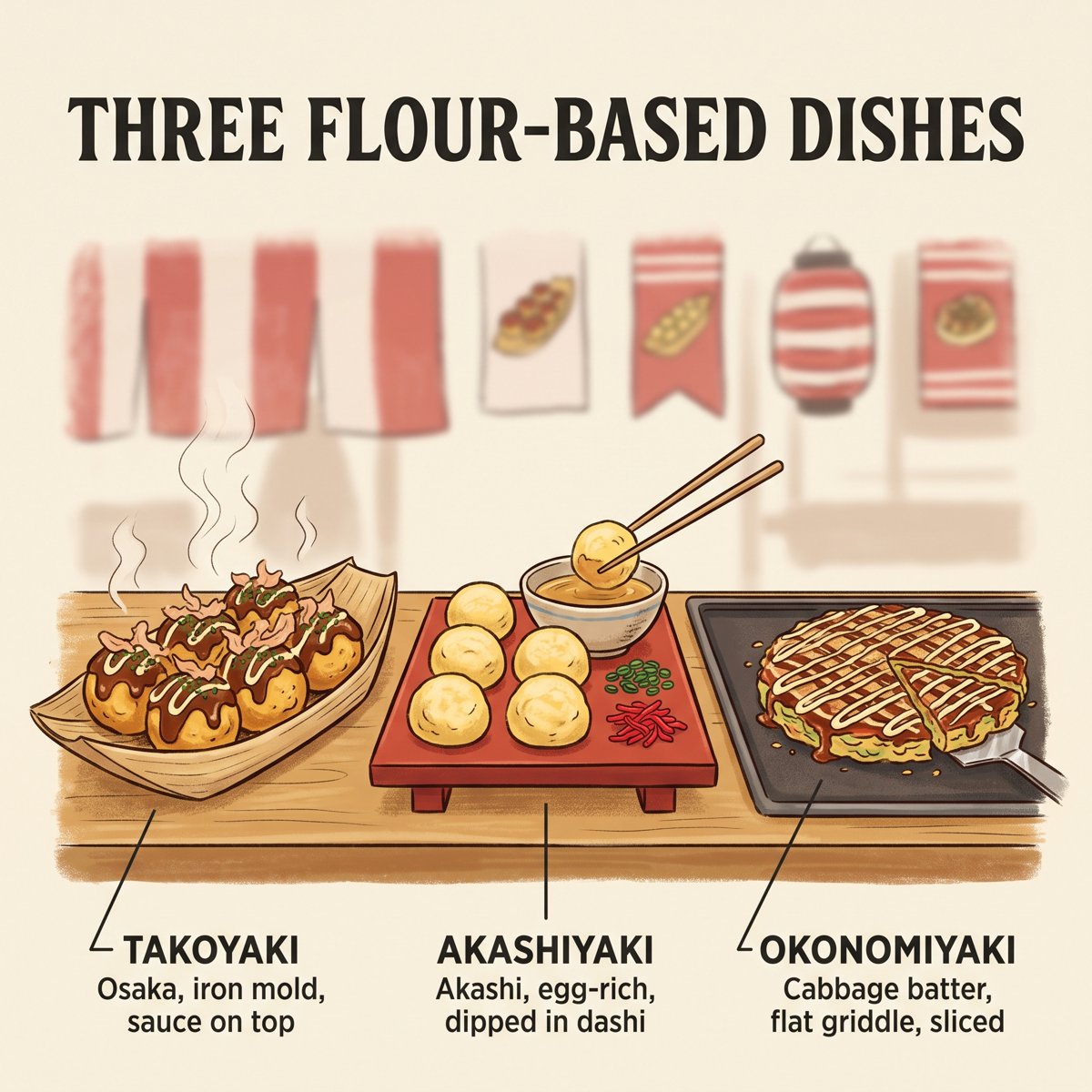
| Dish | Origin | Batter | Pan | How it is served |
|---|---|---|---|---|
| Takoyaki | Osaka | Wheat flour, dashi, egg | Usually iron or another molded griddle | Topped with sauce, mayonnaise, aonori, bonito flakes |
| Akashiyaki | Akashi, Hyogo | Egg-rich, with flour and wheat starch | Copper, round molds | Dipped in warm dashi |
| Okonomiyaki | Osaka and Hiroshima traditions | Flour batter with cabbage | Flat griddle | Sliced, then topped with sauce |
In Akashi, locals call akashiyaki “tamagoyaki,” or egg-yaki. Okonomiyaki is a different dish entirely, closer to a savory pancake than a dumpling.
Takoyaki Ingredients
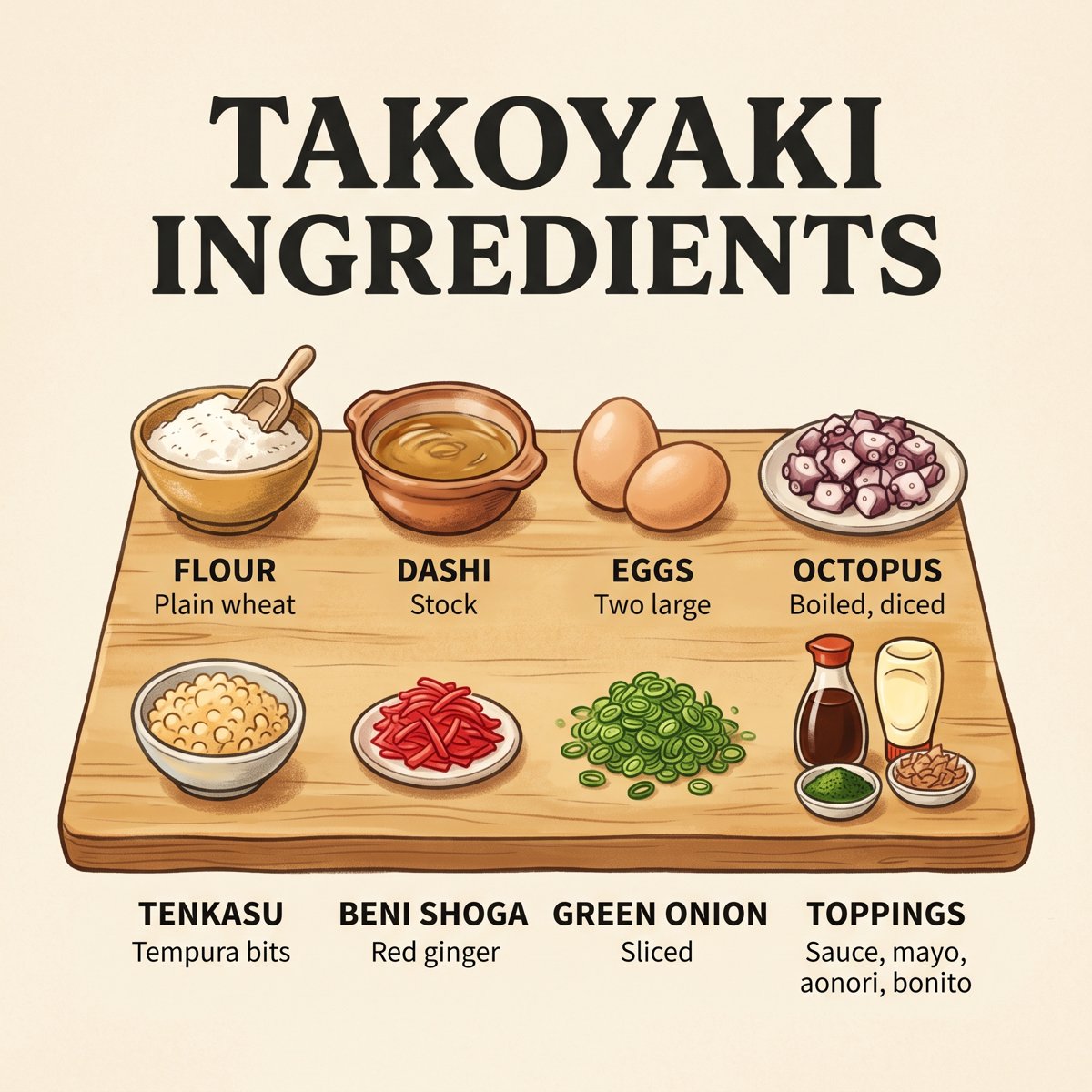
The batter starts with plain flour, dashi stock, and eggs. Inside go diced octopus, tenkasu (crunchy tempura bits), red pickled ginger called beni shoga, and green onion. Toppings include takoyaki sauce, Japanese mayonnaise, aonori, and bonito flakes, added to taste. Use pre-cooked octopus. MAFF’s published recipe also calls for boiled octopus.
Japanese supermarkets may stock takoyaki flour mix, sauce, and mayonnaise, either separately or in kits. Availability varies by store. Outside Japan, check Asian grocery stores for packs labeled “takoyaki flour” and “takoyaki sauce.” If you use takoyaki flour, follow its package for water and egg, because each brand differs.
Allergens
Traditional recipes commonly contain wheat and egg. Both are on Japan’s mandatory allergen list for packaged foods. Sauces, mayonnaise, dashi, and tenkasu vary by product, so they may add soy, fish, shellfish, milk, or other allergens. Some shops use shared pans, oil, picks, or utensils and may not be able to prevent cross-contact. Therefore, read packaged-food labels and ask the shop directly before ordering.
Takoyaki Recipe: How to Make It at Home
This is Food in Japan’s tested home recipe for a standard 24-hole pan. It is our own formula, not the MAFF recipe cited elsewhere in this article. Heating speed varies by pan, so follow the visual cues in each step as well as the clock.
Equipment
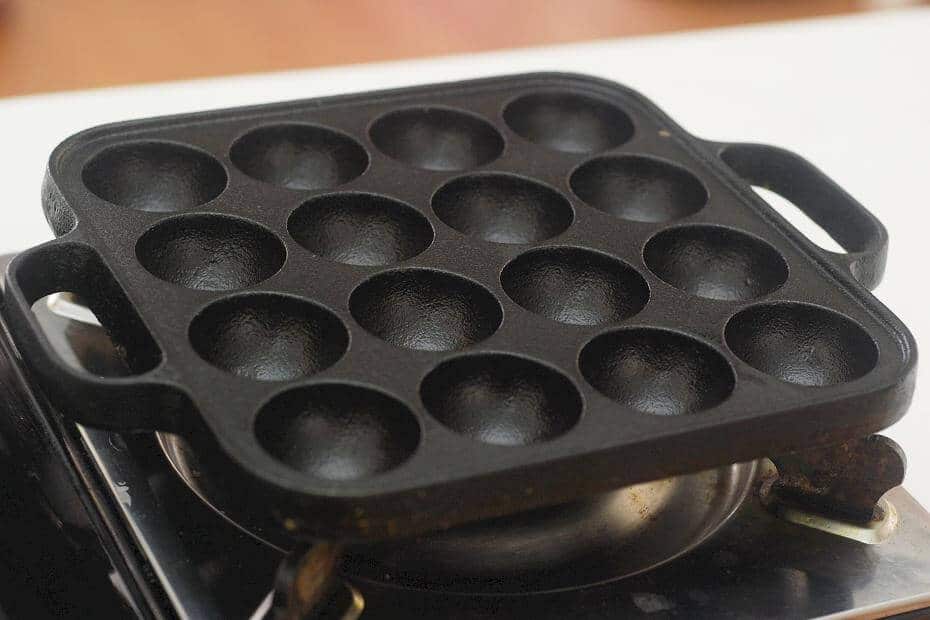
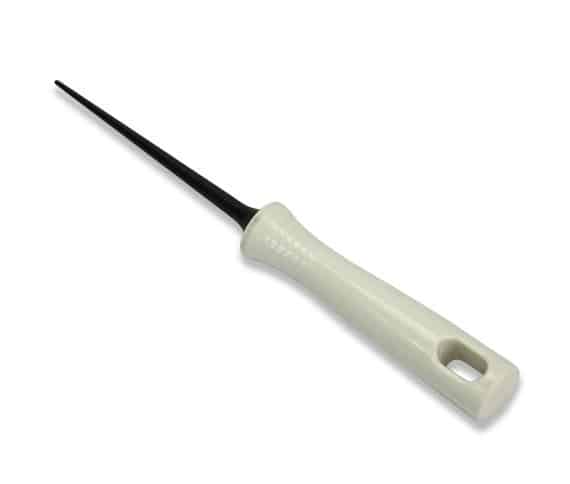
Do you need a special pan? For the round shape, yes. Home cooks can choose a cast-iron stovetop version or an electric plug-in model. You will also need a takoyaki pick or a long chopstick for turning, plus a small brush to oil the molds.
Ingredients and Instructions
Homemade Takoyaki
Ingredients
| Ingredient | Quantity (for 24 balls) | Substitute |
|---|---|---|
| All-purpose flour | 150g (about 1¼ US cups, depending on how the flour is measured) | Takoyaki flour mix |
| Dashi stock | 480ml (2 cups) | Kombu-shiitake stock |
| Eggs | 2 large | None recommended |
| Octopus, diced | 150g | Shrimp, squid, or cheese |
| Tenkasu | 30g | Crushed crackers |
| Beni shoga | 2 tablespoons, minced | Pickled ginger |
| Green onion | 2 stalks, sliced | Chives |
| Vegetable oil | 2 tablespoons | Any neutral oil |
Instructions
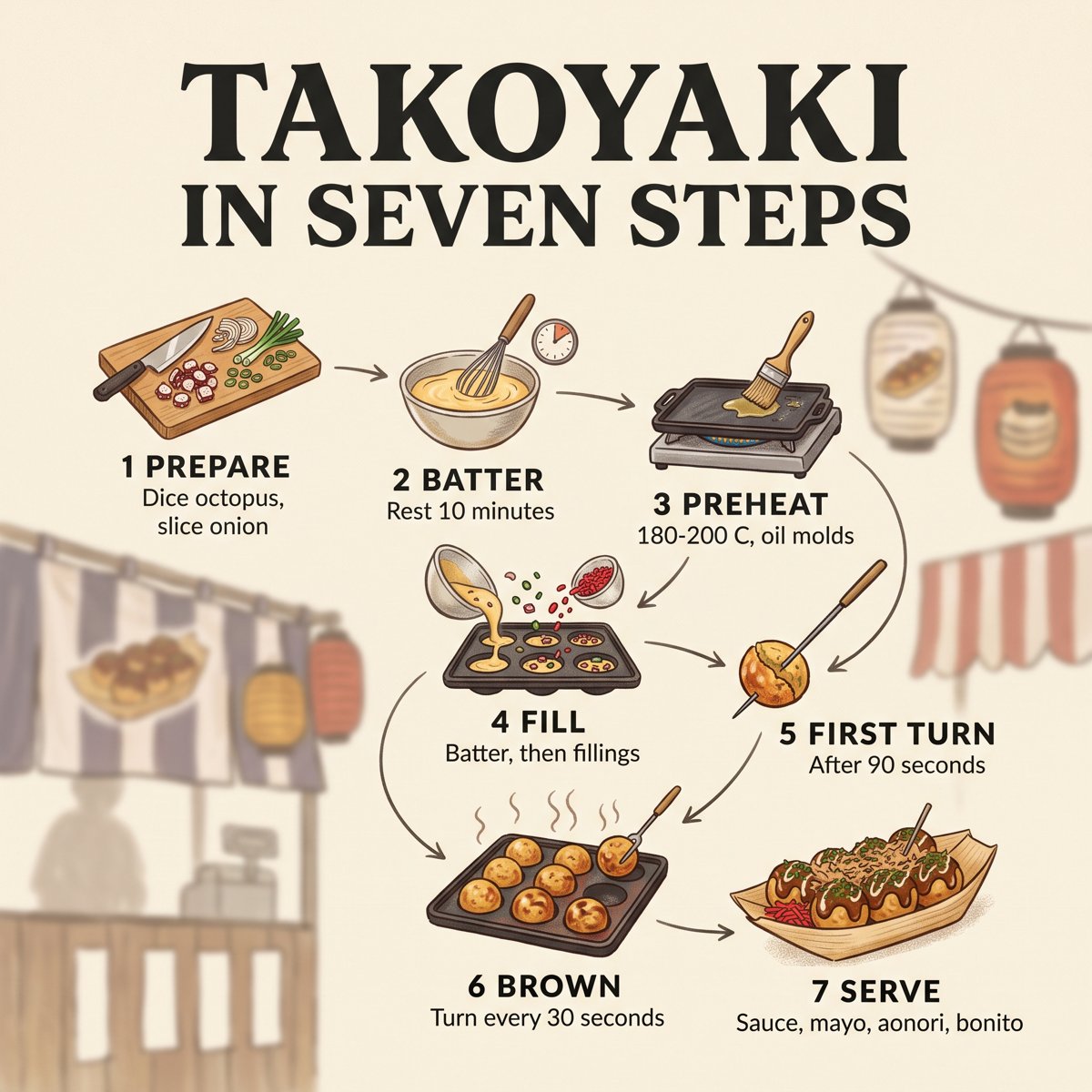
- Prepare the ingredients. Dice the octopus into small, even pieces. Slice the green onion thinly. Set both aside with the tenkasu and beni shoga.
- Mix the batter. Whisk flour, dashi, and eggs in a bowl until smooth. Let it rest for 10 minutes so the gluten relaxes.
- Preheat and oil the pan. Preheat the pan to around 180-200°C. If your pan has no temperature control, add a drop of batter; it should sizzle immediately without burning. Brush oil into every mold.
- Fill the molds. Pour batter until it overflows slightly. Add the octopus, tenkasu, ginger, and green onion right away, while the batter is still wet.
- First turn. Wait about 90 seconds until the edges set. Use the pick to cut around each ball and flip it halfway.
- Shape and brown. Keep turning every 30 seconds for about 4 minutes total. Tuck loose batter inward each time to form a round shape.
- Add toppings and serve. Once golden brown all over, transfer to a plate. Top with sauce, mayonnaise, aonori, and bonito flakes.
A golden surface alone does not confirm that the center is fully heated. For a more reliable check, see How to Eat Takoyaki Safely.
Troubleshooting
| Problem | Likely Cause | Fix |
|---|---|---|
| Balls stick to the pan | Not enough oil before pouring | Brush oil generously into every mold |
| Flat, misshapen balls | Turned too early or too roughly | Wait for the edges to set before flipping |
| Center tastes like raw flour | Pan too cool or cooking time too short | Cook 1 to 2 more minutes while turning frequently |
| Center is soft and creamy | This is normal for Osaka-style takoyaki | Let it rest briefly before eating |
| Tough octopus | Pieces cut too large, or reheated too long | Cut into smaller, even pieces and use pre-cooked octopus |
| Weak dashi flavor | Dashi not concentrated enough | Use a stronger dashi in the measured 480ml; do not add extra liquid after mixing |
| Uneven browning | Inconsistent turning intervals | Turn every 30 seconds on a timer |
Storage and Reheating
- Cool quickly: Spread leftovers in a shallow container so they chill fast.
- Refrigerate promptly: Seal the container and eat leftovers soon.
- Reheat thoroughly: MAFF’s Kinki office suggests reheating leftovers to at least 75°C.
- Keep the shell crisp: A toaster oven or air fryer may restore more surface crispness than a microwave, although results vary. Add fresh sauce and bonito flakes afterward.
How to Eat Takoyaki Safely
Fresh takoyaki stays extremely hot inside. Let each ball cool before biting into it. A good trick is to break one open with your pick or chopsticks first, so the steam escapes. Then eat it in two bites rather than one.
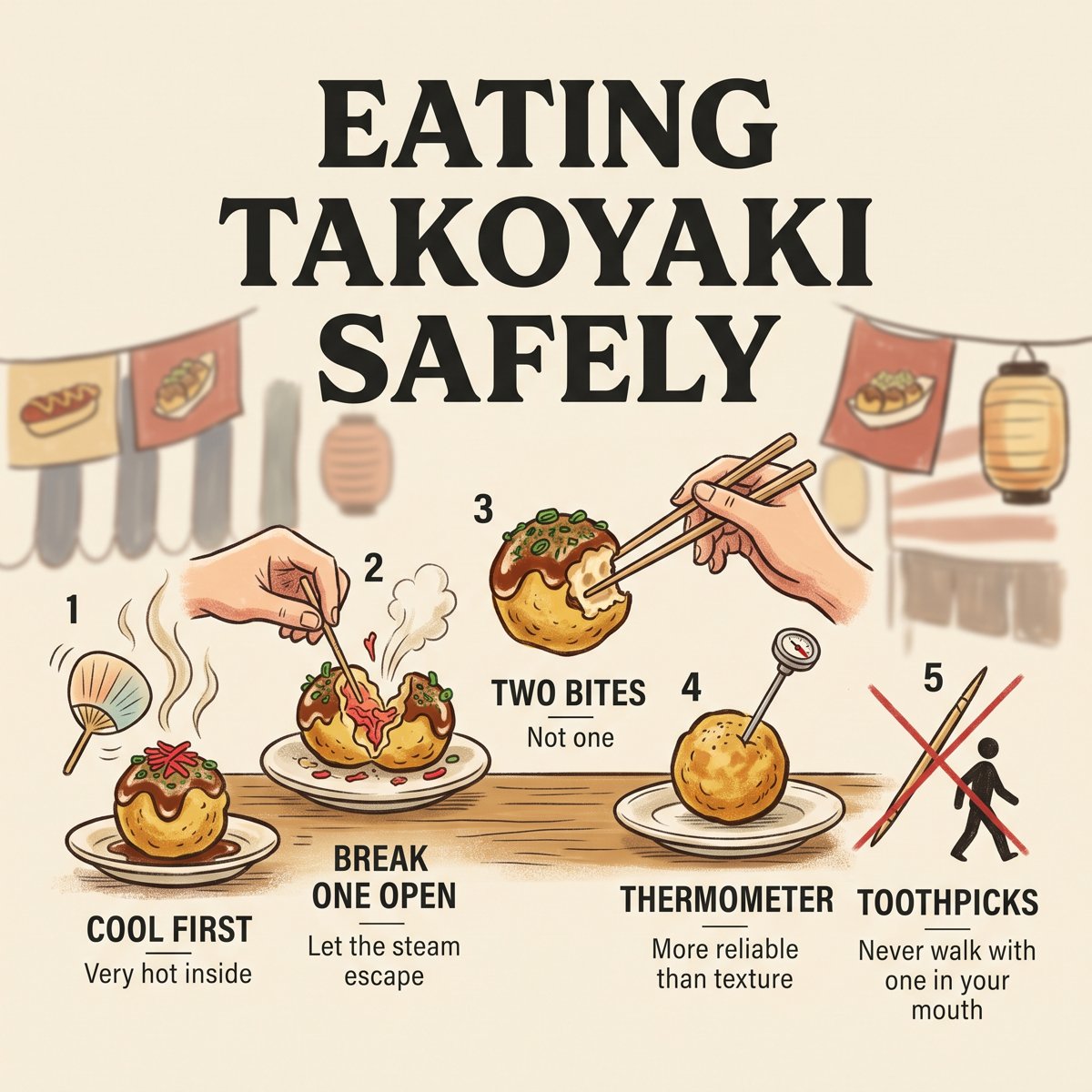
A soft center does not necessarily mean the batter is undercooked. Even so, texture alone cannot confirm safe heating. Japan’s hygiene manual for large-scale cooking facilities uses 75°C at the center for at least one minute as a general benchmark for heated foods. It is not a takoyaki-specific home standard, but a food thermometer is a more reliable check than texture.
Variations
Octopus-Free Fillings
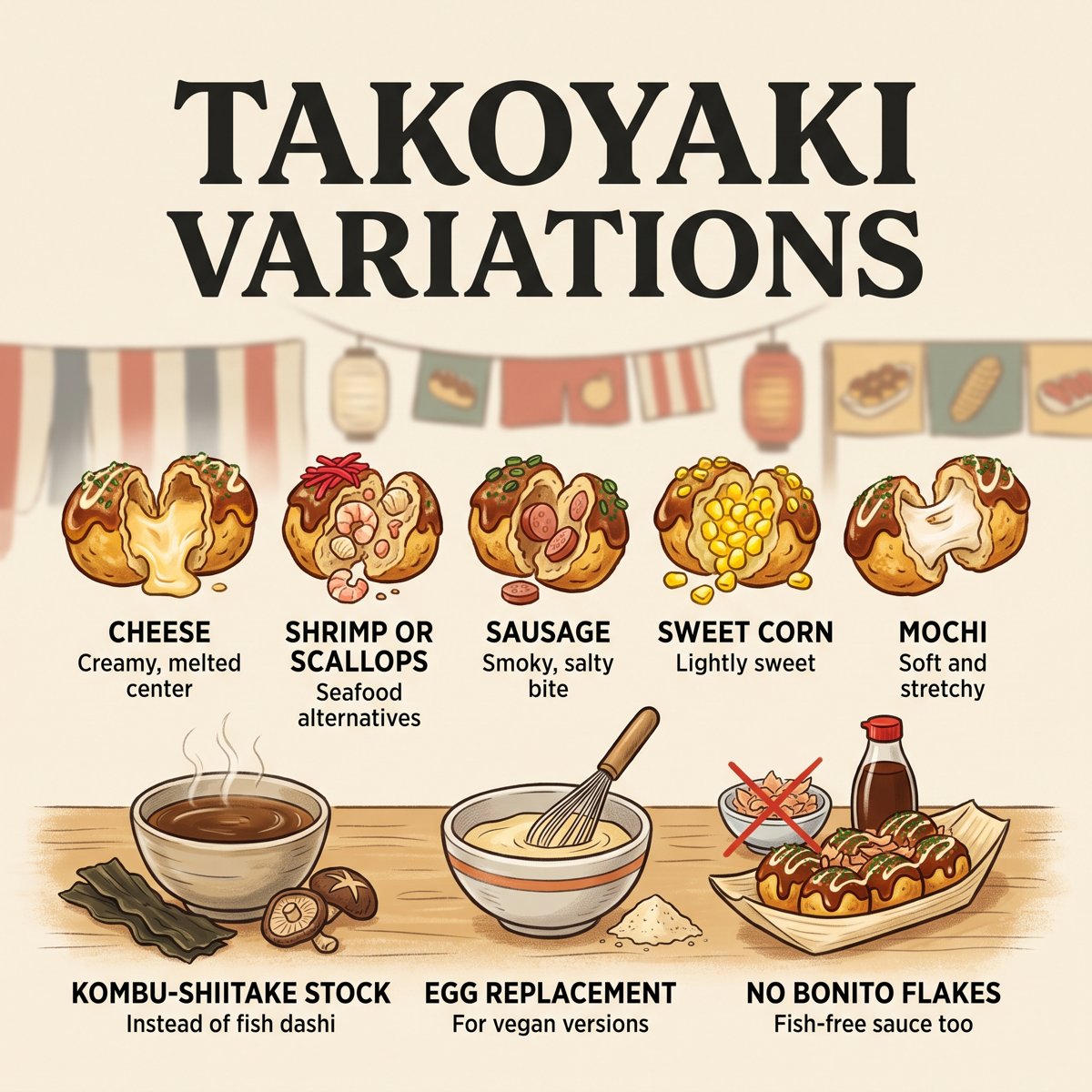
Can you make takoyaki without octopus? Yes. Some shops offer cheese, shrimp, sausage, corn, or mochi instead. These change only the filling, however. The batter itself still contains egg and dashi.
- Cheese, for a creamy, melted center
- Shrimp or scallops, as seafood alternatives
- Sausage, for a smoky, salty bite
- Sweet corn, for a lightly sweet filling
- Mochi, which turns soft and stretchy when heated
Vegetarian and Vegan Takoyaki
For a vegetarian or vegan version, replace both the octopus and the animal-based batter ingredients. That means kombu-shiitake stock instead of fish dashi, an egg replacement, a fish-free sauce, and no bonito flakes. Home cooking gives you the most control. If you eat out, ask whether the shop uses separate pans.
Where Can You Eat Takoyaki in Osaka?
Dotonbori and nearby Namba are the obvious start, and MAFF notes that takoyaki shops line Dotonbori. Umeda, around Osaka Station, suits travelers between trains. Meanwhile, the Osaka Castle area works well with sightseeing, and Tamade is the place for the origin story. For more ideas beyond takoyaki, see what to eat in Osaka.
Best Takoyaki in Osaka: 5 Recommended Shops
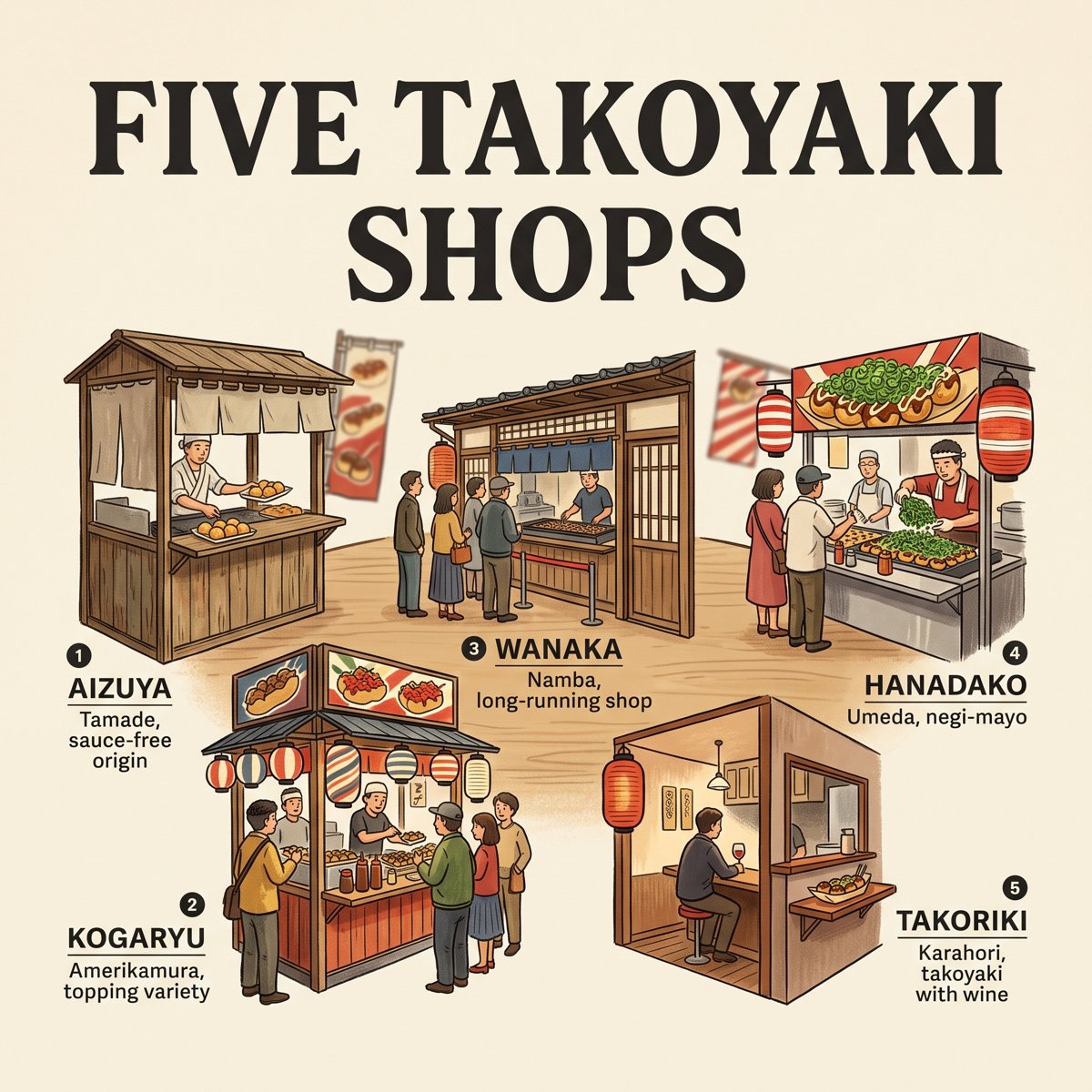
These five shops showcase distinct Osaka styles. Choose one based on location, toppings, or atmosphere. We checked the details against shop websites or official facility listings in October 2026. Hours and menus may change, so confirm before visiting.
| Shop | Best for | Area | Nearest station | Style | Checked |
|---|---|---|---|---|---|
| Aizuya | The origin story | Tamade | Tamade, Exit 1 | Sauce-free, soy-dashi batter | Oct 2026 |
| Kogaryu | Topping variety | Amerikamura | See official site | Sauce-mayo, soy-mayo, negi-pon | Oct 2026 |
| Wanaka | A classic Namba stop | Namba, Osaka Castle | Namba, Exit 3 | Long-running Sennichimae shop | Oct 2026 |
| Hanadako | A quick stop by Osaka Station | Umeda | JR Osaka | Negi-mayo | Oct 2026 |
| Takoriki | Takoyaki with wine | Karahori | Tanimachi 6-chome | Takoyaki at lunch; food and wine in the evening | Oct 2026 |
Aizuya (会津屋)
Aizuya traces its takoyaki to founder Tomekichi Endo in 1935. The business began as a stall in 1933 and has moved more than once. Its current main shop has been in Tamade since 1993. The menu still leads with the plain, sauce-free style, and Aizuya says it tastes good even cold. Aizuya says it received Michelin Bib Gourmand recognition for three consecutive years, from 2016 through 2018.
Aizuya shop details
- Address: 2-3-1 Tamade-nishi, Nishinari-ku, Osaka
- Access: Tamade Station (Osaka Metro Yotsubashi Line), Exit 1
- Hours: 11:00 to 21:00
- Closed: New Year’s Day
- Website: Aizuya official site
- Note: The Umeda HEP NAVIO branch closed on June 28, 2026.
Kogaryu (甲賀流), Amerikamura
Kogaryu’s main shop sits in Amerikamura, Osaka’s youth fashion district. By the shop’s account, its batter uses a base of seven kinds of dashi, including kombu and iriko. The menu lists sauce-mayo, soy-mayo, negi-sauce, negi-pon, and a black pepper, salt, and mayonnaise version. It is a good place to compare seasonings side by side.
Kogaryu shop details
- Address: 2-18-4 Nishi-Shinsaibashi, Chuo-ku, Osaka
- Hours: 10:30 to 20:30; until 21:30 on Saturdays and days before holidays
- Phone: 06-6211-0519
- Website: Kogaryu official site
Takoyaki Doraku Wanaka (たこ焼道楽 わなか)
Wanaka began as a sushi shop and confectioner in Sennichimae. Later the family dropped the sweets and focused on takoyaki. The Sennichimae main shop is a short walk from Namba Station. There is also a branch at JO-TERRACE OSAKA, handy with a visit to Osaka Castle Park.
Wanaka shop details
- Main shop: 11-19 Namba Sennichimae, Chuo-ku, Osaka
- Access: About 5 minutes from Namba Station (Midosuji Line), Exit 3
- Hours: 10:30 to 21:00 on weekdays; 9:30 to 21:00 on weekends and holidays
- Payment: Cash or PayPay, per the official main shop page
- Osaka Castle Park branch: JO-TERRACE OSAKA, 11:00 to 18:00, may change with events
- Website: Wanaka official site
Hanadako (はなだこ)
Hanadako sits in the Shin Umeda Shokudo-gai arcade, about a minute from JR Osaka Station. Its negi-mayo version piles on so much green onion that the balls almost disappear underneath. Seating is counter only, and takeaway is available.
Hanadako shop details
- Address: Shin Umeda Shokudo-gai, 9-26 Kakuda-cho, Kita-ku, Osaka
- Hours: 10:00 to 22:00, open daily
- Phone: 06-6361-7518
- Payment: Cards not accepted
- Listing: Shin Umeda Shokudo-gai shop page
Takoriki (たこりき)
Takoriki pairs its lunchtime takoyaki with wine. In the evening, it turns into a small wine-focused restaurant. The shop also sells frozen takoyaki through its official online store. The shop serves takoyaki only at lunch.
Takoriki shop details
- Address: 1-6-1 Kawarayamachi, Chuo-ku, Osaka
- Access: About 10 minutes on foot from Tanimachi 6-chome Station
- Phone: 06-6191-8501
- Hours: 12:00 to 16:00 (last order 15:30) for takoyaki; 18:00 to 24:00 (last order 22:00) for food and wine
- Closed: Mondays and Tuesdays; the official site notes that it opens when Monday is a public holiday. Check its calendar for exceptions.
- Website: Takoriki official site
Want to see how takoyaki fits into the rest of the city? Our Osaka local cuisine guide covers more dishes worth seeking out.
Takoyaki Price in Osaka and Japan
Prices vary by shop, serving size, and toppings. We could not verify a comparable current price range across the five shops from their official online menus. Hanadako’s official facility listing gives an average customer spend of about 800 yen, but that is not the listed price of one serving. Check the menu board or official shop page for current prices. Prices elsewhere in Japan also vary, and this article does not offer a nationwide price survey.
Final Thoughts
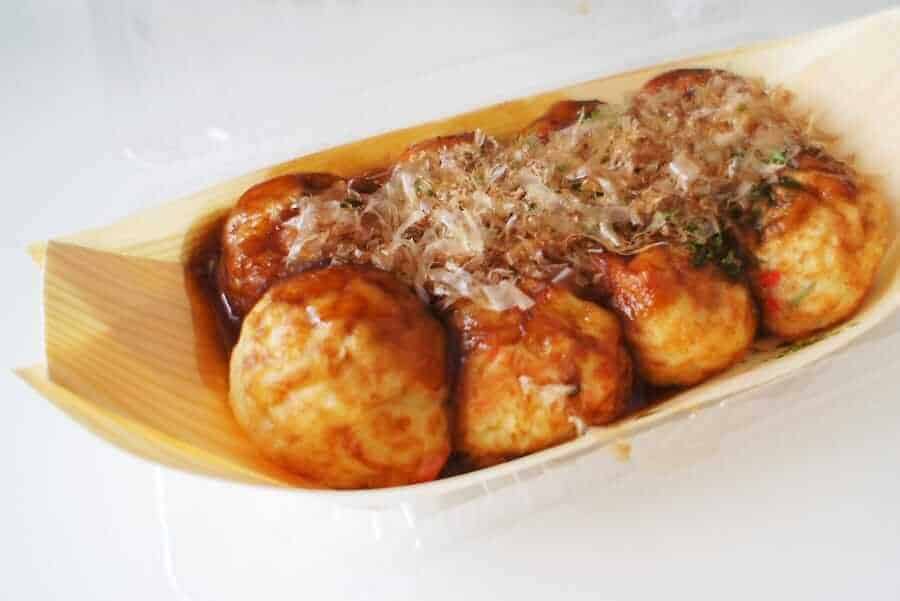
Takoyaki grew from a 1930s street stall into a symbol of Osaka food. Try Aizuya’s sauce-free style, then compare it with a sauce-topped version at another shop. The contrast tells you a lot about how the dish changed. Either way, save room for extra bonito flakes; watching them flutter in the heat is half the fun.
Takoyaki FAQ
Basics
- Where is takoyaki from?
-
Takoyaki comes from Osaka. The standard account credits Tomekichi Endo of Aizuya with creating takoyaki in 1935. Earlier molded snacks, choboyaki and rajioyaki, came before it. Sources differ on some details of that sequence.
- What is takoyaki made of?
-
The batter is wheat flour, dashi, and egg. Inside go boiled octopus, tenkasu, pickled ginger, and green onion. Most shops then add sauce, mayonnaise, aonori, and bonito flakes. See the ingredients section for exact amounts.
- Is takoyaki always made with octopus?
-
No, though octopus is the traditional filling. Some shops offer cheese, shrimp, sausage, corn, or mochi. Menus usually label these clearly. The Variations section lists more options.
- How much does takoyaki cost?
-
Prices vary by shop, serving size, and toppings. We could not verify a current range on official online menus. Hanadako’s official listing gives an average customer spend of about 800 yen, which is not the price of one serving. Check the menu board before ordering.
Cooking and Eating
- Is takoyaki fully cooked in the center?
-
Properly prepared takoyaki should be cooked through, even though the center remains soft. A creamy middle is normal for Osaka style, but softness alone does not prove it is cooked. Japan’s hygiene manual for large-scale cooking facilities uses 75°C at the center for one minute as a general benchmark. At home, check with a food thermometer.
- Can you eat takoyaki cold?
-
Freshly made takoyaki can be eaten after it cools. Aizuya promotes its sauce-free version as enjoyable even when cool. Leftovers, however, still need prompt refrigeration and safe handling. Most people prefer it hot, because the shell softens as it sits.
- Is takoyaki gluten-free?
-
Traditional takoyaki is not gluten-free, because its batter contains wheat flour. Many sauces also contain wheat. A gluten-free version needs a tested wheat-free batter plus wheat-free sauce, dashi, tenkasu, and toppings. Replacing only the flour does not make the dish gluten-free.
- Can I make takoyaki without a special pan?
-
Not in the traditional round shape. A skillet can turn out a takoyaki-inspired batter-and-octopus pancake, but the texture and shape will differ. For standard balls, you need a molded takoyaki pan.
- How do I reheat leftover takoyaki?
-
Reheat it until hot throughout. A toaster oven or air fryer may help restore surface crispness, although results vary by appliance. Add fresh toppings afterward, and see the storage section for cooling tips.
References
- Ministry of Agriculture, Forestry and Fisheries (MAFF) – Takoyaki, Osaka Prefecture | Our Regional Cuisines (Accessed October 2026)
- National Diet Library, Collaborative Reference Database – On the Origin of Osaka’s Takoyaki, answered by Osaka Prefectural Central Library (Accessed October 2026)
- Aizuya Official Site – The Birth of Takoyaki (Accessed October 2026)
- Aizuya Official Site – About Aizuya (Accessed October 2026)
- Akashi City – Akashi’s Treasures 10: Akashiyaki (Tamagoyaki) (Accessed October 2026)
- OSAKA-INFO, Osaka Convention and Tourism Bureau – Takoyaki (Accessed October 2026)
- Ministry of Health, Labour and Welfare – Hygiene Management Manual for Large-Scale Cooking Facilities (Accessed October 2026)
- MAFF Kinki Regional Agricultural Administration Office – Tips for Handling Leftover Food (Accessed October 2026)
- Consumer Affairs Agency – Food Allergy Labeling Information (Accessed October 2026)
- J-STAGE, Journal of Cookery Science of Japan – 中谷梢・坂本薫・吉村美紀 (2026), Changes in Recipes and Serving Methods of Akashiyaki (Tamagoyaki), 59(3), 205-213 (Accessed October 2026)
- J-STAGE, Japan Society of Cookery Science Annual Meeting Abstracts – 中谷梢・吉村美紀・坂本薫 (2023), Comparison of Akashiyaki and Takoyaki Batters (Accessed October 2026)
- Kogaryu Official Site – Shop Information (Accessed October 2026)
- Takoyaki Doraku Wanaka Official Site – Shops and History (Accessed October 2026)
- Shin Umeda Shokudo-gai Official Site – Hanadako Shop Listing (Accessed October 2026)
- Takoriki Official Site – Shop Information (Accessed October 2026)
Related Articles
- Osaka Food: A Culinary Journey (Surveyed: October 2026)
- What to Eat in Osaka: 20 Must-Try Foods for Every Visitor (Surveyed: October 2026)
- The World of Osaka’s Konamon (Surveyed: October 2026)
- The Complete Kansai Food Guide (Surveyed: October 2026)
- Akashiyaki (明石焼き) (Surveyed: October 2026)
- Okonomiyaki (お好み焼き) (Surveyed: October 2026)
- Osaka Local Cuisine (Surveyed: October 2026)




Comments
List of comments (5)
Your posts never fail to enlighten me. Thanks for consistently sharing your knowledge and expertise.
I like how you broke down this complex topic into bite-sized, understandable chunks. Great job!
Thanks for providing actionable tips in your post. They’re practical and easy to implement. I can’t wait to try them out!
Thank you so much!! 🙂
The clarity in your writing is something I truly appreciate. This was easy to understand, yet detailed enough to cover the topic thoroughly.