





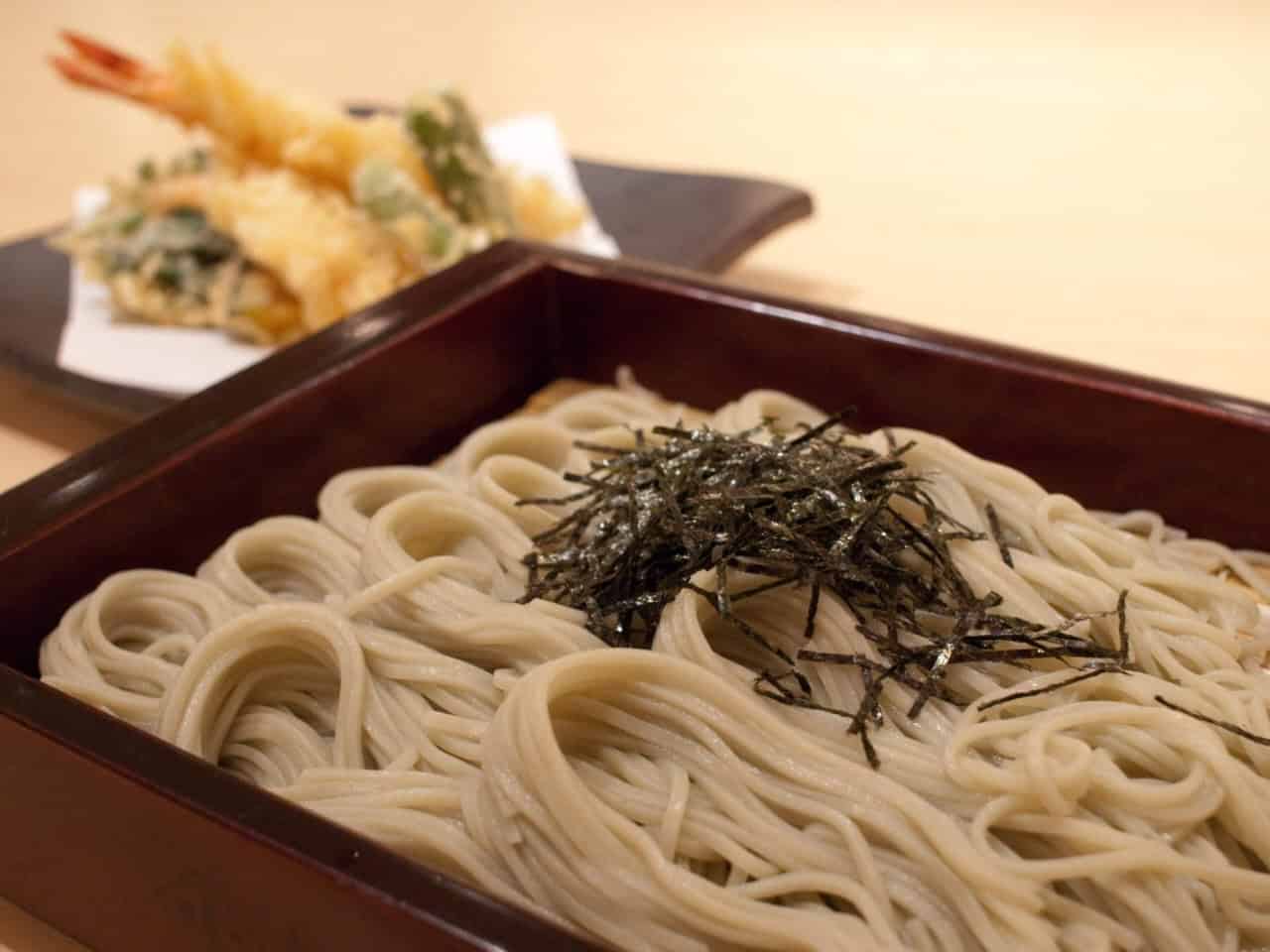
Hegi soba is a cold buckwheat noodle specialty from Niigata Prefecture, which sits on the Sea of Japan coast of central Honshu, roughly two hours from Tokyo by Joetsu Shinkansen. Cooks traditionally bind it with processed funori seaweed, then arrange it in bite-sized bundles on a rectangular wooden tray called a hegi. The funori gives the noodles their smooth surface, firm elasticity, and distinctive throat feel. This guide covers where it comes from, how it compares to other soba, and where to try it in Niigata.
Hegi Soba at a Glance
| Japanese name | へざそば (hegi soba) |
| Origin | Uonuma region, Niigata Prefecture |
| Main ingredients | Buckwheat flour, processed funori, water |
| Binder | Processed funori; some recipes and products also contain wheat flour |
| Serving vessel | Wooden hegi tray |
| Presentation | Bite-sized teguri bundles |
| Texture | Smooth throat feel, firm and elastic bite |
| Typical condiments | Karashi mustard, green onion, sesame; some shops also offer wasabi |
| Serving temperature | Cold, with a separate dipping sauce |
What Is Hegi Soba?
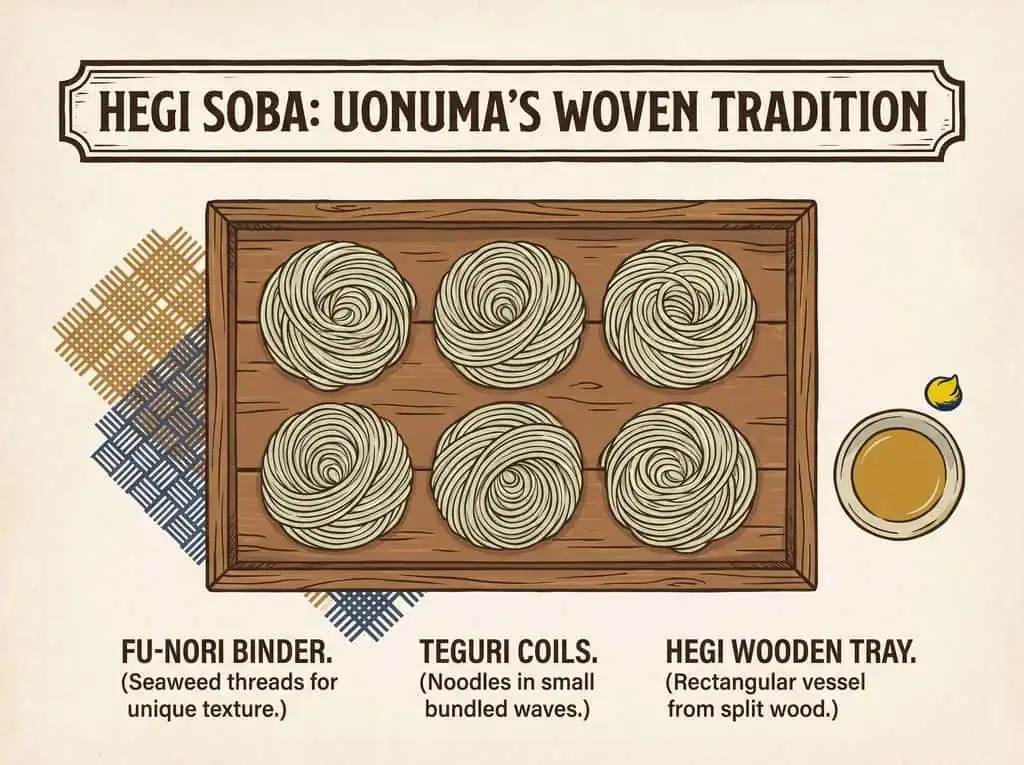
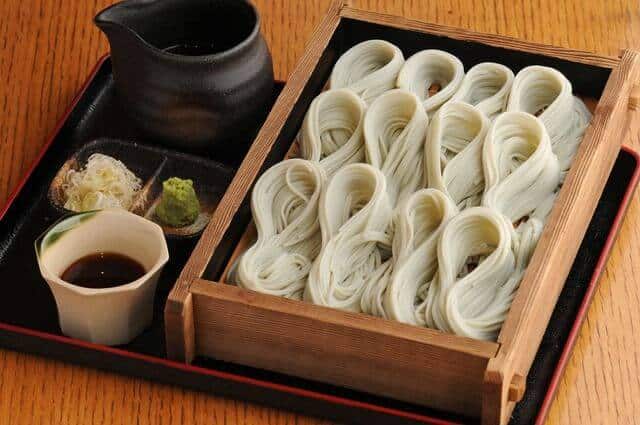
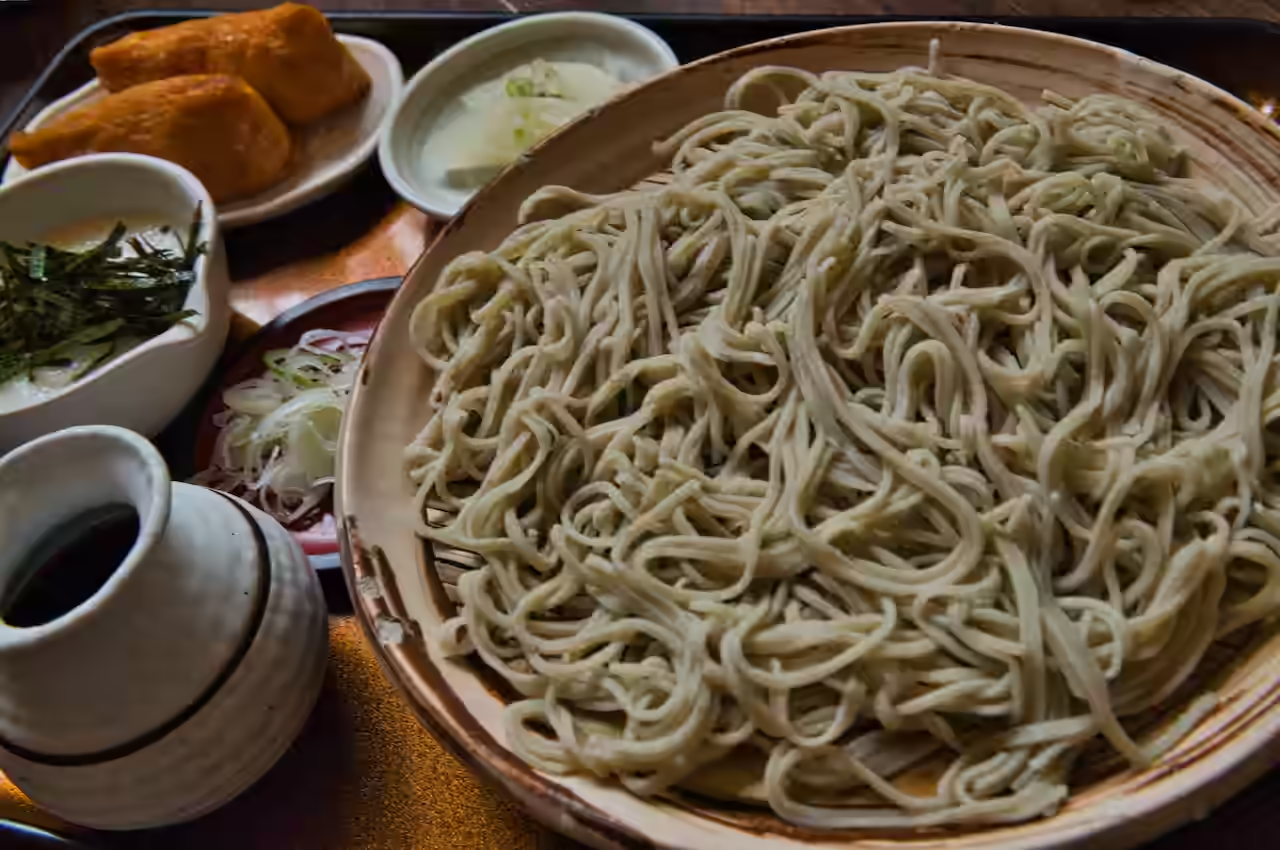
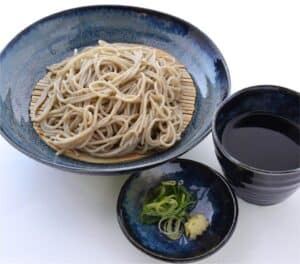
In Japanese, this dish is written へざそば and romanized as hegi soba. Three details define it. First, processed funori binds the buckwheat dough. Second, cooks plate the noodles in small coiled bundles called teguri (手緂り). Third, the noodles rest on a hegi (へざ), a rectangular wooden tray.
The name hegi comes from the verb hegu, meaning to peel or split thin layers from wood. Chefs arrange the noodles neatly on this tray rather than serving them in a bamboo basket. That tray is the easiest way to identify the dish in a photo or on a menu.
The Uonuma region historically includes areas such as Tokamachi and Ojiya in central Niigata Prefecture. Modern administrative boundaries and older food regions do not always line up exactly. That is why well-known hegi soba restaurants also appear in nearby Nagaoka and other parts of the prefecture.
Hegi Soba vs Ni-Hachi and Juwari Soba
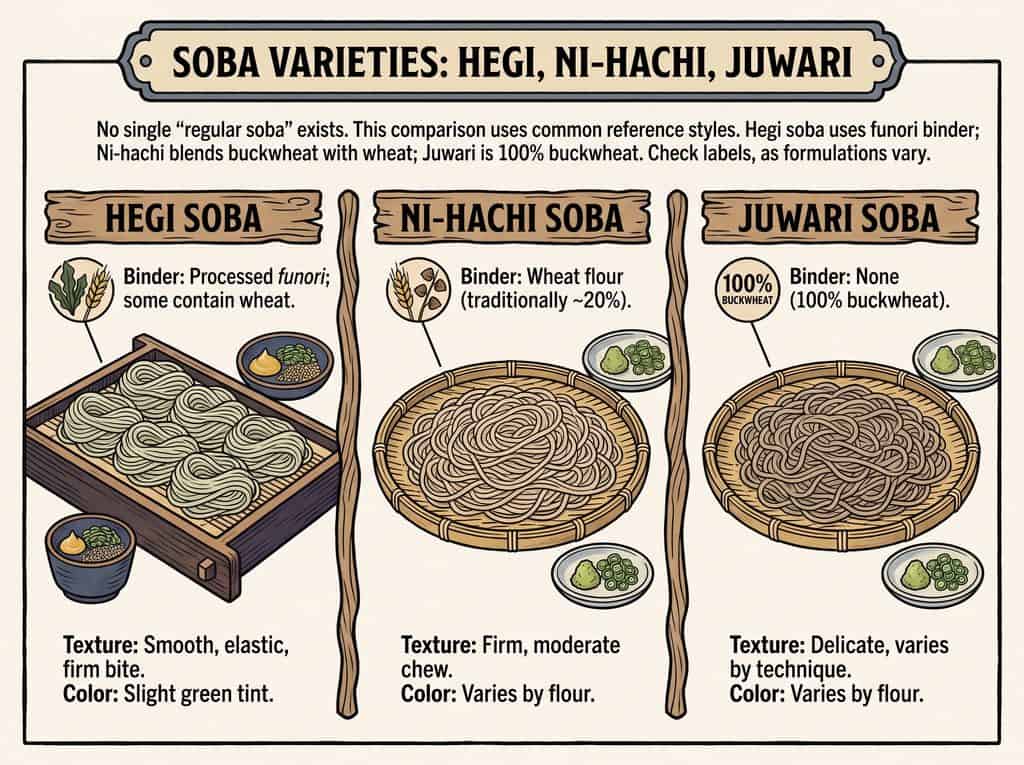
There is no single type of “regular soba,” so this comparison uses two common reference styles. Ni-hachi soba usually blends buckwheat with about 20% wheat flour as a binder, though formulations vary. Juwari soba uses no binder and relies on buckwheat alone. Hegi soba is traditionally defined by its use of processed funori. Some restaurant noodles and packaged products also contain wheat flour, though, so check the ingredient label rather than assuming every product is wheat-free.
| Feature | Hegi Soba | Typical Ni-Hachi Soba | Juwari Soba |
|---|---|---|---|
| Binder | Processed funori; some products also contain wheat flour | Wheat flour | None (100% buckwheat) |
| Wheat content | Varies by product | Traditionally around 20%, though formulations vary | None |
| Texture | Smooth, elastic, firm bite | Firm, moderate chew | Can feel more delicate, depending on the flour and technique |
| Color | Slight green tint | Varies with the flour and milling method | Varies with the flour and milling method |
| Presentation | Teguri bundles on a wooden hegi tray | Loose pile on a bamboo zaru | Loose pile on a bamboo zaru |
| Condiments | Karashi, green onion, sesame; wasabi at some shops | Common examples include wasabi and green onion | Common examples include wasabi and green onion |
How to Eat Hegi Soba
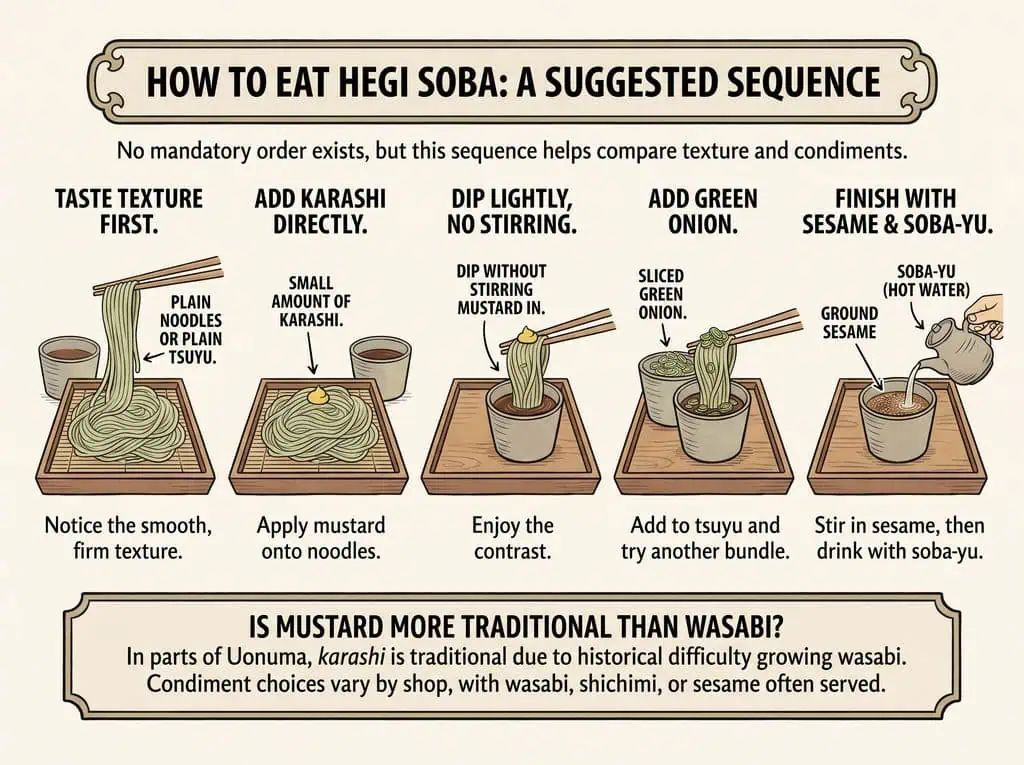
There is no single mandatory order, and serving customs vary by restaurant. If you want to compare the texture and condiments, this sequence works well as a starting point.
- Taste a bundle of plain noodles, or dip it in plain tsuyu, to notice the texture first.
- Add a small amount of karashi mustard directly onto the noodles.
- Dip the noodles lightly into the tsuyu without stirring the mustard in.
- Add finely sliced green onion to the tsuyu and try another bundle.
- Finish with ground sesame seeds stirred into the tsuyu.
Each condiment changes the smooth noodles differently, so try mustard, green onion, and sesame one at a time. Some restaurants offer soba-yu, the hot water used to boil the noodles. If it is available, pour it into your remaining tsuyu and drink it as a light, savory finish.
Is Mustard More Traditional Than Wasabi?
In parts of the Uonuma region, karashi mustard is the traditional condiment associated with hegi soba. This custom is often linked to the historical difficulty of growing wasabi locally. Condiment choices still vary by restaurant, and some modern shops serve wasabi, shichimi, or sesame alongside or instead of mustard.
Where to Eat Hegi Soba in Niigata
Hegi soba restaurants cluster around Niigata Station, Ojiya, Tokamachi, and the Minamiuonuma area. The three shops below were checked against official sources and suit different travel needs. Information checked: September 17, 2026. Hours, prices, and menus can change, so confirm before visiting.
- Best for first-time visitors without a car: the Niigata Station branch below
- Best for a historic, hands-on noodle shop: the Ojiya branch below
- Best for pairing with tempura: the Tokamachi branch below
These labels are editorial suggestions based on access, menu style, and setting. They are not a ranking of food quality.
Nagaoka Kojimaya, CoCoLo Niigata Branch
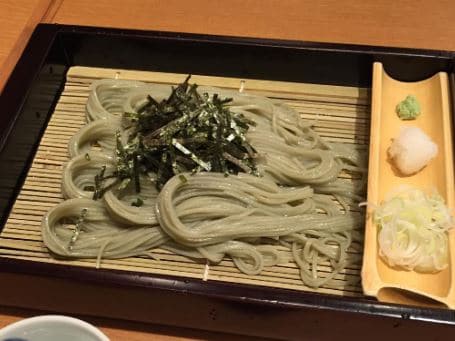
This branch sits inside the CoCoLo Niigata shopping area on the first floor of Niigata Station’s building. That location suits travelers with limited time between trains. According to its official store page, the restaurant offers an English menu and step-free access.
- Signature menu
- Hegi soba, tare-katsu don, and tempura sets
- Price range
- Roughly ¥1,500-¥2,000 per person for lunch or dinner
- Address
- 1-1-1 Hanazono, Chuo-ku, Niigata (Niigata Station Bldg. CoCoLo Niigata, 1F)
- Nearest station
- Niigata Station (inside the station building)
- Phone
- 025-384-4196
- Hours
- Daily 11:00-22:00 (food and drink last order 21:00)
- Closed
- No regular closures
- Payment
- Visa, Mastercard, Amex, JCB, and Suica accepted
- English menu
- Available
- Accessibility
- Step-free access available; parking at CoCoLo Niigata parking
- Reservation
- Not required for small groups
- Official source
- kojimaya-cocolo.owst.jp
Wataya, Hirasawa Branch
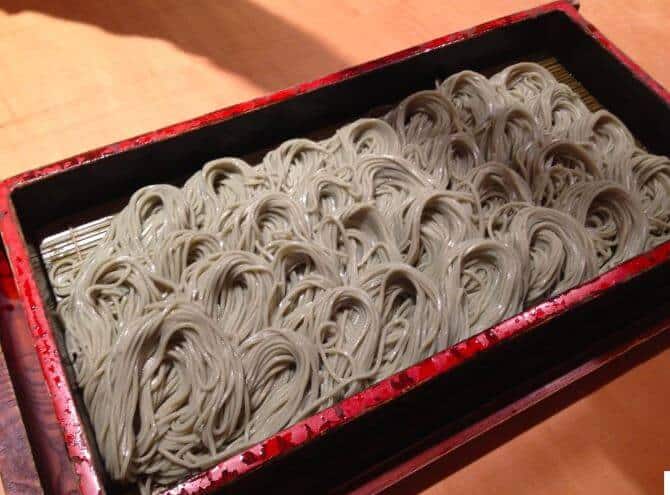
Wataya describes its Ojiya main store as the birthplace of hegi soba. Because long-established producers differ on origin claims, treat this as the restaurant’s own historical account rather than a universally settled fact. The Hirasawa branch serves Wataya’s signature funori-bound noodles. It sits roughly a 25-minute walk from Ojiya Station, so most visitors arrive by car or taxi.
- Signature menu
- Hegi soba set
- Price range
- Under ¥2,000 per person for lunch (check current menu)
- Address
- 1-8-5 Hirasawa, Ojiya, Niigata 947-0042
- Nearest station
- Ojiya Station
- Phone
- 0258-83-0588
- Hours
- Weekdays 11:00-16:00 and 17:00-20:30; weekends and holidays 10:45-20:30
- Closed
- Irregular holidays
- Payment
- Check with the restaurant
- English menu
- Not confirmed
- Reservation
- Recommended for groups
- Official source
- watayasoba.co.jp
Kojimaya Sohonten, Tokamachi
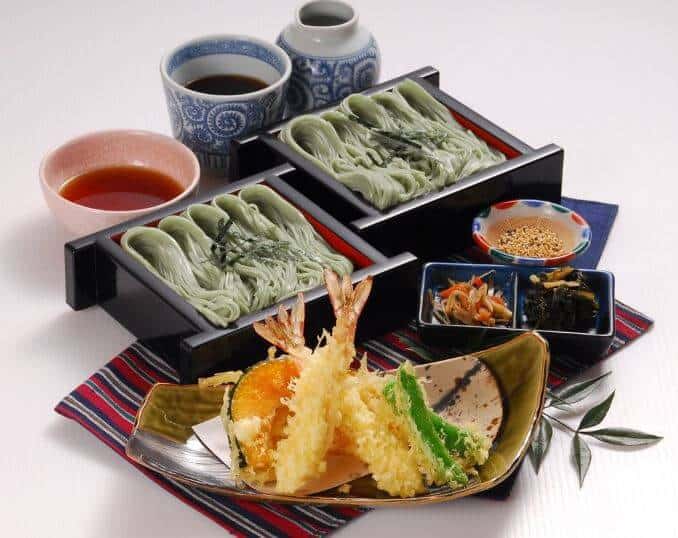
Kojimaya describes its founder as having completed the original funori-bound noodle recipe, a separate origin claim from Wataya’s. Its noodles have also been presented to the Imperial family on multiple occasions, according to the company. The restaurant pairs its noodles with freshly fried tempura and sits in Nakayashiki, a short drive from central Tokamachi.
- Signature menu
- Hegi soba and tempura set
- Price range
- Check current menu
- Address
- 758-1 Nakayashiki, Tokamachi, Niigata
- Nearest station
- Tokamachi Station
- Phone
- 025-768-3311
- Hours
- Daily 11:00-21:00
- Closed
- Check with the restaurant
- Payment
- Check with the restaurant
- English menu
- Not confirmed
- Reservation
- Recommended for groups
- Official source
- kojimaya.co.jp
Note on a fourth option: The restaurant formerly known as Nakanoya Shiozawa, in Minamiuonuma, closed and has reopened under new ownership as Sobatomi (そば処富永), which continues to serve hegi soba at the same location. Address: 534-89 Minamitanaka, Minamiuonuma, Niigata. Phone: 025-775-7797. Hours: 11:00-19:30 (last order 19:00). Closed Tuesdays, with additional irregular closures. Reservations are not accepted, according to local reporting. Confirm current details on the restaurant’s official site or Instagram before visiting.
How Much Does Hegi Soba Cost?
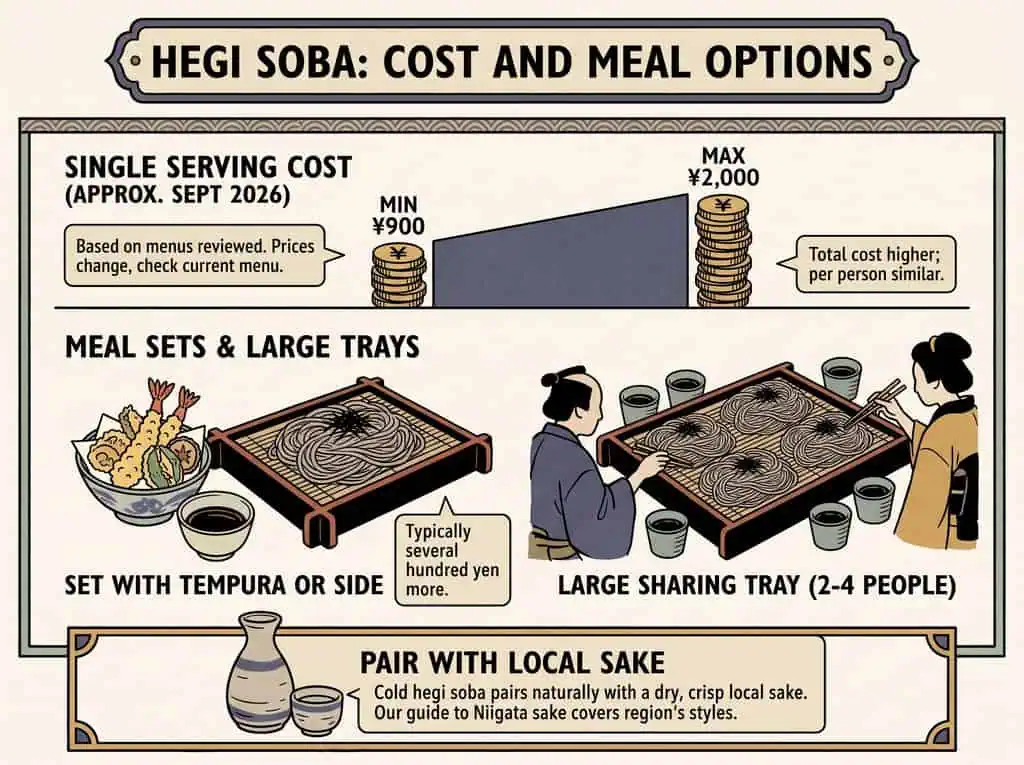
At the restaurants checked for this guide, a single serving generally costs between roughly ¥900 and ¥2,000. This range reflects official menus and listings reviewed in September 2026. Sets that add tempura or a side dish typically cost several hundred yen more. Large trays for two to four people cost more in total, but the price per person is often close to a single serving. Prices change over time, so check the current menu before you visit.
Cold hegi soba pairs naturally with a dry, crisp local sake. Our guide to Niigata sake covers the region’s brewing styles in more detail.
History: How Niigata’s Textile Culture Shaped Hegi Soba
Soba cultivation in the Uonuma area dates back to the Edo period. The mountainous terrain suited buckwheat better than rice in many local fields. Around the same era, Ojiya developed Ojiya-chijimi, a crinkled ramie fabric that became one of Japan’s prized textiles.
From Textile Starch to Noodle Binder
According to Ojiya City’s official tourism information, weavers coated ramie threads with boiled funori seaweed. This smoothed rough fibers and made them easier to weave without snagging. Japan’s Ministry of Agriculture, Forestry and Fisheries describes hegi soba as a local dish said to have developed from a fusion of this textile culture with the region’s food culture. In other words, cooks applied the same funori binder to buckwheat dough. That gave the noodles a strength and smoothness that pure buckwheat lacks.
Why the Noodles Are Arranged in Teguri Bundles
The bite-sized teguri bundles are said to echo the coiled thread bundles used in weaving. This is a visual link between the two crafts, not a confirmed historical rule. Today, restaurants throughout the Uonuma region and beyond still serve noodles prepared with this funori-based method, and the dish is now recognized nationally as one of Niigata’s signature specialties.
Ingredients and How Hegi Soba Is Made
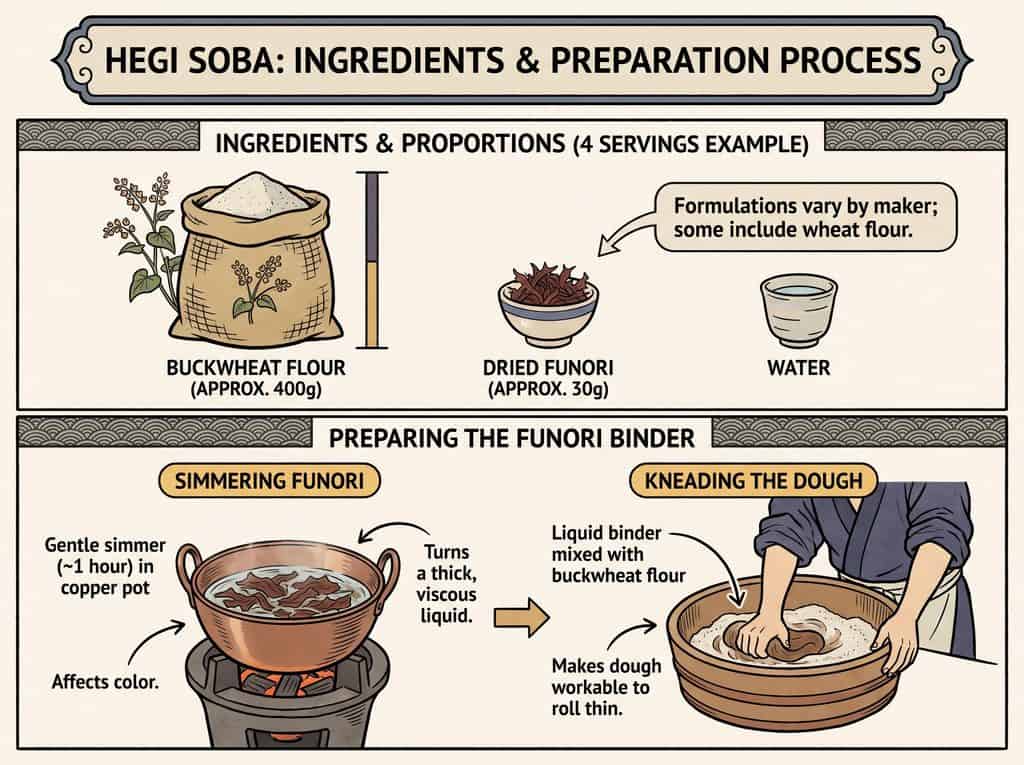
Hegi soba ingredients traditionally include buckwheat flour, processed funori, and water. Some restaurant recipes and packaged products also include a portion of wheat flour, so formulations vary by maker. Japan’s Ministry of Agriculture, Forestry and Fisheries publishes an official regional recipe for four servings. It calls for roughly 400g of buckwheat flour to 30g of dried funori, which shows how small the funori portion is relative to the buckwheat.
To prepare the binder, cooks simmer dried funori over low heat until it breaks down into a thick, viscous liquid. The official recipe calls for about one hour of gentle simmering in a copper pot, which also affects the color of the finished funori. Cooks then knead that liquid into the buckwheat flour, roll it flat, and cut it into noodles. This differs from simply mixing dried seaweed into dry flour. It explains why the dough becomes workable enough to roll thin.
When Is the Best Season for Hegi Soba?
Hegi soba is available year-round across Niigata. Locally harvested autumn shin-soba generally appears from late October through November. The exact timing varies by harvest, producer, and restaurant. Shin-soba tends to have a more vivid aroma and fresher color than soba made from older flour. Several areas of Niigata hold seasonal shin-soba events to mark the new harvest.
Where to Buy Hegi Soba
Hegi soba is sold fresh, semi-dried, and fully dried. Fresh noodles give the closest texture to a restaurant bowl, but they spoil quickly and travel poorly. Semi-dried noodles balance shelf life with a reasonably springy texture, making them a practical souvenir. Fully dried noodles keep the longest and are the easiest option for first-time buyers to cook with confidence.
Before buying, check the package for these details.
- Buckwheat percentage listed on the label
- Whether funori and wheat flour are both included
- Allergen statements for wheat and buckwheat
- Number of servings per package
- Recommended cooking time
- Whether a tsuyu dipping sauce is included
You can find packaged hegi soba at Niigata Station, Echigo-Yuzawa Station, and regional product halls in Tokamachi and Ojiya. Some producers, including Kojimaya, also sell noodles through official online stores. Stock and shipping areas change, though, so confirm availability before planning a purchase around a specific product.
How to Cook Packaged Hegi Soba at Home
Making traditional funori-bound noodles from scratch requires precise control of the funori concentration and dough hydration. It also takes about an hour of simmering just for the binder. For a first attempt, packaged dried or semi-dried hegi soba produces more reliable results, and it lets you focus on the tsuyu and condiments instead.
Bring plenty of water to a rolling boil and follow the cooking time printed on the package.
Add the noodles gradually and stir gently so they do not stick together or to the pot.
Drain immediately once cooked, then rinse thoroughly under running water to remove surface starch.
Chill briefly in cold water, drain well, then twist small portions into teguri bundles. Serve with tsuyu and your choice of condiments.
Dietary Notes
Is Hegi Soba Gluten-Free?
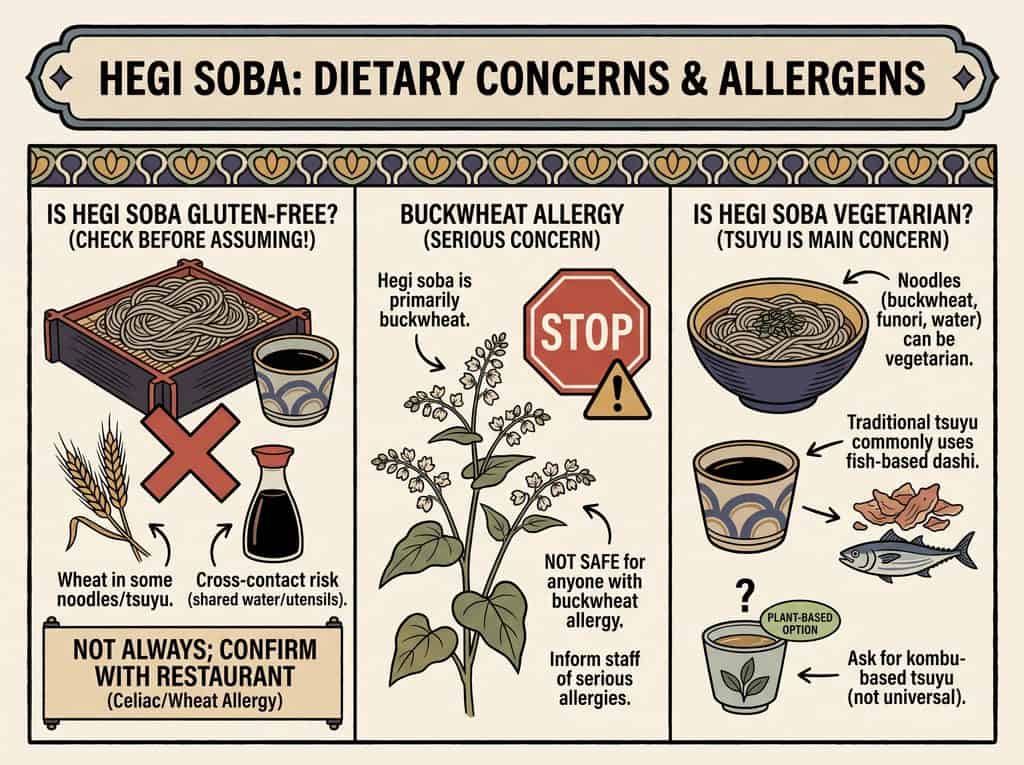
Not always, so check before assuming it is safe. Some products use processed funori as the primary binder, but others also mix in wheat flour. The tsuyu dipping sauce usually contains regular soy sauce brewed from wheat as well. Cross-contact may also occur if noodles are boiled in shared water or prepared with shared utensils. If you have celiac disease or a medically diagnosed wheat allergy, do not rely on the menu name alone. Confirm the noodle recipe, the tsuyu, and the kitchen procedures directly with the restaurant.
A buckwheat allergy is a separate and more serious concern, since hegi soba is made primarily from buckwheat. This dish is not a safe option for anyone with a diagnosed buckwheat allergy, regardless of whether wheat is present. Staff should be informed of any serious food allergy in advance.
Is Hegi Soba Vegetarian?
The noodles themselves can be vegetarian, since buckwheat, funori, and water contain no animal products. The traditional tsuyu is the main concern, because it commonly uses bonito flakes or other fish-based dashi. Tempura batter may also be plant-based, but the frying oil, dipping sauce, and side dishes served alongside it can still contain fish-based ingredients. Some shops offer a kombu-based, plant-derived dipping sauce instead. This is not universal, though, so ask before ordering if you follow a vegetarian diet.
Other Regional Soba Styles
Hegi soba is one of several regional soba styles worth comparing. Shinshu soba, from Nagano Prefecture, is often served simply. A light dipping sauce highlights the buckwheat flavor on its own. Togakushi-style soba, also from Nagano, shares hegi soba’s bundled presentation. It typically sits in a round basket, though, rather than a wooden tray.
Explore traditional Japanese noodles, including regional soba varieties, for more dishes to compare.
The Uonuma region is equally known for Koshihikari rice. Our guide to Koshihikari rice explains why the region’s rice carries its own strong reputation, separate from its noodle culture.
Is Hegi Soba Worth Trying?
Hegi soba is worth seeking out if you enjoy noodles with a smooth surface and a firm, elastic bite. For the easiest introduction, try it at Niigata Station. For a stronger connection to its textile history, visit Ojiya or Tokamachi. Start with plain noodles and tsuyu, then compare karashi, green onion, and sesame one at a time. If you bring some home, choose dried or semi-dried noodles. They are far easier to handle than the traditional funori-bound dough made from scratch.
For more of the prefecture’s specialties, see our Niigata food guide.
Hegi Soba FAQ
What makes hegi soba different from ordinary soba?
The binder is the main difference. Standard ni-hachi soba usually uses wheat flour, while this dish is traditionally defined by processed funori seaweed instead. Some modern products also contain wheat flour. The exact formulation varies by maker, so checking the label is the only reliable way to know.
Is hegi soba gluten-free?
Not necessarily, so verify before ordering if this matters to you. Some products mix in wheat flour, and the tsuyu dipping sauce usually contains wheat-based soy sauce. Ask staff directly about the noodle recipe and sauce if you need to avoid gluten strictly.
Is hegi soba vegetarian?
The noodles can be vegetarian, since buckwheat, funori, and water contain no animal products. The traditional tsuyu usually contains fish-based dashi, though some shops offer a kombu-based alternative. Ask whether the tsuyu is fish-free before ordering.
Is mustard more traditional than wasabi?
In parts of the Uonuma region, karashi mustard is the traditional condiment. This custom is often linked to the local difficulty of growing wasabi. Condiment choices still vary by restaurant, and some shops serve wasabi, shichimi, or sesame as well.
Can one person order hegi soba?
Yes. Restaurants often serve large wooden trays sized for two to four people to share. Most also offer single servings for solo diners. Check the menu for both options, since portion names can vary by shop.
References
- Ministry of Agriculture, Forestry and Fisheries of Japan – Hegi Soba: Our Regional Cuisines (origin, ingredients, official recipe) (Accessed September 2026)
- Ministry of Land, Infrastructure, Transport and Tourism of Japan – Hegi Soba Noodles (terminology, eating method) (Accessed September 2026)
- Ojiya City Official Website – Ojiya Chijimi (textile history) (Accessed September 2026)
- Japan Traditional Crafts (Kogei Japan) – Ojiya Chijimi Textiles (textile history) (Accessed September 2026)
- Niigata Prefecture Tourism Association – Soba in Niigata (seasonal context) (Accessed September 2026)
- Wataya Soba – Official Website (restaurant information, origin claim) (Accessed September 2026)
- Nagaoka Kojimaya CoCoLo Niigata – Official Store Page (restaurant information) (Accessed September 2026)
- Kojimaya Sohonten – Official Website (restaurant information, origin claim) (Accessed September 2026)
- Sobatomi (formerly Nakanoya Shiozawa) – Official Website (restaurant information) (Accessed September 2026)
Related Articles
- Japanese Noodles (Surveyed: September 2026)
- Niigata Food Guide (Surveyed: September 2026)
- Niigata Sake (Surveyed: September 2026)
- Koshihikari Rice (Surveyed: September 2026)




Comments