




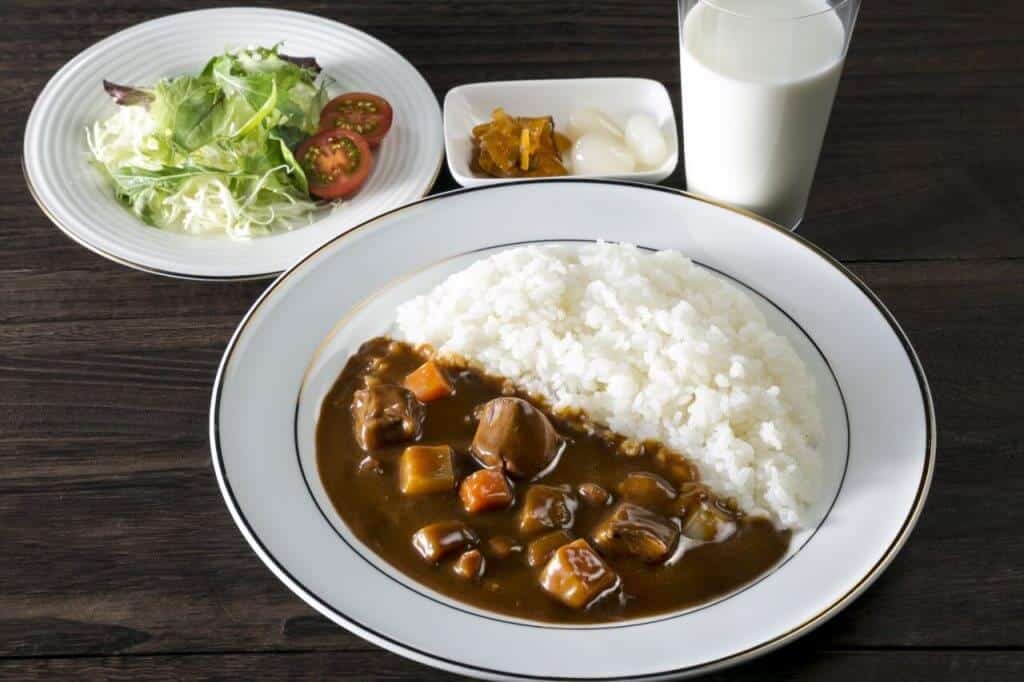
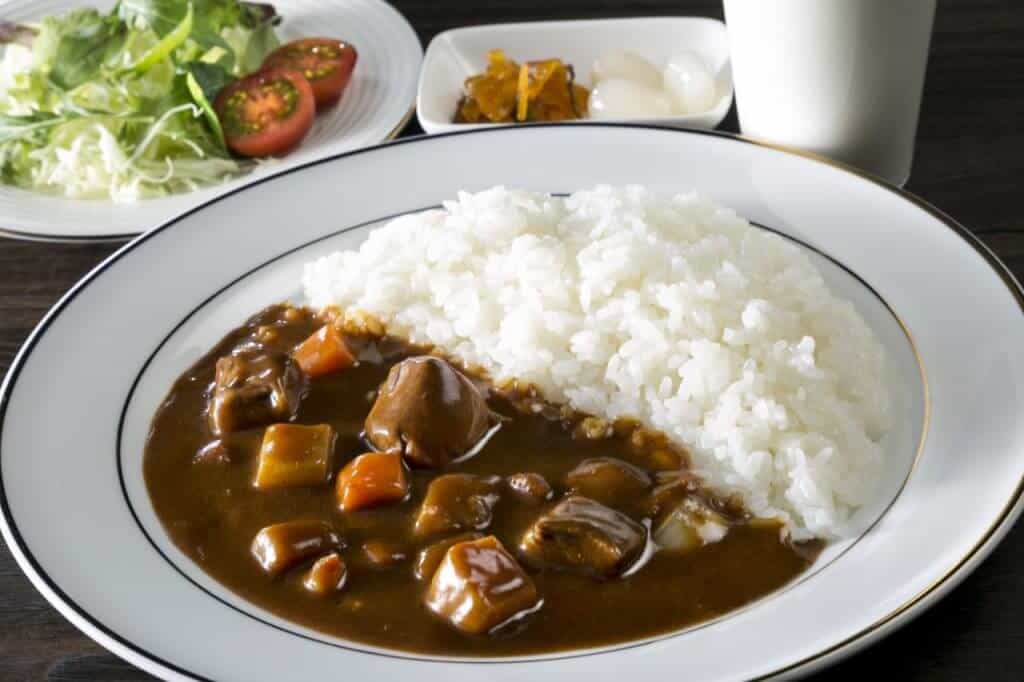
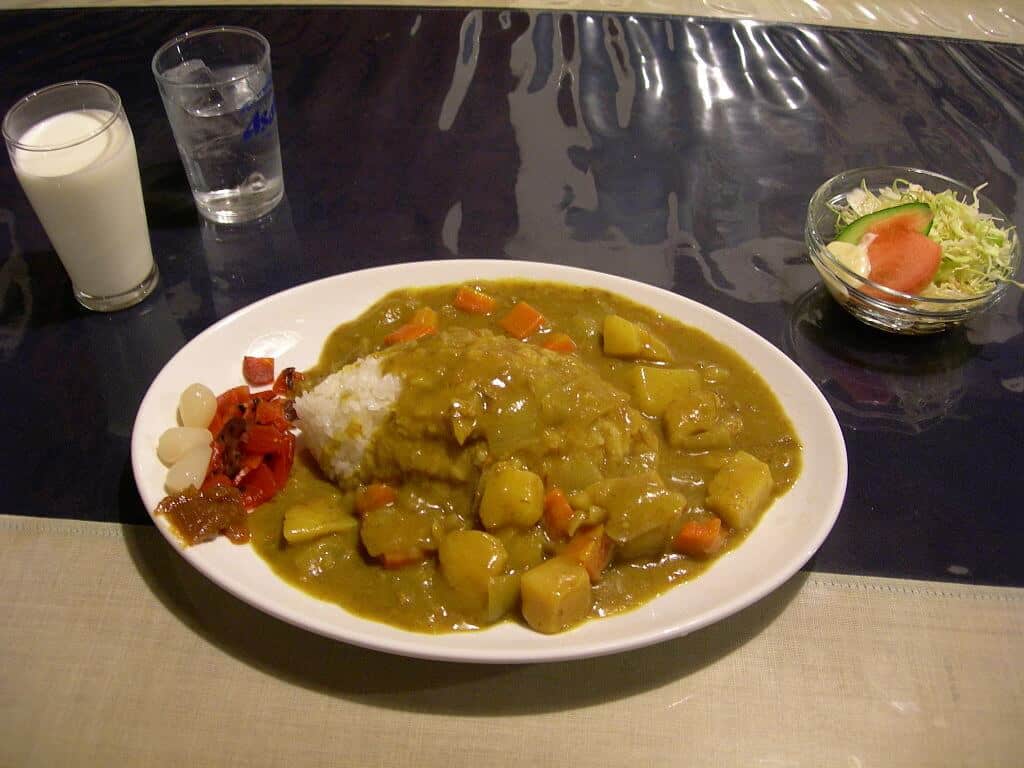
Order curry in Yokosuka, and something unexpected usually lands beside the plate. A cold glass of milk. In fact, Yokosuka Kaigun Curry is a Japanese curry rice dish with a paper trail. It follows a curry method recorded in the 1908 Kaigun Kappojutsu Sankosho, the former navy’s cooking manual. Certified restaurants in Yokosuka, Kanagawa, serve it with rice, salad, and milk.
Of course, that milk is not decoration. It belongs to the serving rule that defines the local brand today. Below you will find the official requirements, the history behind them, a home recipe, and current places to eat. For wider context on the region, our Kanagawa food guide also covers the prefecture’s other port-city dishes.
What Is Yokosuka Kaigun Curry?
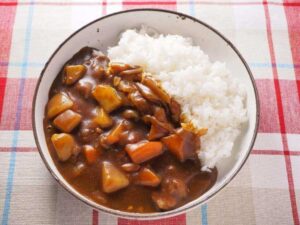
Yokosuka Kaigun Curry, also called Yokosuka Navy Curry, is a certified local curry rice dish from Yokosuka City in Kanagawa Prefecture, Japan. Cooks build the sauce from curry powder and wheat flour instead of a ready-made roux block. In addition, every certified serving arrives with a salad and a glass of milk.
Yokosuka Kaigun Curry Quick Facts
- Japanese name
- よこすか海軍カレー (Yokosuka Kaigun Curry)
- Also called
- Yokosuka Navy Curry
- Origin
- Yokosuka City, Kanagawa Prefecture
- Historical source
- Kaigun Kappojutsu Sankosho, the navy’s cooking reference book
- Date of source
- 1908 (Meiji 41)
- Typical flavor
- Mild, savory, flour-thickened, deliberately old-fashioned
- Main ingredients
- Curry powder, wheat flour, beef or chicken, carrot, onion, potato
- Required accompaniments
- Salad, milk, and chutney as a condiment
- Certification area
- Yokosuka City, in principle
- Nearest major stations
- Keikyu Yokosuka-Chuo, Keikyu Shioiri, JR Yokosuka
- Brand launched
- Curry Town Declaration, May 20, 1999
The name carries more weight than most visitors expect. Yokosuka City’s tourism office describes it as a registered trademark. So a navy-themed curry sold elsewhere is simply not the same product. In general, the dish is ordinary Japanese curry rice, one of the country’s everyday comfort plates. The rules around it, though, are unusually strict for a regional specialty.
Official Requirements for Yokosuka Kaigun Curry
Yokosuka City and the Curry Town Yokosuka Business Association publish the standard together. Specifically, the seven points below summarize what those official sources state.
- Restaurants base the dish on the cooking method recorded in the 1908 Kaigun Kappojutsu Sankosho.
- The recipe must include curry powder, wheat flour, meat (beef or chicken), carrot, onion, and potato.
- Cooks make the roux by toasting curry powder together with wheat flour.
- Kitchens add chutney, or an equivalent condiment, as a yakumi on the side.
- Every certified plate comes with a fresh salad and a glass of milk.
- In principle, only businesses inside Yokosuka City may serve it.
- Businesses must join the Curry Town Yokosuka Business Association and pass a product review before using the name.
Certification is an administrative process rather than a taste contest. First, shops join the association. Then they submit a menu item or product and wait for the review. So the mark tells you the kitchen follows the rules, yet each cook still seasons to their own judgment. That is why two certified plates on the same street can taste noticeably different.
History of Yokosuka Kaigun Curry
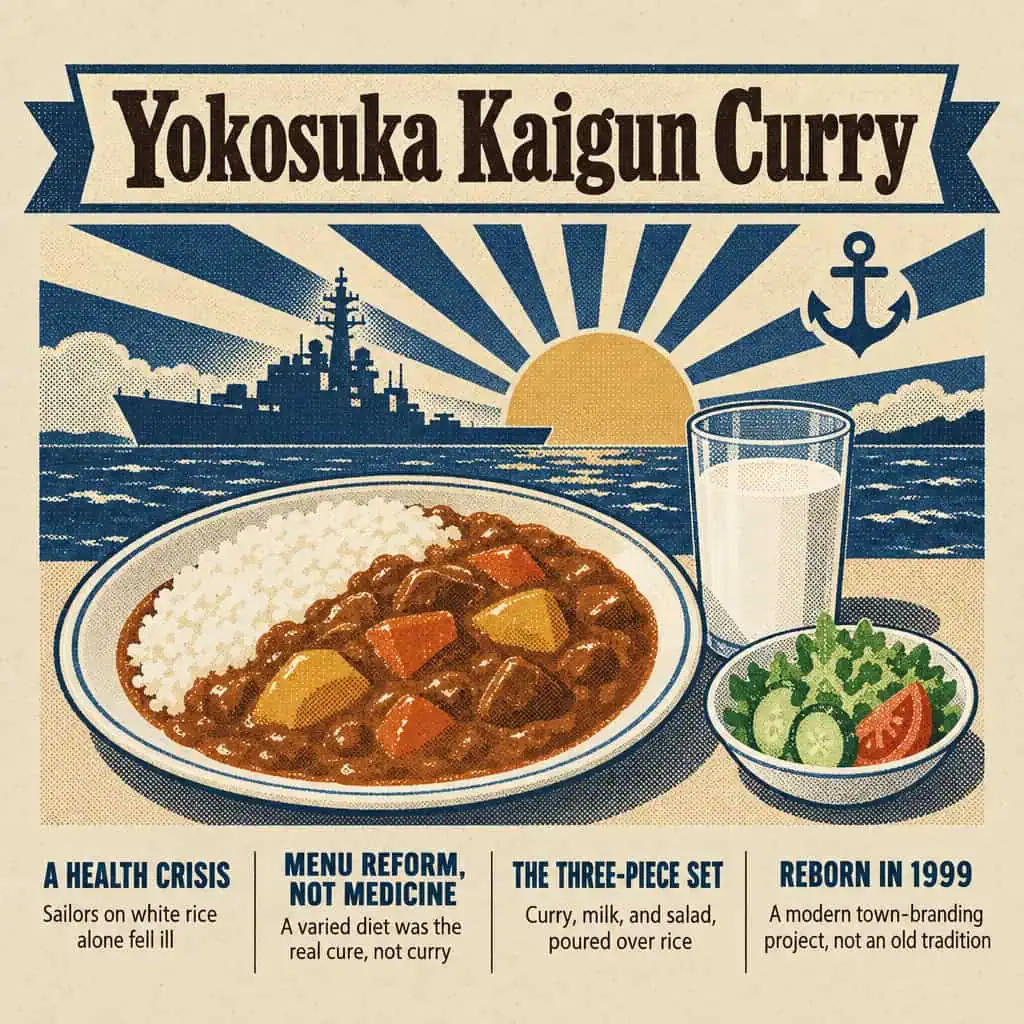
Japan’s navy faced a serious health crisis during the 1880s. Beriberi spread among sailors because they lived mainly on polished white rice. Naval medical officer Takaki Kanehiro compared Japanese crews with Western ones, then pushed for a more varied diet. Writing in the Journal of the Royal Society of Medicine, Sugiyama and Seita describe how those reforms cut the disease dramatically.
Later, science identified thiamine deficiency as the real cause. Curry itself never cured or prevented anything. Instead, it fitted neatly into the broader menu reform. A thick British-style stew fed many people from one pot, and it poured well over rice. In 1908 the navy published the Kaigun Kappojutsu Sankosho, usually rendered in English as the Navy Cooking Reference Book. Alongside dozens of other shipboard dishes, that manual also recorded a curry method.
How Yokosuka Navy Curry Became a Local Specialty
The modern dish is a town-branding project, not an unbroken tradition. In December 1998, at a Maritime Self-Defense Force event in Yokosuka, a senior officer suggested that Japan’s curry story began with the navy. Yokosuka City, the local Chamber of Commerce, and the JMSDF then discussed how to use that idea. On May 20, 1999, the city issued its Curry Town Declaration.
Trademark registration followed in 2000, and the network grew steadily after that. At first, the project involved about fifteen cooperating companies. By 2025 the association counted roughly one hundred registered businesses, including more than forty certified restaurants. Yokosuka Kaigun Curry therefore preserves one influential chapter in the history of Japanese curry, rather than the whole story.
Timeline: Five Moments Behind the Dish
- 1880sNaval dietary reform under Takaki Kanehiro sharply reduces beriberi at sea.
- 1908The navy publishes the Kaigun Kappojutsu Sankosho, which records a curry method.
- Dec 1998A proposal at a JMSDF gathering sparks the local curry project.
- May 20, 1999Yokosuka issues the Curry Town Declaration.
- 2000 onwardTrademark registration leads to certified shops, festivals, and retort souvenirs.
Kaigun Curry, Everyday Curry Rice, and JMSDF Curry Compared
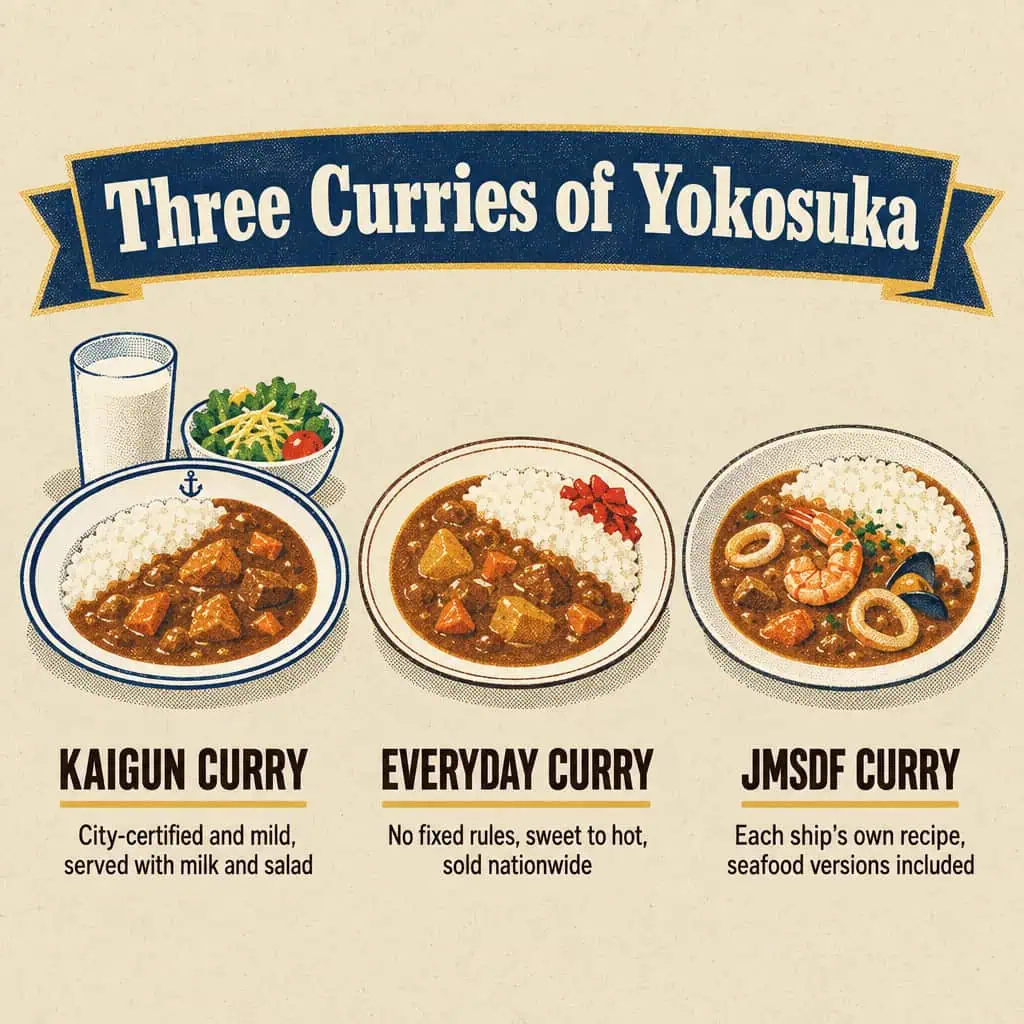
Three similar-looking plates circulate in Yokosuka, and shops often sell them side by side. Confusing them is easy, so the table below sets out the practical differences.
| Point | Yokosuka Kaigun Curry | Everyday Japanese curry rice | Yokosuka JMSDF Curry |
|---|---|---|---|
| Historical basis | 1908 navy manual | Meiji-era Western cooking, then home cooking | Recipes used on today’s vessels |
| Recipe ownership | City brand with published rules | No owner | Individual ships and units |
| Roux | Curry powder toasted with flour | Usually a commercial roux block | Varies by ship |
| Flavor | Mild, savory, old-fashioned | Sweet to medium-hot | Ranges widely, including seafood versions |
| Serving style | Rice, salad, milk, chutney | Rice and pickles | Follows each shop’s presentation |
| Certification | Association review required | None | Approved through the JMSDF program |
| Availability | Yokosuka City, in principle | Nationwide | Participating Yokosuka shops |
The distinction is genuine rather than cosmetic. Kaigun Curry, for example, reconstructs a historical recipe tradition from one printed source. In contrast, Yokosuka JMSDF Curry works differently: local restaurants reproduce recipes from individual modern ships and units. The program began in 2015 with sixteen certified shops. Yokosuka City then relaunched it on November 22, 2025 with nineteen varieties. Nineteen distinct curries obviously cannot share one identical formula.
Why Is It Called Navy Curry?
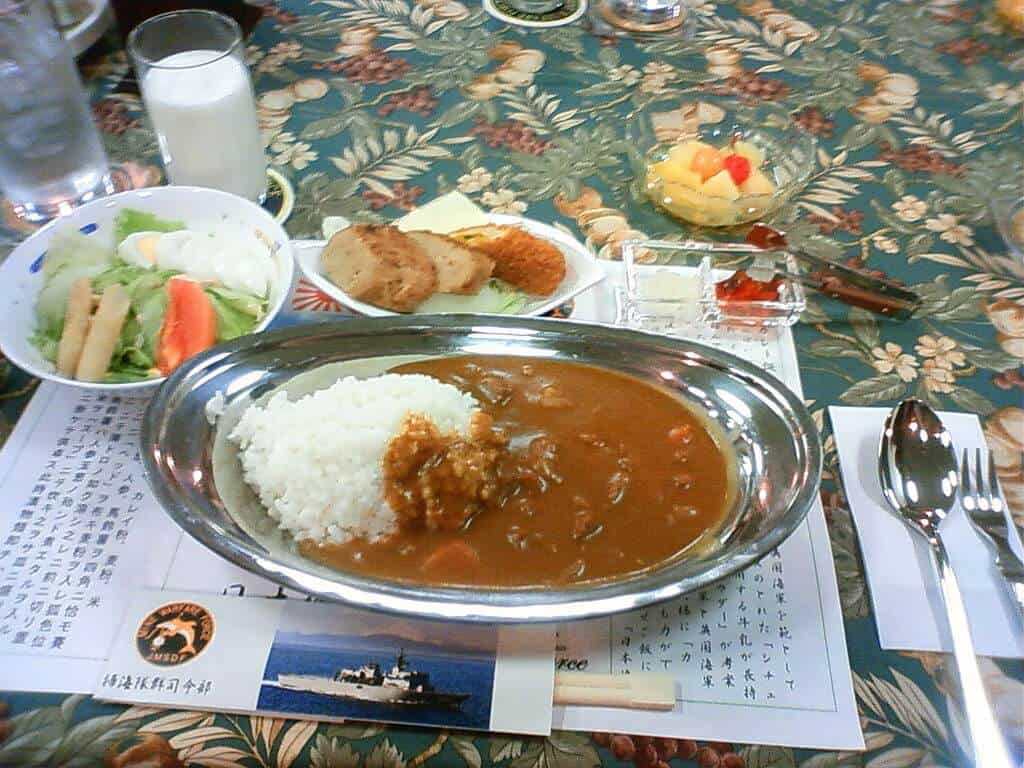
The modern local dish reconstructs curry associated with the former Japanese navy. It also draws on the curry method printed in the 1908 Kaigun Kappojutsu Sankosho. The name then entered everyday use through the city-branding initiative that began in 1999. Yokosuka has hosted naval facilities since the nineteenth century, so the label reflects the town’s own identity too.
What Does Yokosuka Navy Curry Taste Like?
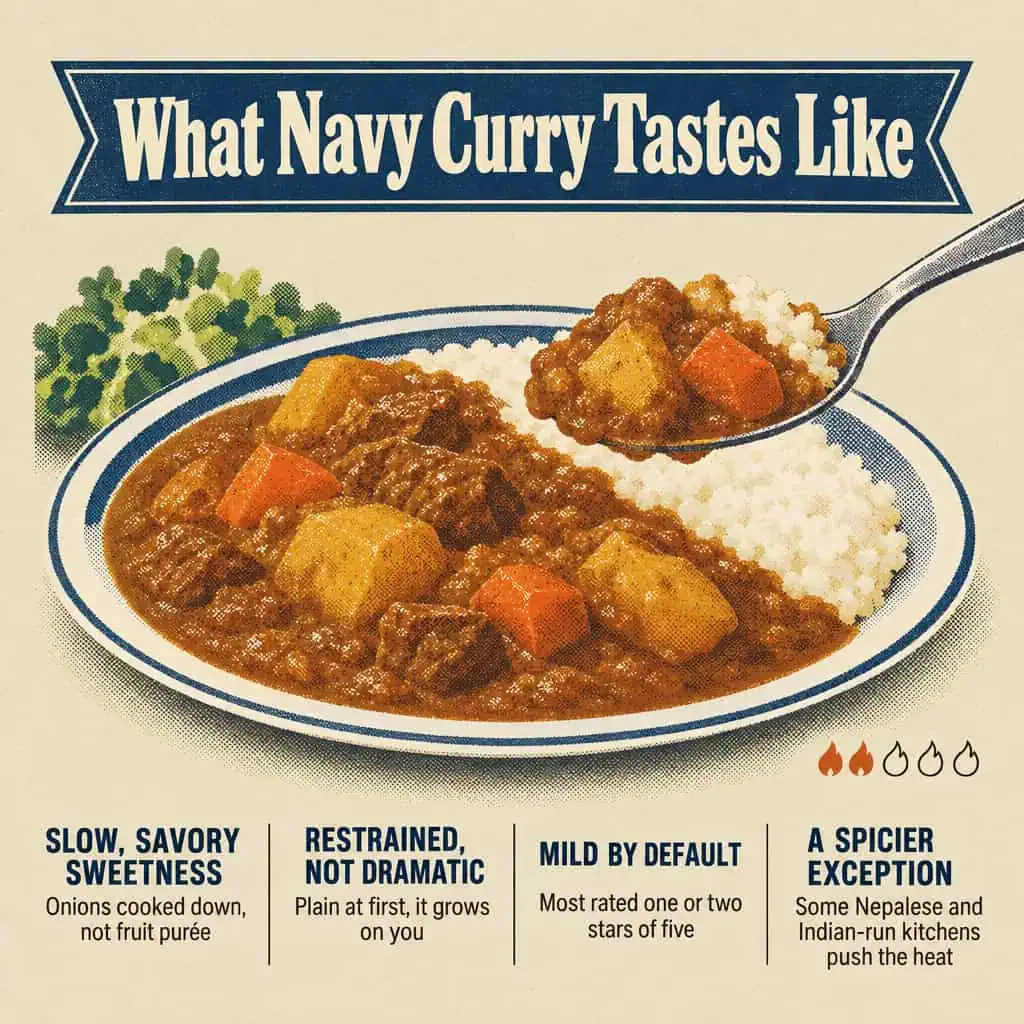
Think restrained rather than dramatic. Golden-brown and flour-thickened, the sauce carries a savory warmth that builds slowly. Sweetness usually comes from onions cooked down patiently, not from fruit purée. Meat and root vegetables hold their shape, which gives each spoonful a pleasant sense of substance.
Some visitors find it plain at first, and that reaction is fair enough. Modern Japanese curry, by comparison, is richer and glossier. Still, the understated quality tends to grow on people by the halfway point. Sweetness, spice level, meat choice, and texture all vary by restaurant, so no single description fits every certified plate.
Is Yokosuka Navy Curry Spicy?
Usually, no. Most certified versions sit at the mild end. The official shop directory, for example, rates many of them at one or two stars out of five. A few kitchens do push the spice higher, especially those run by Nepalese or Indian chefs. Ask before ordering if you are sensitive to heat.
Why Is Milk Served with Navy Curry?
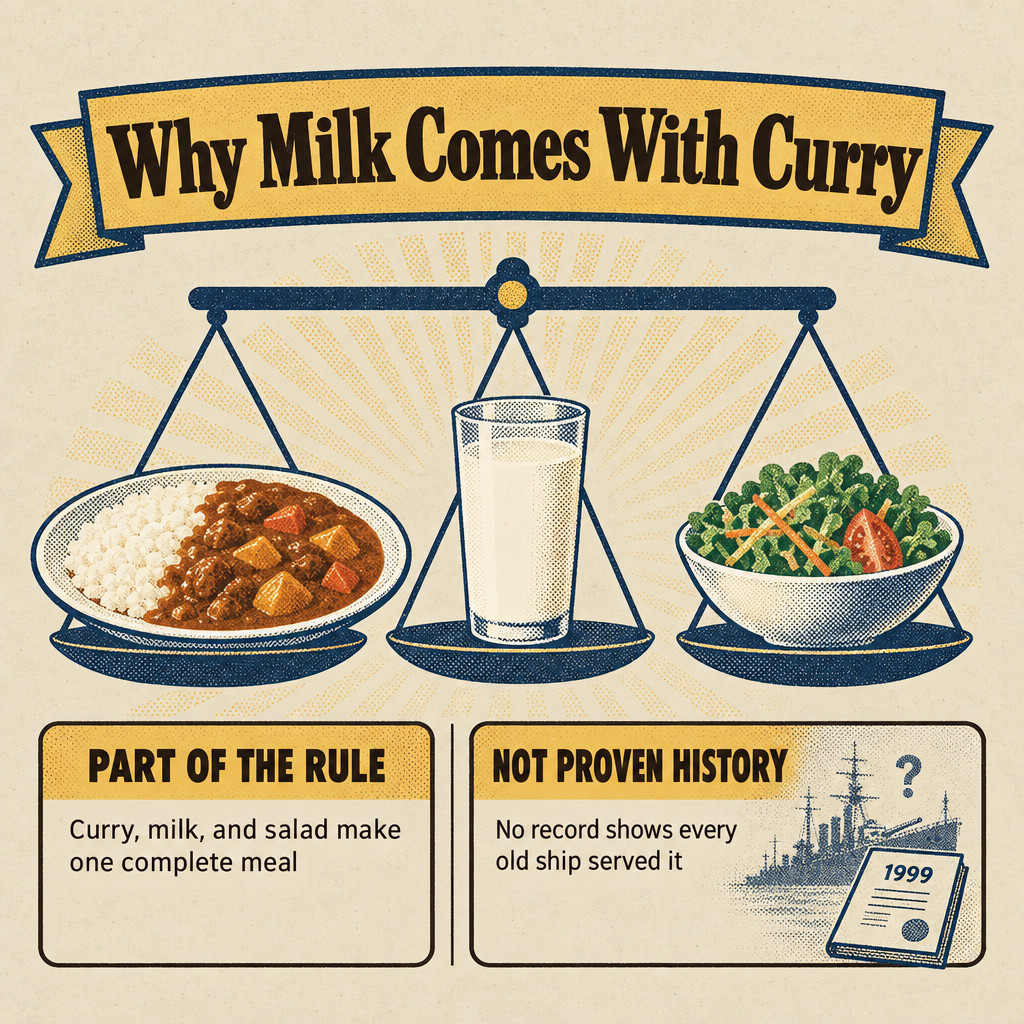
Milk and salad form part of the modern certified serving standard. Yokosuka City and its tourism office both describe the three-part set as the basic rule. Nutritional balance is the official reason. In other words, the combination turns a single plate into a complete meal.
It is tempting to read the milk as a direct survival from Meiji-era ships. However, no primary source that we could find confirms that every historical naval serving included it. The honest answer is narrower. In short, milk belongs to the 1999 brand rules, which echo the navy’s nutritional thinking without copying a documented shipboard menu.
How to Make Yokosuka Kaigun Curry
This home version is an interpretation. It follows the historical method and the local serving rules, yet the quantities below reflect modern home cooking. Optional items such as prepared veal stock and measured umami seasoning did not appear in the 1908 source in this exact form.
Ingredients
| Ingredient | Amount for 6 servings |
|---|---|
| Cooked short-grain rice | 900 g (150 g per plate) |
| Beef, stewing cut | 300 g |
| Potato, peeled | 400 g |
| Carrot | 250 g |
| Onion | 500 g |
| Beef fat (tallow) | 140 g, split into two 70 g portions |
| Wheat flour | 37 g |
| Curry powder | 90 g |
| Fond de veau (prepared veal stock) | 1,200 ml |
| Salt | 2.5 g, plus more to taste |
| Black pepper | To taste; the historical source gives no amount |
| Chutney | 9 g in the sauce, plus extra to serve |
| Umami seasoning (optional) | 20 g, or simply use salt to taste |
| Fukujinzuke pickles | To serve |
| Green salad and cold milk | 1 portion of each per person |
Two ingredients need a word of explanation. Fond de veau simply means prepared veal stock, sold chilled or in cartons at larger supermarkets. Unsalted beef stock works as a modern home-cook substitute, though the finished sauce tastes a little lighter. We also removed a vague seasoning that older versions of this recipe listed. Nobody could identify the intended commercial product, so salt does the job instead. For the pickles, see our guide to fukujinzuke.
Method
- Prepare the ingredients. Dice the potato and carrot into 5 mm cubes. Soak the potato briefly, then drain it. Slice the onion and chop the beef fat small.
- Season the beef. Cut the beef into bite-size pieces. Sprinkle it lightly with salt and pepper.
- Sauté the onion. Melt 70 g of beef fat over medium heat. Lower the heat if it starts to smoke. Then add the onion and cook for three minutes.
- Brown the beef. Add the seasoned beef and stir until the surfaces color.
- Cook the vegetables. Add the potato and carrot, then sauté for two minutes over medium-high heat. Reduce to medium and continue for five more minutes.
- Add the stock. Pour in the fond de veau and bring it to a boil.
- Skim the surface. Lower the heat and simmer for twenty minutes. Meanwhile, skim off any foam or impurities that rise to the surface.
- Make the roux. Melt the remaining 70 g of beef fat in a frying pan over low heat. Stir in the flour and cook until it bubbles and turns light brown. Next, add the curry powder and stir gently until the mixture thickens.
- Combine and simmer. Ladle a little hot stock into the roux, whisk it smooth, then stir everything back into the pot.
- Adjust the seasoning. Season with salt, pepper, the 9 g of chutney, and the optional umami seasoning. Taste as you go.
- Serve with salad and milk. Plate the rice, pour the curry beside it, then add chutney and fukujinzuke. Finally, set out a green salad and a glass of cold milk.
Cook’s Notes and Storage
Choose firm potatoes and sweet onions, since the sauce carries very little else. Never heat the fat until the pan smokes; medium heat is safer and gives a cleaner flavor. Cool leftovers quickly, refrigerate them within two hours, and eat within two days. Reheat thoroughly while stirring, adding a splash of water if the sauce has tightened overnight.
Best Places to Eat Yokosuka Kaigun Curry
Check before you travel. Business hours, closing days, and sell-out times change often. So open each restaurant’s official page or social account on the morning of your visit. Last checked: September 2026.
Wood Island Curry Restaurant
Choose this one if you want the veteran benchmark. The shop has traded on the same corner for more than forty years, and it won the first Yokosuka Curry Festival popularity contest. The curry uses a beef base, rates two stars out of five for heat, and comes with salad and milk. Nearest station: Yokosuka-Chuo or Shioiri, roughly eleven minutes on foot. Typical spend: ¥1,000–1,999. Hours: 11:30–19:00, closed Tuesday and Wednesday. Certified shop; retort pouches on sale in store. Official listing.
Gyorantei
Come here for the historical footnote. Gyorantei carries the line of Yokosuka’s first certified Kaigun Curry shop, and the current specialist restaurant keeps that name alive. The official directory also rates its heat at one star, highlighting a sweeter beef roux with generous chunks. Nearest station: Yokosuka-Chuo. Hours and prices: confirm on the official page, since the listing does not publish them. Certified shop. Vegetarian options: ask directly, because the base uses beef. Official listing.
Yokosuka Kaigun Curry Honpo
Pick this shop if souvenirs matter as much as lunch. The kitchen reproduces the standard recipe closely and cooks each element separately, which keeps the vegetables distinct. Heat rating: two stars. Nearest station: Yokosuka-Chuo, a short walk away. Hours and prices: check the official page before travel. Certified shop, with a retail counter selling retort pouches and gift boxes. Vegetarian options: limited, so confirm the stock and the roux in advance. Official listing.
TSUNAMI
Head here when you want two Yokosuka specialties in one sitting. TSUNAMI sits on Dobuita Street and also serves the city’s famous Yokosuka Navy Burger. The official directory describes a European-style sauce built over two days from beef, vegetables, fruit, wine, and thirty spices. Heat rating: three stars. Nearest station: Shioiri or JR Yokosuka. Hours and prices: confirm on the official page. Weekend queues are common. Official listing.
Dobuita Shokudo Perry
Try this diner for a slightly sharper take. The official directory calls it a by-the-book Kaigun Curry with a noticeable kick, rated four stars for heat. That makes it a useful contrast if you have already eaten a milder version elsewhere. Nearest station: Shioiri or JR Yokosuka, inside the Dobuita Street strip. Hours and prices: check the official page. Certified shop. Vegetarian options: unlikely, so ask about the stock. Official listing.
Where to Buy Yokosuka Navy Curry Souvenirs
Retort pouches are the obvious gift, and they certainly travel well. Boxed assortments pair several shops’ recipes in one carton, while bakeries around Kurihama and Shioiri sell certified curry bread for the train home. You will find stock in restaurant retail counters and in department stores near Yokosuka-Chuo. Souvenir shops at the entrance to Dobuita Street also carry it, as does the Coaska Bayside Stores complex.
Check the packaging before you pay. Look for the official brand wording and the association’s mark. Then check the manufacturer details, the allergen list, the meat or stock ingredients, and the expiry date. One more caution: the same shelf usually carries Yokosuka JMSDF Curry products too. Both are legitimate local souvenirs, but they follow different recipe concepts, so read the label rather than the ship illustration.
How to Visit Yokosuka for Navy Curry
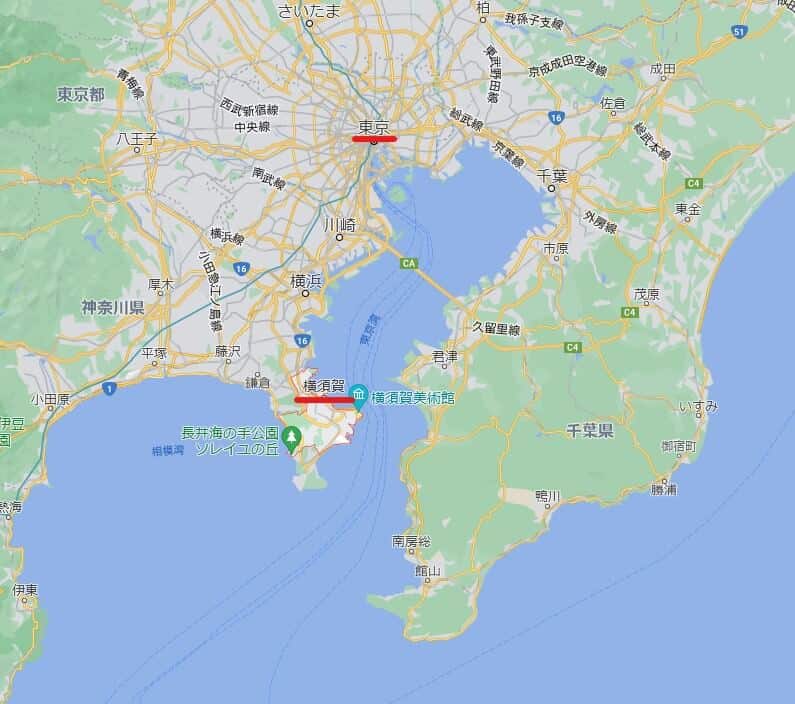
To try an officially certified serving, travel to Yokosuka, an accessible day-trip destination from central Tokyo. The Keikyu Main Line runs from Shinagawa. Meanwhile, the JR Yokosuka Line runs from Tokyo Station. According to the Japan National Tourism Organization, both routes take roughly an hour.
Station choice matters more than line choice. Yokosuka-Chuo puts you in the commercial center, close to most certified restaurants. Shioiri sits nearest the western end of Dobuita Street and the waterfront. JR Yokosuka station opens onto Verny Park and the naval port, so it suits a harbor-first plan. Dobuita Street itself runs only about 300 meters, which makes comparing two shops in one afternoon realistic.
Curry pairs easily with nearby sights. Mikasa Park, the naval port cruise, and Verny Park all sit within walking distance of one station or another. Check a railway journey planner on the day itself, because timings shift with service disruptions and transfers. Note the last return train before you order a second plate.
Allergens, Dietary Needs, and Nutrition
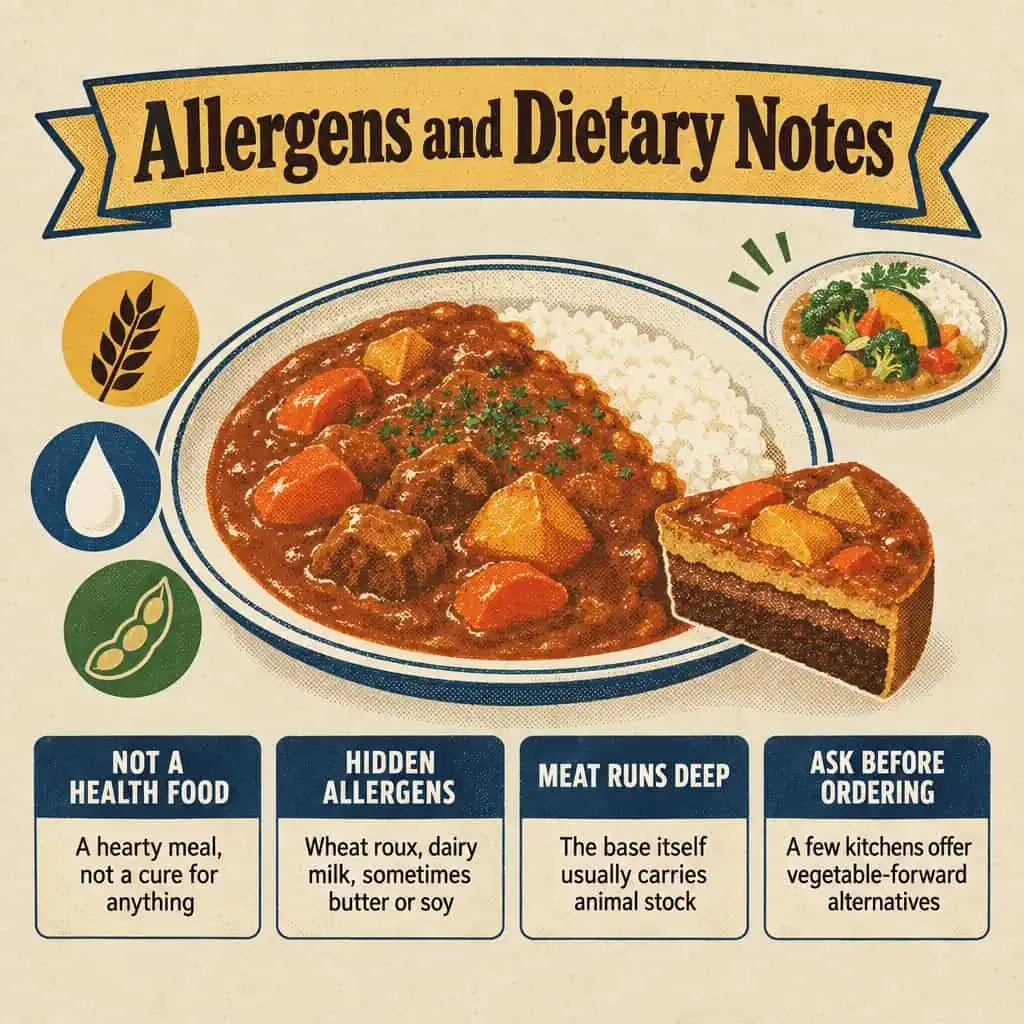
Curry spices and vegetables can contribute flavor and nutrients. However, the nutritional profile depends on the ingredients, portion size, fat, and sodium content. Treat it as a satisfying meal rather than a health food, and ignore claims that any spice treats a medical condition.
Allergens deserve a moment of attention. The roux contains wheat, and the serving rule adds dairy in the milk. Butter appears in some kitchens too. In addition, commercial seasonings and condiments may contain soy or other allergens. Confirm ingredients directly with the restaurant, especially if you react strongly to gluten or dairy.
Vegetarian and Vegan Guidance
Traditional and restaurant versions often contain beef, chicken, pork, beef fat, veal stock, or other animal-based stock. Visible meat pieces are not a reliable signal, because the base itself usually carries the animal ingredients. So ask about the roux, the stock, the toppings, shared cookware, and the side dishes. A few shops run by South Asian chefs offer vegetable-forward alternatives, though these may fall outside the certified standard.
Conclusion
Yokosuka Kaigun Curry rewards anyone curious about Japanese curry, maritime food history, or Kanagawa cuisine. In short, its defining feature is not heat but presentation. Rice, salad, and a glass of milk arrive together under published rules. Use the verified restaurant list above for a day trip, or cook the home version if Yokosuka is out of reach. Either way, explore other Japanese curry dishes next.
Frequently Asked Questions About Yokosuka Kaigun Curry
What is Yokosuka Kaigun Curry?
It is a certified local curry rice dish from Yokosuka City in Kanagawa Prefecture. Cooks follow a curry method recorded in the 1908 navy cooking manual. The sauce uses curry powder and wheat flour instead of a roux block. In addition, certified restaurants always add a salad and a glass of milk.
How old is the dish?
The source is old, but the brand is not. The navy published its cooking reference book in 1908. Yokosuka then revived the recipe as a town project and declared itself a curry town on May 20, 1999. So the plate you order today dates from the late 1990s.
What does it taste like?
Mild, savory, and gently sweet from slow-cooked onions. The flour-based roux gives a smooth, slightly heavy texture. Vegetables and meat stay chunky rather than dissolving. Flavor varies between shops, though, so two certified plates rarely taste identical.
Is Yokosuka Navy Curry spicy?
Usually, no. The official directory rates most certified versions at one or two stars out of five. A handful of kitchens go hotter, especially those with Nepalese or Indian chefs. So ask the staff if heat is a concern for you.
Why is milk served with navy curry?
Milk and salad belong to the modern certified serving standard. Yokosuka City describes the three-part set as the basic rule, and nutritional balance is the stated reason. However, no primary source confirms that every historical naval serving included milk. Treat it as a 1999 brand rule with a historical echo.
How does a restaurant get certified?
The name is a registered trademark. First, a business joins the Curry Town Yokosuka Business Association. Then it submits its dish or product for review. Once approved, the shop may use the name and display the mark. Simply cooking a navy-themed curry does not qualify.
How is it different from Yokosuka JMSDF Curry?
They are separate programs. Kaigun Curry reconstructs a historical recipe tradition from the 1908 manual. In contrast, JMSDF Curry reproduces recipes from individual modern ships and units. Yokosuka City relaunched that lineup on November 22, 2025 with nineteen varieties, which shows how much the two differ.
Where is the best area to eat it?
Two areas cover most visitors. Around Yokosuka-Chuo station you will find long-running specialists and the largest cluster of certified shops. Meanwhile, Dobuita Street near Shioiri mixes curry with burgers and American-style diners. Both sit within a short walk of each other.
Can I buy it as a souvenir?
Yes. Retort pouches, boxed assortments, and curry bread are widely available. Restaurant counters, department stores, and souvenir shops near the stations all stock them. Check the brand wording and the manufacturer details on the box, since JMSDF curry products sit on the same shelves.
How do I get to Yokosuka from Tokyo?
Take the Keikyu Main Line from Shinagawa, or the JR Yokosuka Line from Tokyo Station. The Japan National Tourism Organization puts both at roughly one hour. Yokosuka-Chuo suits restaurant hopping, while JR Yokosuka works better for the harbor. Check a journey planner on the day, because timings change.
Is there a vegetarian version?
Rarely, and never assume. Certified recipes normally use beef or chicken, plus beef fat or animal stock. Even a plate without visible meat may hide animal ingredients in the base. So ask about the roux, the stock, the toppings, and shared cookware before ordering.
Which allergens should I watch for?
Wheat sits in the flour-based roux, while dairy arrives with the milk or butter. Soy may also appear in commercial seasonings, chutney, and pickles. Menus in Japan do not always list allergens in English. So confirm the details with staff before you order.
Can I make it at home?
Yes, and the method above walks through eleven steps. The key difference from everyday home curry is the roux. Instead of melting a block, you toast curry powder with flour in beef fat. Finish the meal properly with salad and cold milk. Your version will be an interpretation, not a certified serving.
References
- Yokosuka City, よこすか海軍カレーとは?, city.yokosuka.kanagawa.jp (Accessed September 2026)
- Yokosuka City Tourism Information (Cocoyoko), よこすか海軍カレー, cocoyoko.net (Accessed September 2026)
- Curry Town Yokosuka Business Association, よこすか海軍カレー公式サイト ショップ検索, kaigun-curry.net (Accessed September 2026)
- Curry Town Yokosuka, よこすか海軍カレー・横須賀海上自衛隊カレー ガイドブック 2025 (PDF), cocoyoko.net (Accessed September 2026)
- Yokosuka City, 「横須賀海自カレー」をリニューアルします, prtimes.jp (Accessed September 2026)
- Ministry of Agriculture, Forestry and Fisheries, Yokosuka kaigun curry — Our Regional Cuisines, maff.go.jp (Accessed September 2026)
- Japan National Tourism Organization, Yokosuka, japan.travel (Accessed September 2026)
- Sugiyama, Y., & Seita, A. (2013). Kanehiro Takaki and the control of beriberi in the Japanese Navy. Journal of the Royal Society of Medicine, 106(8), 332–334. doi.org (Accessed September 2026)
- Itokawa, Y. (1976). Kanehiro Takaki (1849–1920): A biographical sketch. The Journal of Nutrition, 106(5), 581–588. doi.org (Accessed September 2026)
Related Articles
- A Dive into Japanese Curry: Flavors, Variations, and Comfort (Surveyed: September 2026)
- Kanagawa Food Guide (Surveyed: September 2026)
- Yokosuka Navy Burger (Surveyed: September 2026)
- Kanazawa Curry Guide (Surveyed: September 2026)
- Fukujin zuke — Japan’s Iconic Curry Pickle (Surveyed: September 2026)
- What to Eat in Yokohama (Surveyed: September 2026)
- Japanese Rice Dishes (Surveyed: September 2026)




Comments
List of comments (2)
There’s no cooking of the beef in your recipe.
In step 4, you state “add 1 and sauté to brown.”
Do you mean “add the beef and sauté to brown?”
Also, under Cooking Tips, there is a repetitive sentence, “If you are making fond de veau at home, you can add the used meat to the curry for more flavor. If you want to make fond de veau at home, you can add the used meat to the curry.”
Thank you.
I modified the part.
1 is the beef in step1