





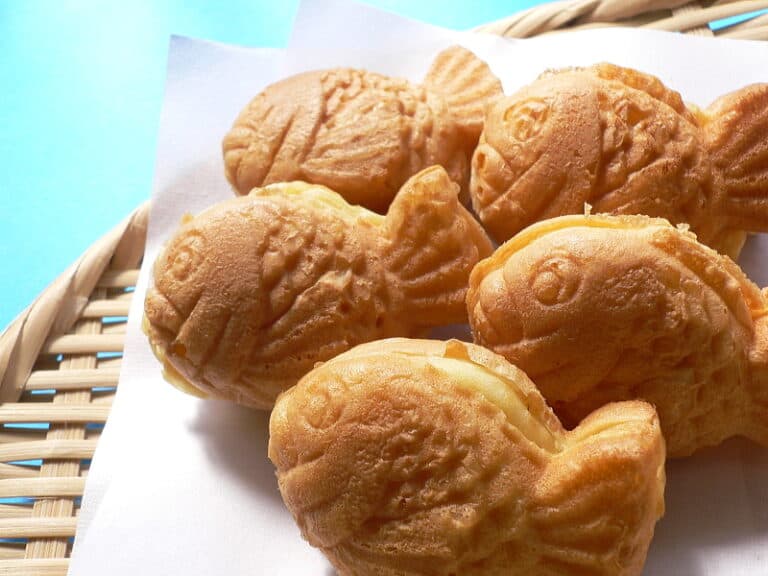
On a cold evening in Azabu-Juban, the queue outside one small Tokyo shop barely moves. Everyone is waiting for a hot cake shaped like a fish. Taiyaki is a fish-shaped Japanese street food dessert from Tokyo, filled with sweet azuki bean paste called anko.
This guide explains what taiyaki tastes like, where its curious shape came from, and how it differs from imagawayaki. It also covers prices, fillings, allergens, and a simple home recipe. Then it lists the Tokyo shops that are genuinely worth the wait.
What Is Taiyaki?
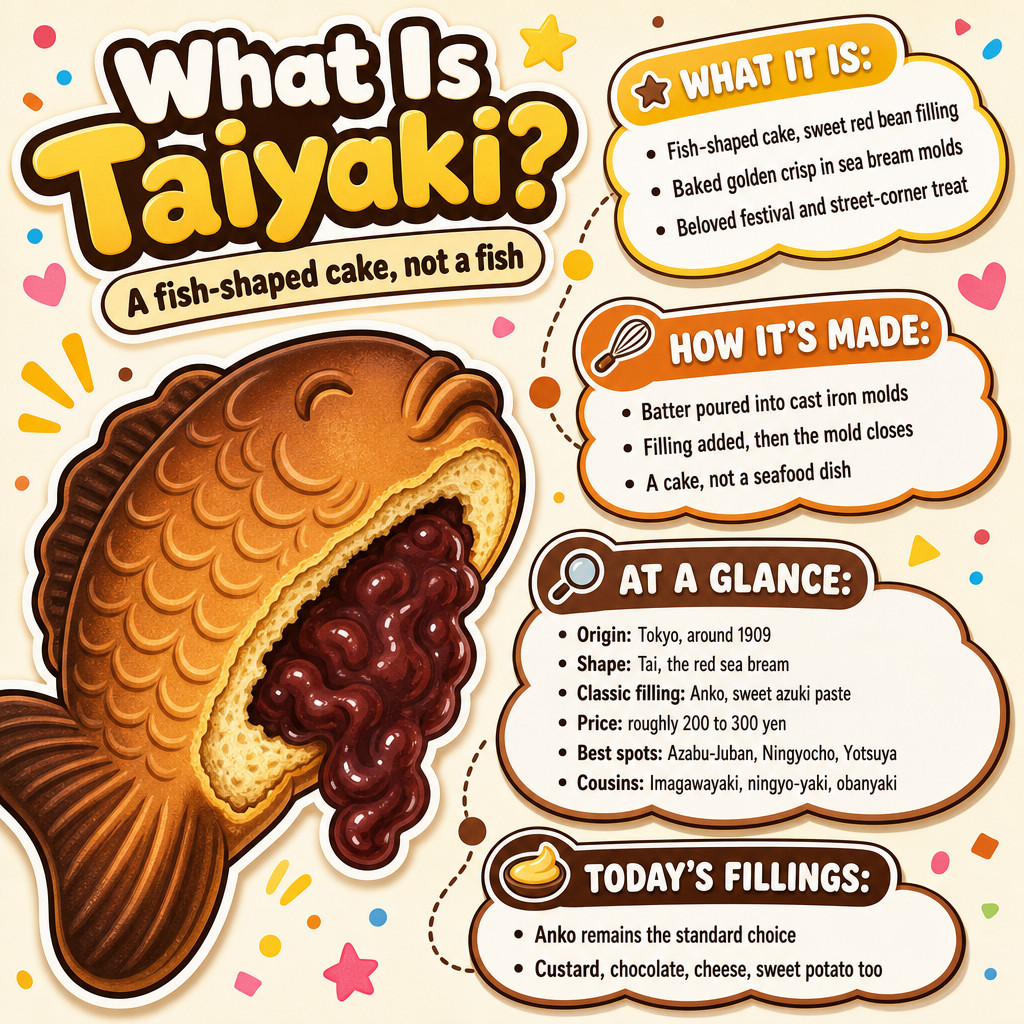
Taiyaki is a fish-shaped cake filled with sweet red bean paste. Shops bake it in sea bream-shaped molds until the outside turns golden and crisp. It is especially popular at Japanese festivals, shopping streets, and old Tokyo sweet shops.
Vendors pour the batter into cast iron molds, add the filling, and close the lid. Because the shape looks so unusual, first-time visitors often stop and stare before buying one. Despite that fish silhouette, taiyaki is a sweet cake, not a seafood dish.
It also counts as one of Japan’s most popular street snacks. Additionally, you can find it at festivals, shopping streets, and many sweet shops in Tokyo. Prices stay low, so it suits a quick stop between sightseeing.
Taiyaki at a Glance
- Origin: Tokyo, around 1909
- Shape: Tai, the red sea bream
- Classic filling: Anko, or sweet azuki paste
- Typical price: Roughly 200 to 300 yen per piece
- Best place to try: Azabu-Juban, Ningyocho, and Yotsuya
- Similar sweets: Imagawayaki, ningyo-yaki, and obanyaki
Anko remains the standard filling, though shops now offer plenty of alternatives. Custard, chocolate, cheese, and sweet potato all appear on menus nowadays. A few stalls even sell savoury versions with okonomiyaki batter or a sausage tucked inside.
What Does Taiyaki Taste Like?
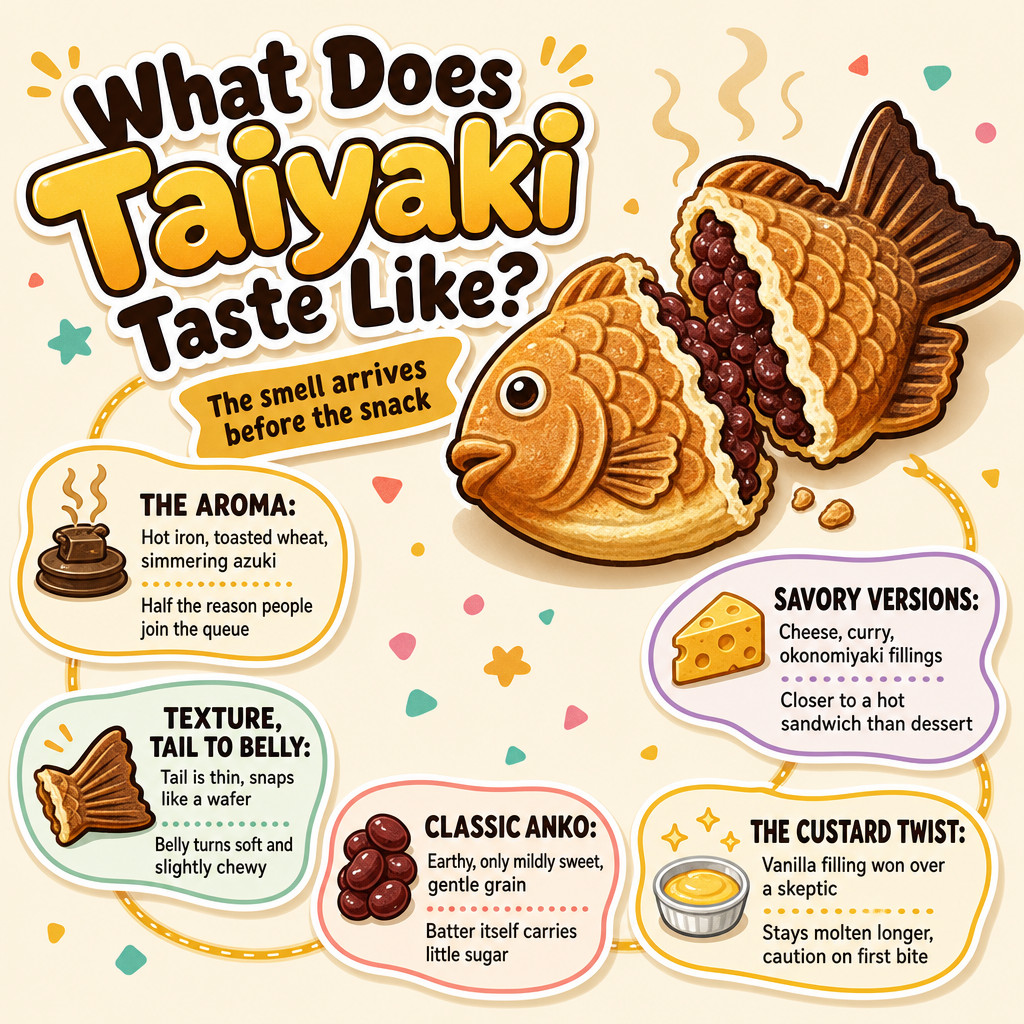
The smell arrives before the snack does. Hot iron, toasted wheat, and simmering azuki drift down the street simultaneously. That aroma is honestly half the reason people join the queue.
Most people start at the tail, since the batter is thinnest there. It snaps like a wafer. Move toward the belly, however, and the texture turns soft and slightly chewy.
Inside, warm anko tastes earthy and only mildly sweet. Bits of azuki skin also give it a gentle grain. Because the batter itself carries little sugar, a whole piece rarely feels heavy.
I hesitated the first time I ordered a custard one, since it felt like a small betrayal of the classic. Still, on a cold evening in Tokyo, the vanilla filling won me over. Custard also stays molten far longer than anko, so be careful with the first bite.
Savoury versions taste completely different. Cheese, curry, or okonomiyaki fillings instead turn the cake into something closer to a hot sandwich. Treat those as a light meal rather than a dessert.
How to Order Like a Local
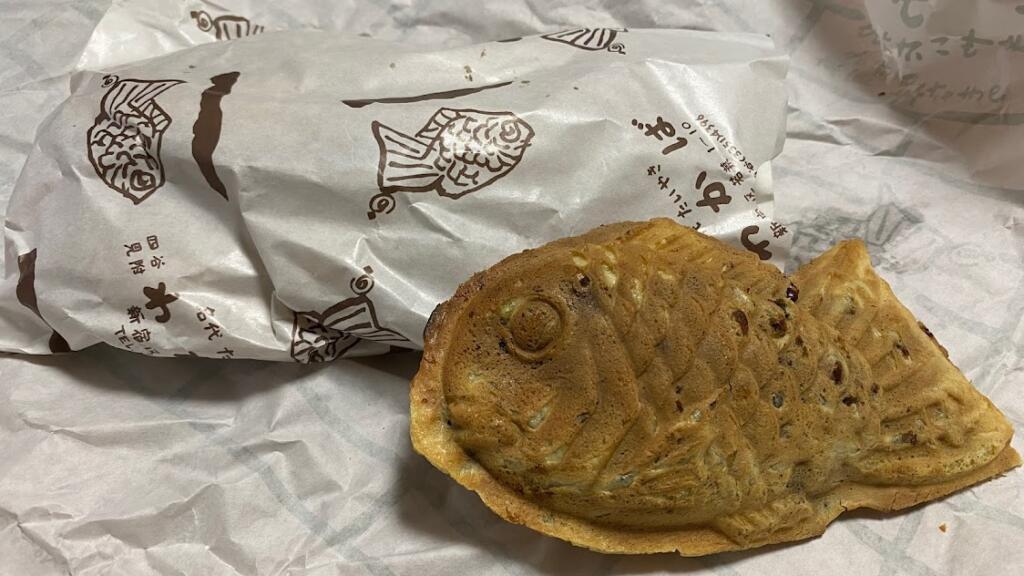
Two small choices shape the whole experience. First, shops may ask about the paste: tsubuan keeps the bean skins, whereas koshian is strained smooth. Second, some counters offer usukawa, a thin crisp skin, alongside atsukawa, a thicker cakey one.
Timing matters too. Taiyaki sells all year, yet demand peaks between autumn and early spring, when a hot snack feels welcome. Seasonal pastes such as sakura arrive around March, so the menu shifts quietly through the year.
Etymology: Why a Fish Shape?
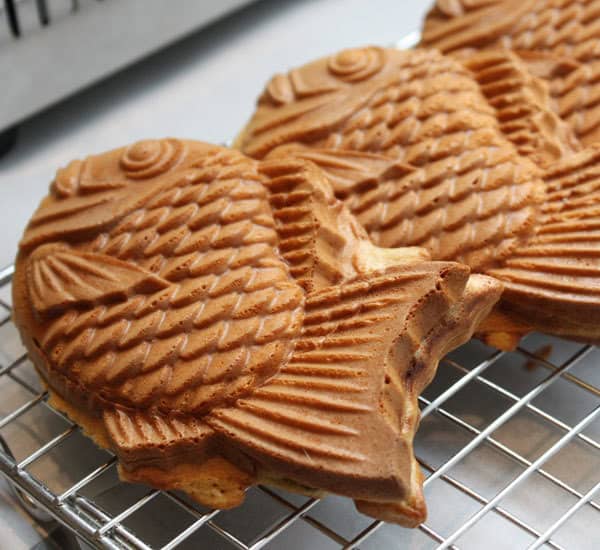
Japanese writes the word as たい焼き. The “tai” in taiyaki means sea bream, the lucky fish that inspired its shape. “Yaki”, meanwhile, simply means baked or grilled. Its batter and cooking style make it similar to a stuffed waffle.
Why Sea Bream Means Good Luck
A neat piece of wordplay sits behind the design. The adjective medetai means joyful or auspicious, and it hides the word tai inside. Thanks to that pun, the fish became a fixture at weddings, New Year meals, and birth celebrations.
Japan’s Fisheries Agency notes that a whole sea bream, head and tail intact, still appears at coming-of-age ceremonies and weddings. Ebisu, the god of fortune, also carries a tai in almost every image. Its red colour helped too, since red traditionally keeps misfortune away.
Real sea bream cost a great deal, though. Ordinary families therefore rarely tasted it. So a cheap cake in that shape offered a small piece of luck, and the idea caught on quickly.
The History of Taiyaki
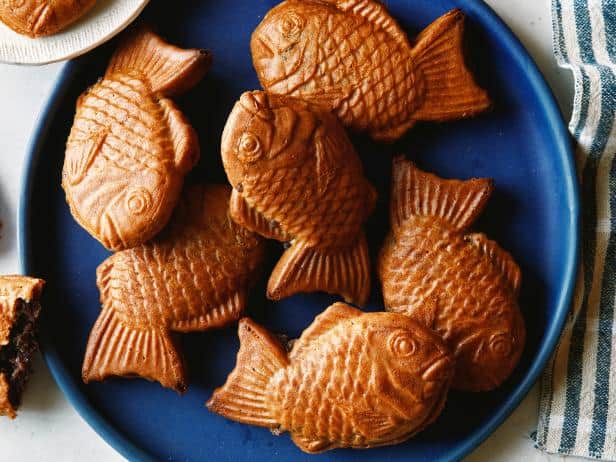
A Tokyo Shop and the Year 1909
A Tokyo shop first sold taiyaki in 1909, according to the most widely repeated account. Its founder, Seijiro Kanbe, came from the Kansai region and opened a cheap eatery in central Tokyo. He began with Imagawa Yaki, the round filled pancake that later inspired the fish version.
Sales went badly at first. He then tried a turtle-shaped cake, and that flopped as well. After switching to a sea bream mold, however, the snack sold quickly, and the business grew into Naniwaya Sohonten in Azabu-Juban.
How Taiyaki Travelled
Japanese influence brought taiyaki-style fish cakes to Korea during the colonial period. Locals there call them bungeo-ppang, and the snack still sells well every winter. Similar cakes later appeared in Taiwan, and postwar migration carried the idea to the United States.
Modern and Regional Variations
Meanwhile, the recipe kept evolving at home. Bakers tried croissant dough, pale mochi-like skins, and open versions topped with soft ice cream. Sizes changed too, so festival pieces now range from palm-sized to enormous.
Regional habits differ as well. Many Kansai shops sell the round obanyaki instead of the fish. On Tsushima island, one local style curves the tail, which makes the cake look as though it is swimming.
Taiyaki Ingredients: Batter, Anko, and Popular Fillings
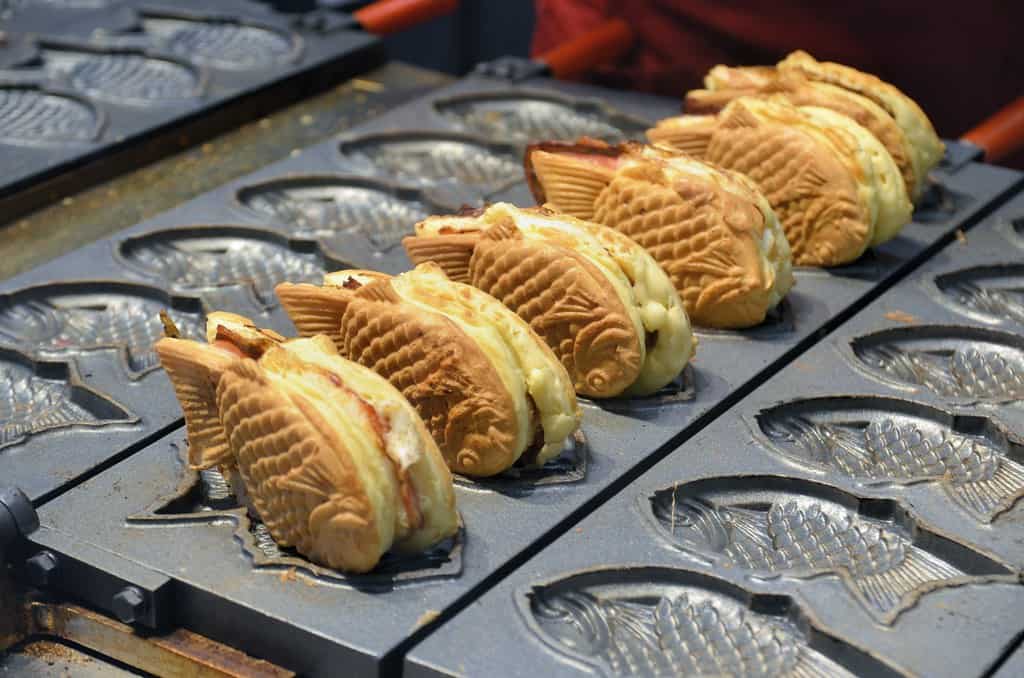
The batter list stays short. Wheat flour, sugar, egg, milk, and a raising agent basically do all the work. Old shops keep it even simpler, since flour, baking soda, sugar, salt, and water are enough.
Anko carries the flavour instead of the batter. Naniwaya, for example, simmers Tokachi azuki from Hokkaido in a single batch each morning. Because bean paste loses aroma overnight, several old shops refuse to sell yesterday’s stock.
Popular Taiyaki Fillings
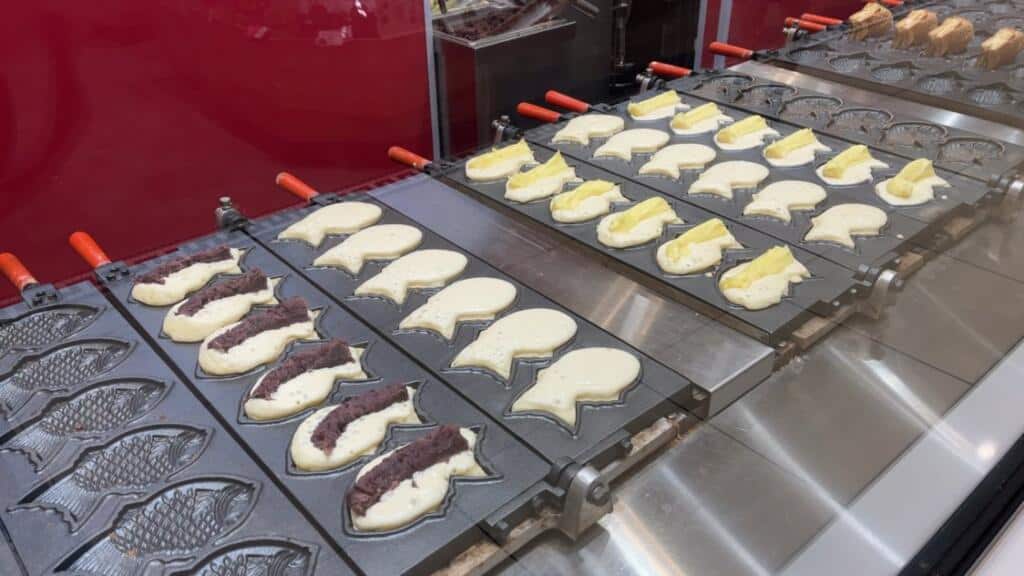
- Anko: the classic bean paste filling, smooth or chunky
- Custard: soft vanilla cream, the usual second choice
- Chocolate: rich and popular with children
- Cheese cream: tangy, closer to Western confectionery
- Sweet potato: an autumn favourite across Japan
- Okonomiyaki: savoury cabbage and sauce filling
- Sausage: a meal-style option sold at some stalls
Seasonal flavours appear as well. Sakura bean paste shows up in spring, whereas chestnut and sweet potato take over in autumn. Some shops sell frozen packs, so you can keep a small collection at home.
Home Recipe Ingredients
| Ingredient | Amount |
|---|---|
| Cake flour | 1 1/4 cup |
| Baking powder | 1 tsp |
| Baking soda | 1 tsp |
| Large egg | 1 |
| Whole milk | 3/4 cup |
| Sugar | 3 tbsp |
| Red bean paste or anko | 5 tbsp |
| Oil | 1 tbsp |
| Taiyaki pan or mold | 1 |
Taiyaki vs Imagawa Yaki vs Ningyo-yaki
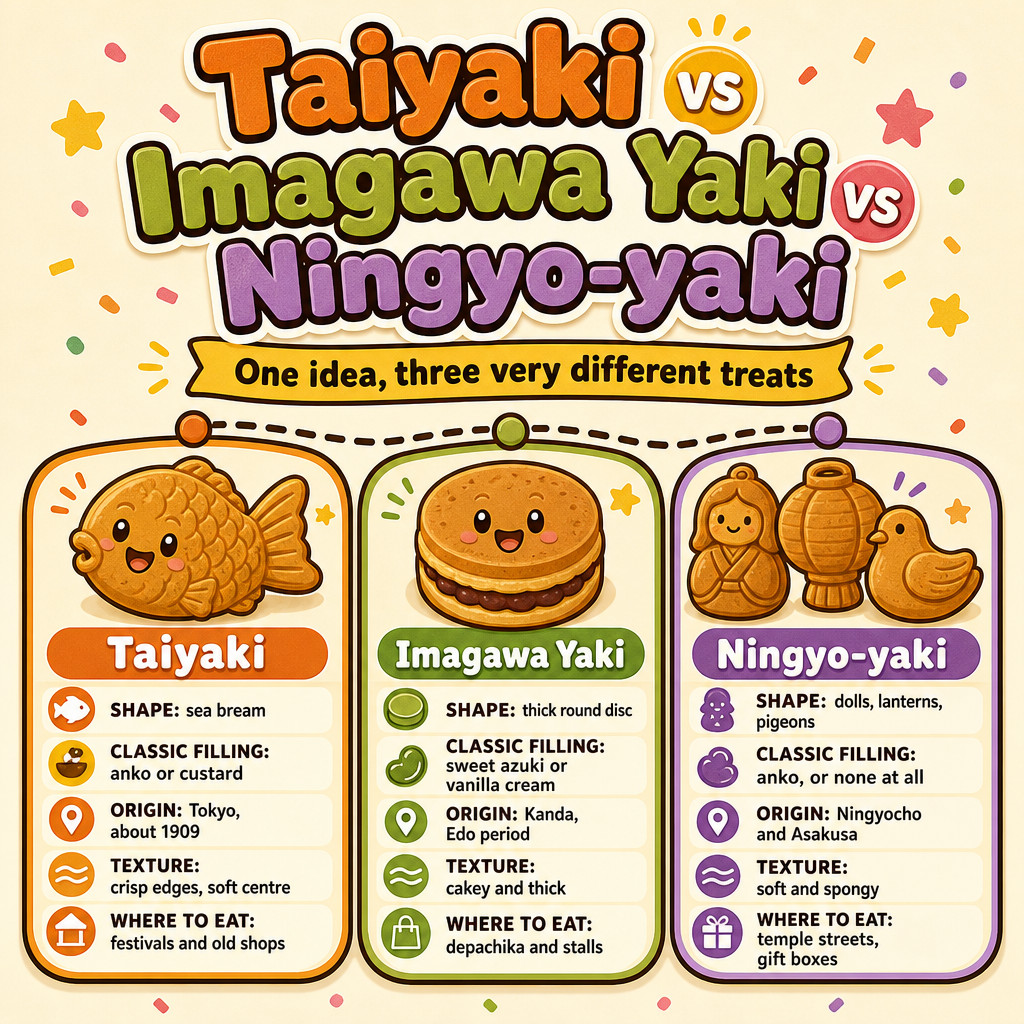
Three Tokyo sweets share the same basic idea. Each one wraps bean paste in a baked flour batter, yet they feel quite different in the hand. The table below sets them side by side.
| Taiyaki | Imagawa Yaki | Ningyo-yaki | |
|---|---|---|---|
| Shape | Sea bream | Thick round disc | Dolls, lanterns, pigeons |
| Classic filling | Anko or custard | Sweet azuki or vanilla cream | Anko, or none at all |
| Origin | Tokyo, about 1909 | Kanda, Edo period | Ningyocho and Asakusa |
| Texture | Crisp edges, soft centre | Cakey and thick | Soft and spongey |
| Where to eat | Festivals and old shops | Depachika and stalls | Temple streets and gift boxes |
In short, the difference is mostly shape and thickness. Reference librarians in Japan reached the same conclusion when readers asked. If you want the full story, our Ningyo-yaki guide covers the doll-shaped cousin in detail.
How to Make Taiyaki at Home
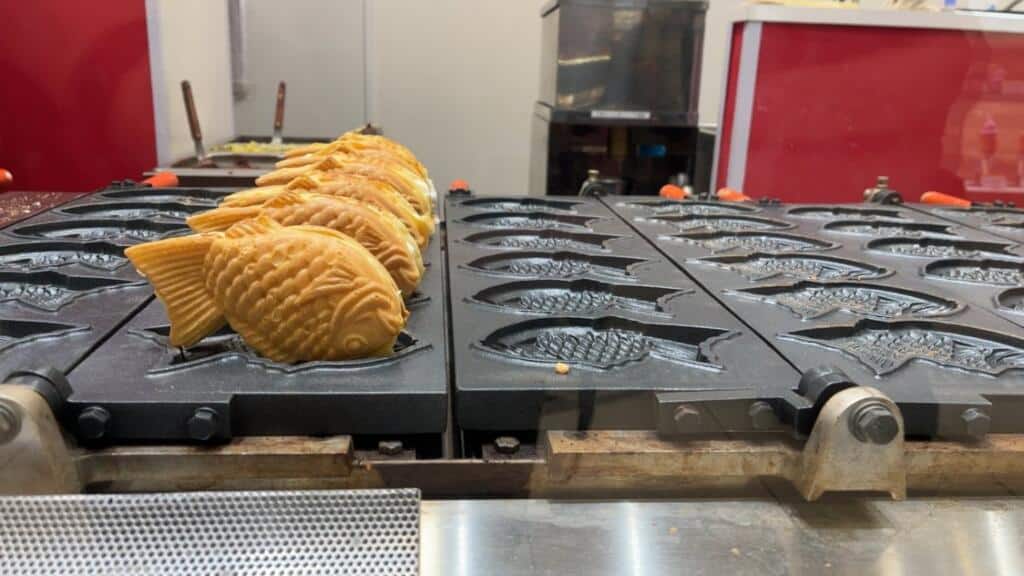
Home cooking is easier than it looks, especially if a craving hits at night. Every ingredient sits in most supermarkets too. A mold is the only special item, and small stovetop pans cost very little.
First, sift the cake flour, baking powder, and baking soda into a large bowl. Then add the sugar and mix it through evenly.
Whisk the egg in a second bowl, then pour in the milk. After that, combine the dry and wet mixtures gently. Resting the batter for 30 minutes in the fridge is optional, though it gives a fluffier crumb.
Warm the taiyaki pan over medium heat. Brush both halves with a little oil. Because thin batter burns fast, drop the heat to medium-low before you pour.
Pour batter into the mold slowly, filling roughly half of each cavity. Next, spoon about 2 tbsp of anko along the middle. Finally, cover the filling with more batter and close the mold.
Flip the pan after about two minutes, then cook the other side until golden brown. Peek once or twice, since every stove behaves differently. Trim any batter that escapes the edges.
Repeat with the remaining batter and filling. Custard, chocolate, cheese, and sweet potato all work nicely here. Serve straight away, because the crisp edge softens within minutes.
Where to Eat Taiyaki in Tokyo
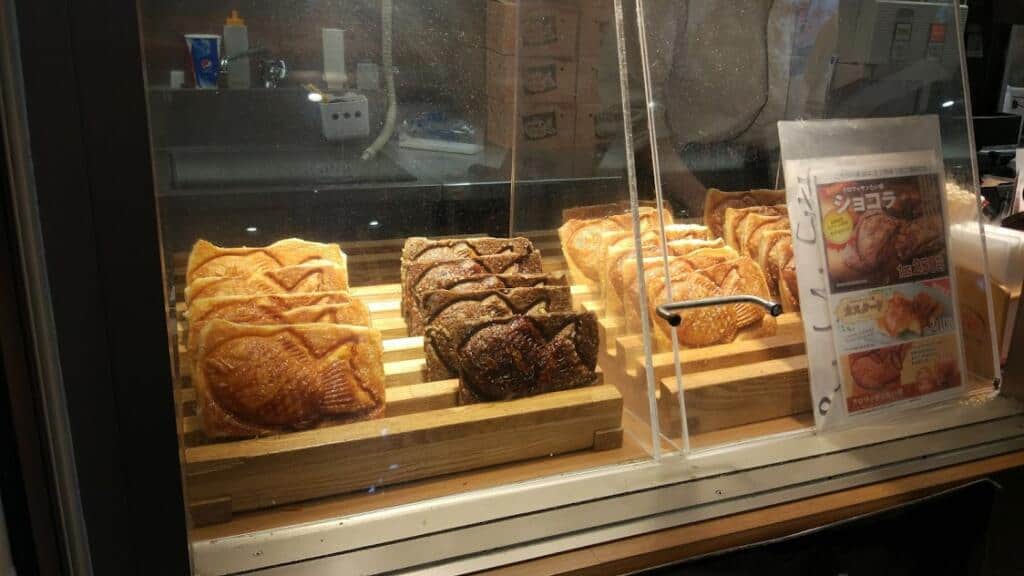
You can buy taiyaki almost anywhere in the city. Festival stalls sell it during summer matsuri, while shopping streets keep it year round. Department store basements, or depachika, usually stock a version too.
Asakusa certainly makes an easy first stop, especially along the Nakamise approach to Senso-ji. For a deeper dive into stall culture, browse our Japanese Street Food section. Serious fans, meanwhile, head straight to the specialist shops below.
Naniwaya Sohonten (Azabu-Juban)
This is the shop most people call the original. Staff bake each fish in a single hand-held iron, a method called ippon-yaki. The skin turns thin and crisp, while Tokachi azuki fills the body right down to the tail.
Yanagiya (Nihonbashi Ningyocho)
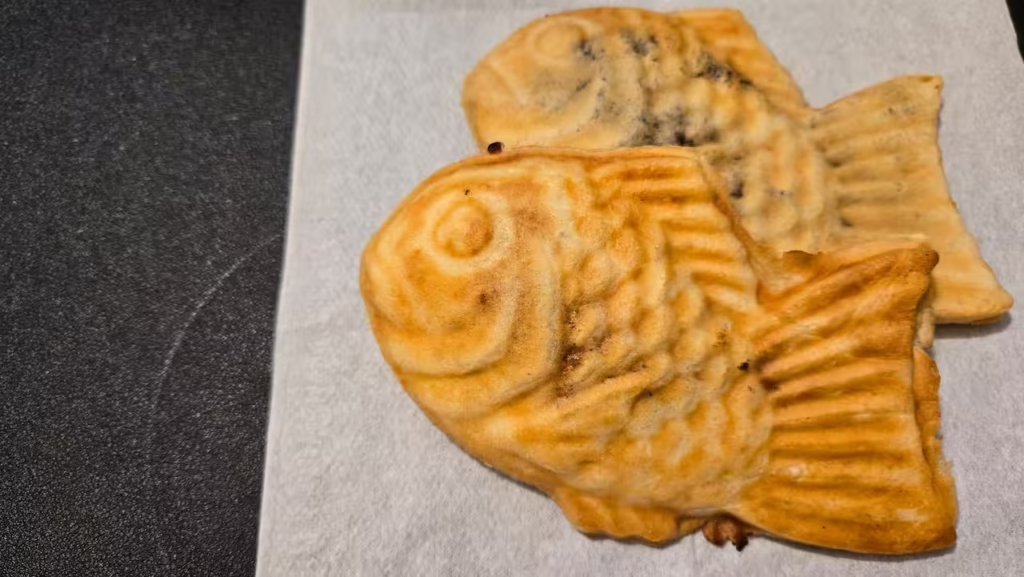
Yanagiya opened in 1916 on Amazake Yokocho, a lane full of old confectioners. The team makes anko fresh each morning and generally sells it out the same day. Its skin bakes darker than most, so the edges taste faintly toasted.
Queues here can stretch past twenty people at lunchtime, particularly on weekends. Locals often phone ahead instead. While you wait, the surrounding Tokyo food guide neighbourhoods reward a short walk.
Wakaba (Yotsuya)
Wakaba dates from 1953 and completes Tokyo’s so-called big three. Its first owner was a joiner who opened a penny-sweet shop after the war. A newspaper column by theatre critic Tsuruo Ando then turned the taiyaki into the main attraction.
Ando’s line about anko always reaching the tail became the shop motto. True to that, the filling runs to the very tip, so each piece feels surprisingly heavy. A faintly salty batter balances the Hokkaido azuki nicely.
Ginza Taiyaki Sakuraya (Shimbashi)
Sakuraya sits in Shimbashi, a district packed with office workers. The shop offers both a thin-skin and a thick-skin version, which makes comparison easy. Late hours help as well, so it suits an evening detour after dinner or drinks.
Chain Shops and Station Stalls
Chains such as Naruto Taiyaki Honpo run branches beside major stations. Their prices sit slightly below the old specialists, and English menus appear more often. For visitors on a tight schedule, that convenience matters more than heritage.
Taiyaki Buying Tips for Visitors
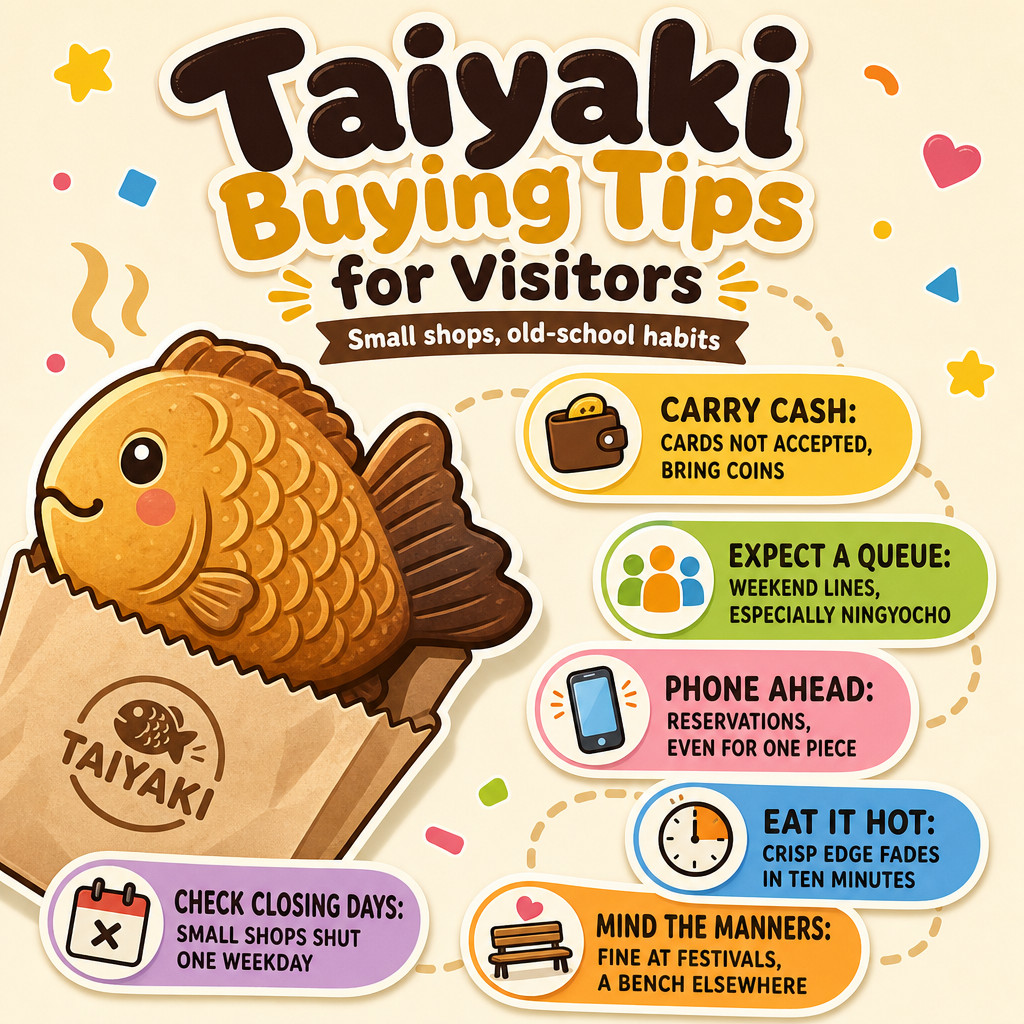
- Carry cash. Several old shops still refuse cards, so coins help.
- Expect a queue. Weekends draw long lines, especially in Ningyocho.
- Phone ahead. Some shops accept reservations, even for one piece.
- Eat it hot. The crisp edge fades within about ten minutes, so do not wander far.
- Check closing days. Small shops often shut on a fixed weekday.
- Mind the manners. Eating while walking is fine at festivals, though quieter streets prefer a bench.
Allergens and Dietary Notes

Standard taiyaki contains wheat, egg, milk, and azuki paste. Anyone avoiding gluten or dairy should therefore ask carefully before ordering. Staff at small stalls rarely speak English, so a written note helps a lot.
Vegan and gluten-free versions do exist, but only at specialist bakeries and a few plant-based cafes. Most classic shops, unfortunately, will not have them. Filled sweets like this belong to the wider world of wagashi, where recipes vary widely between makers.
How to Store and Reheat Taiyaki
Fresh is always best, so eat it on the day you buy it. If leftovers appear, then wrap them loosely and keep them at room temperature overnight. For longer storage, freeze each piece separately in a sealed bag.
Reheating in a toaster oven works well, because dry heat brings the crisp skin back. A microwave alone, however, turns the batter rubbery. Still, a short microwave burst followed by two toaster minutes works when the centre is frozen.
Conclusion
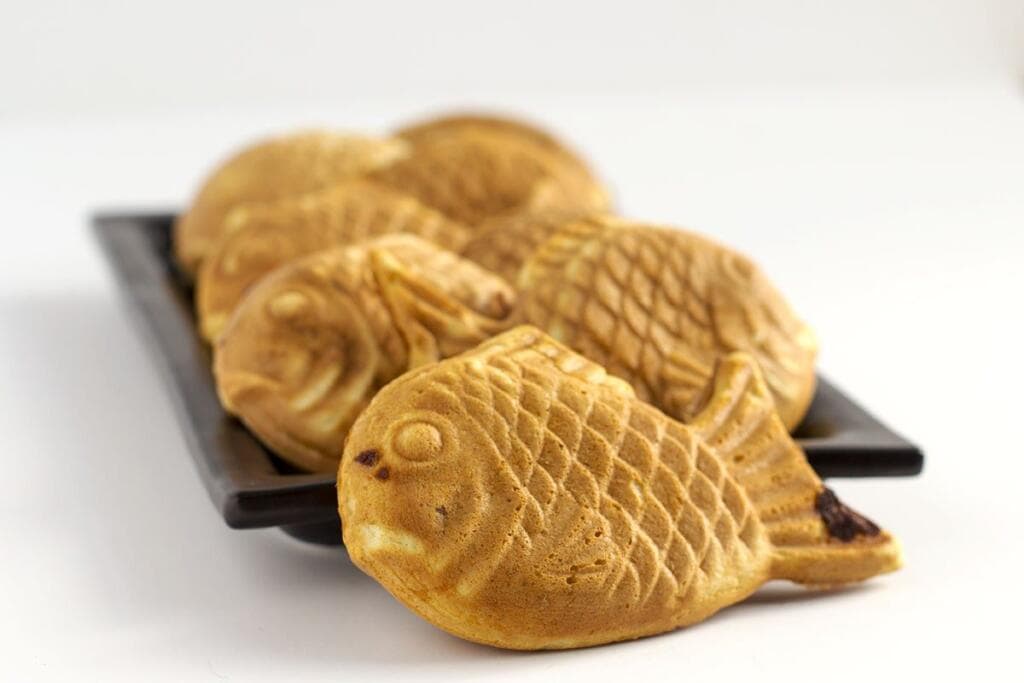
Taiyaki is a classic Japanese sweet known for its charming fish shape and warm filling. It costs very little, travels well in the hand, and suits nearly every season. That mix of luck, warmth, and simplicity keeps it popular after more than a century.
There is even a playful old saying about eating order. Start at the head and you are an optimist, while tail-first eaters supposedly lean toward idealism. People who bite the sides, meanwhile, apparently have plenty of energy.
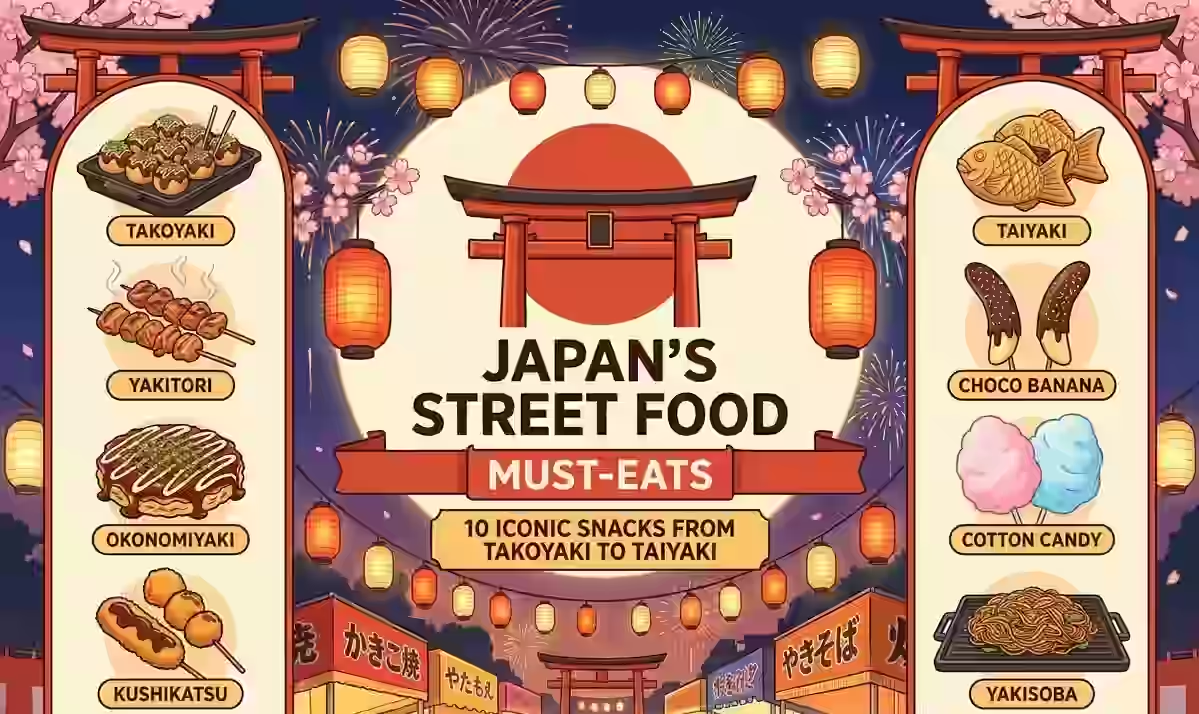
So order one hot, step aside from the queue, and start wherever you like. If you want more ideas for stall food, our guide to Japan’s street food must-eats lists plenty of options. Tokyo certainly rewards hungry walkers, and this little fish is a fine place to begin.
Taiyaki FAQ
Is taiyaki the same as imagawayaki?
No, though the two share almost everything except shape. Taiyaki takes the form of a sea bream, while Imagawa Yaki stays round and thick. Both also use a flour batter around anko or custard. Japanese reference librarians reached the same conclusion, since the batter and filling barely differ.
What is the most popular taiyaki filling?
Anko still leads by a wide margin. Custard usually comes second, while chocolate follows close behind. Seasonal pastes such as sakura or chestnut appear for a few weeks each year. Order anko first, then compare it with custard on your next visit.
Can you make taiyaki without a taiyaki pan?
You need a mold for the proper fish shape. Without one, you can still cook a filled pancake in a small frying pan. First pour a thin circle of batter, next add anko, then cover it with more batter. The taste comes close, although the crisp edge will not match.
Does taiyaki taste like fish?
Not at all, despite the shape. The batter tastes like a light waffle, while the filling brings gentle sweetness. Shops chose the sea bream design for luck rather than flavour. Savoury versions do exist, but they use cheese, curry, or sausage instead of seafood.
Where can you buy taiyaki in Tokyo?
Look for festival stalls, covered shopping streets, and department store basements. Azabu-Juban, Nihonbashi Ningyocho, and Yotsuya hold the three most famous specialists. Asakusa additionally suits visitors who want a temple walk alongside the snack. Station chains cover everyone else.
How much does taiyaki cost?
Most pieces sit in an affordable street snack range, roughly 200 to 300 yen. Chains and festival stalls, meanwhile, sometimes charge less. Premium fillings, larger sizes, and tourist areas push the price up. Because shops adjust prices often, check the counter board before you queue.
Is taiyaki vegetarian or vegan?
The classic anko version suits most vegetarians, since it contains no meat. It is not vegan, however, because the batter normally holds egg and milk. Gluten-free options are rare too, as wheat flour forms the base. Specialist bakeries make plant-based versions, so ask ahead.
What are natural and farmed taiyaki?
Fans use those nicknames as a joke about cooking method. “Natural” taiyaki cooks one fish at a time in a hand-held iron. “Farmed” taiyaki bakes five or six together in a hinged tray. The single-iron style therefore gives a thinner, crisper skin.
How do you reheat leftover taiyaki?
Simply use a toaster oven for two or three minutes. Dry heat restores the crisp shell better than anything else. A microwave alone leaves the batter soft and slightly rubbery. If the piece came from the freezer, warm it briefly first, then finish it in the toaster.
References
- Azabu-Juban Shopping Street Association, Naniwaya Sohonten, https://www.azabujuban.or.jp/shop/shop_category/eat/219/ (Surveyed: August 2026)
- National Diet Library, Collaborative Reference Database, Origin and history of taiyaki, https://crd.ndl.go.jp/reference/entry/index.php?id=1000189942 (Surveyed: August 2026)
- National Diet Library, Collaborative Reference Database, Imagawayaki and taiyaki compared, https://crd.ndl.go.jp/reference/entry/index.php?id=1000353379 (Surveyed: August 2026)
- Fisheries Agency of Japan, White Paper on Fisheries: Japan’s Fish-Eating Culture, https://www.jfa.maff.go.jp/hakusyo/h19/html/s1_1_1.htm (Surveyed: August 2026)
- Ministry of Agriculture, Forestry and Fisheries, aff Magazine March 2024: Azuki and Anko, https://www.maff.go.jp/j/pr/aff/2403/pdf/aff2403-04.pdf (Surveyed: August 2026)
- Government of Japan, Highlighting Japan, Tai: A Special Fish for the Japanese, https://www.gov-online.go.jp/eng/publicity/book/hlj/html/202305/202305_01_jp.html (Surveyed: August 2026)
- Nippon.com, The Original Taiyaki of Azabu-Juban, https://www.nippon.com/ja/guide-to-japan/gu900222/ (Surveyed: August 2026)
- SHUN GATE, Taiyaki: A Sweet With 100 Years of History, https://shun-gate.com/power/power_104/ (Surveyed: August 2026)
- Taiyaki Wakaba, Official Site, http://www.246.ne.jp/~i-ozawa/ (Surveyed: August 2026)
- J-STAGE, Kojima, M. et al. (2006), Antioxidative Activity of Azuki Bean Polyphenols, https://www.jstage.jst.go.jp/article/nskkk/53/7/53_7_386/_article/-char/ja/ (Surveyed: August 2026)
- J-STAGE, Koriyama, T. (2019), Hardening and Softening of Beans in Cooking, https://www.jstage.jst.go.jp/article/cookeryscience/52/3/52_129/_article/-char/ja/ (Surveyed: August 2026)
Related Articles
- Imagawa Yaki (Surveyed: August 2026)
- Ningyo-yaki (Surveyed: August 2026)
- Japanese Street Food (Surveyed: August 2026)
- Japan’s Street Food Must-Eats (Surveyed: August 2026)
- Wagashi: Its History, Aesthetics, and Cultural Significance (Surveyed: August 2026)
- Monaka (Surveyed: August 2026)
- Depachika Guide (Surveyed: August 2026)
- Tokyo Food Guide (Surveyed: August 2026)




Comments