





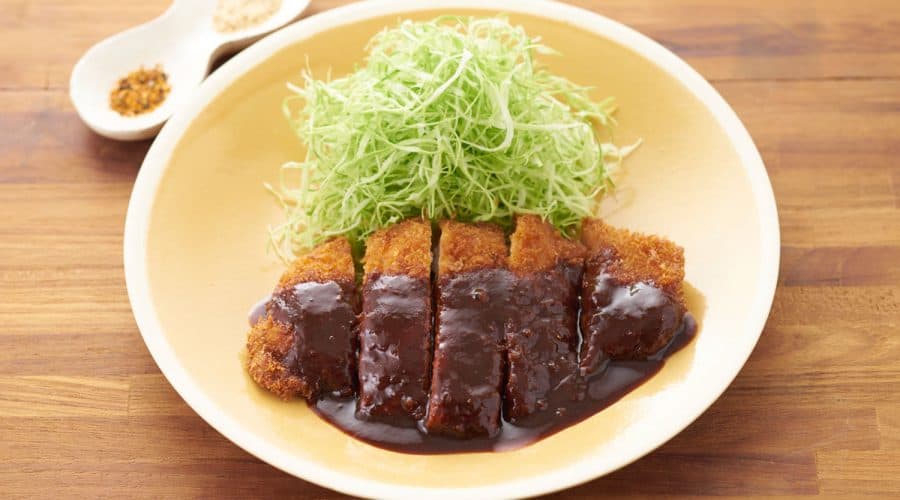
Miso Katsu is Nagoya’s iconic tonkatsu topped with a rich hatcho miso sauce. The dark, sweet-savory red miso sauce sets it apart from regular pork cutlet. Locals eat it with rice, shredded cabbage, and often a dab of karashi mustard.
It’s one of Nagoya’s best-known dishes. Locals love the contrast between crisp pork and thick miso sauce. This guide covers its taste, history, a home recipe, and the best places to eat it in Aichi.
What Is Miso Katsu?
Here are the quick answers before we go deeper.
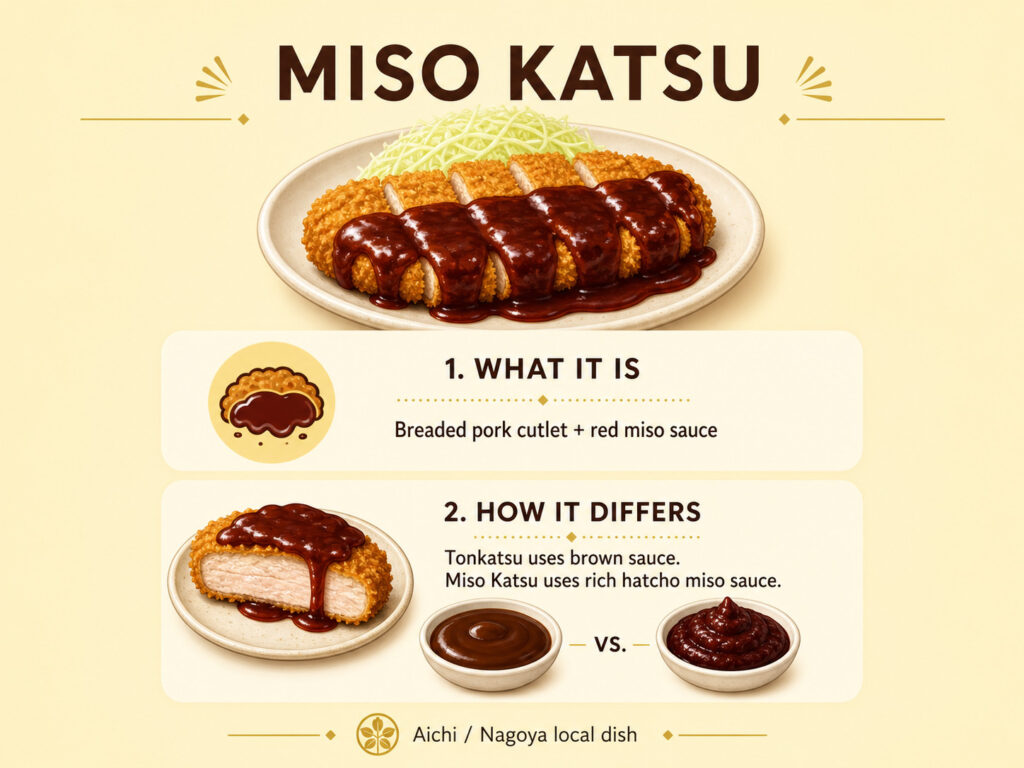
- What is it? A breaded, deep-fried pork cutlet covered in red miso sauce. The sauce blends hatcho miso, sugar, and dashi.
- Where is it from? Nagoya and the wider Tokai region, in and around Aichi Prefecture. It is a core dish of Nagoya meshi, the city’s local cuisine.
- How is it different from tonkatsu? Regular tonkatsu uses a brown Worcestershire-style sauce. Miso Katsu swaps it for a darker, deeper miso sauce.
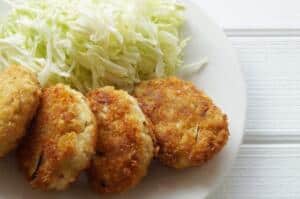
The cutlet itself follows the standard katsu method. Cooks bread pork loin in flour, egg, and panko, then deep-fry it. The miso sauce is what changes everything. In many Tokai-region restaurants, staff will even ask: miso or regular sauce?
Taste Profile of Miso Katsu
The first bite is a small surprise. The crust stays crispy, yet the thick sauce coats it in deep umami. Hatcho miso brings a slight bitterness under the sweetness. That push and pull is the whole charm.
I will admit, I wondered if miso on fried pork would feel heavy. It can, a little. That is exactly why the shredded cabbage matters. Its fresh crunch resets your palate between bites. A bowl of rice then soaks up the extra sauce perfectly.
Miso Katsu as Nagoya Meshi
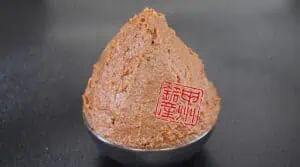
Nagoya cooks with red miso like nowhere else in Japan. The star is hatcho miso, a dark soybean miso aged for two to three years. People make miso by fermenting soybeans with salt and koji. Hatcho miso skips the rice and uses soybeans alone, so its flavor turns rich and slightly bitter.
That miso shapes the whole local menu. Miso nikomi udon, miso oden, and doteni all lean on it. Miso Katsu belongs to this same family, called Nagoya meshi. Alongside tebasaki chicken wings and hitsumabushi eel rice, it defines how the city eats.
Locals treat it as everyday food, not a special-occasion dish. Set-meal restaurants, department store food halls, and specialty shops all serve it. So a visit to Nagoya almost guarantees a chance to try it.
History of Miso Katsu
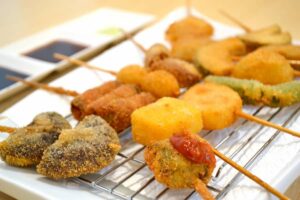
Like many beloved local dishes, miso katsu has more than one origin story. One popular account traces it to postwar street stalls. There, customers dipped fried kushikatsu skewers into doteni, a red miso stew, and loved the result. Some long-running shops, like Yabaton, grew from that tradition in the late 1940s.
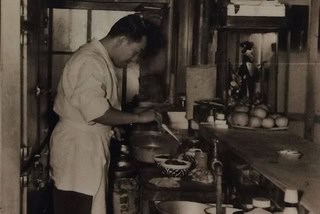
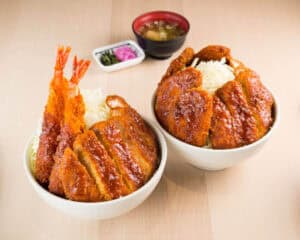
The most famous account, though, belongs to Ajidokoro Kano. Toshisuke Sugimoto opened this small restaurant in 1949 in central Nagoya. He put “Kano” in the name in hopes that his dream would come true. Before the war, he had run a soba shop in Asakusa, Tokyo, serving tendon.
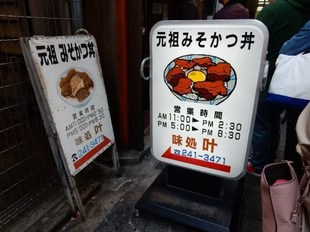
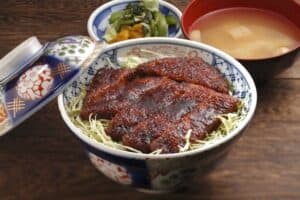
That tendon experience sparked the idea. If a soy-based sauce worked over fried food, he reasoned, miso should work too. So he built a sauce on hatcho miso and served it over a katsu rice bowl, as a lunch-only dish.
At first, the owner had not given the dish a formal name. The shop had no written menu, so staff asked each guest, “the miso katsudon, right?” Regular customers shortened it, and the name stuck. From there, “miso katsu” spread across Nagoya and the Tokai region.
Miso Katsu vs Tonkatsu vs Katsu Sando
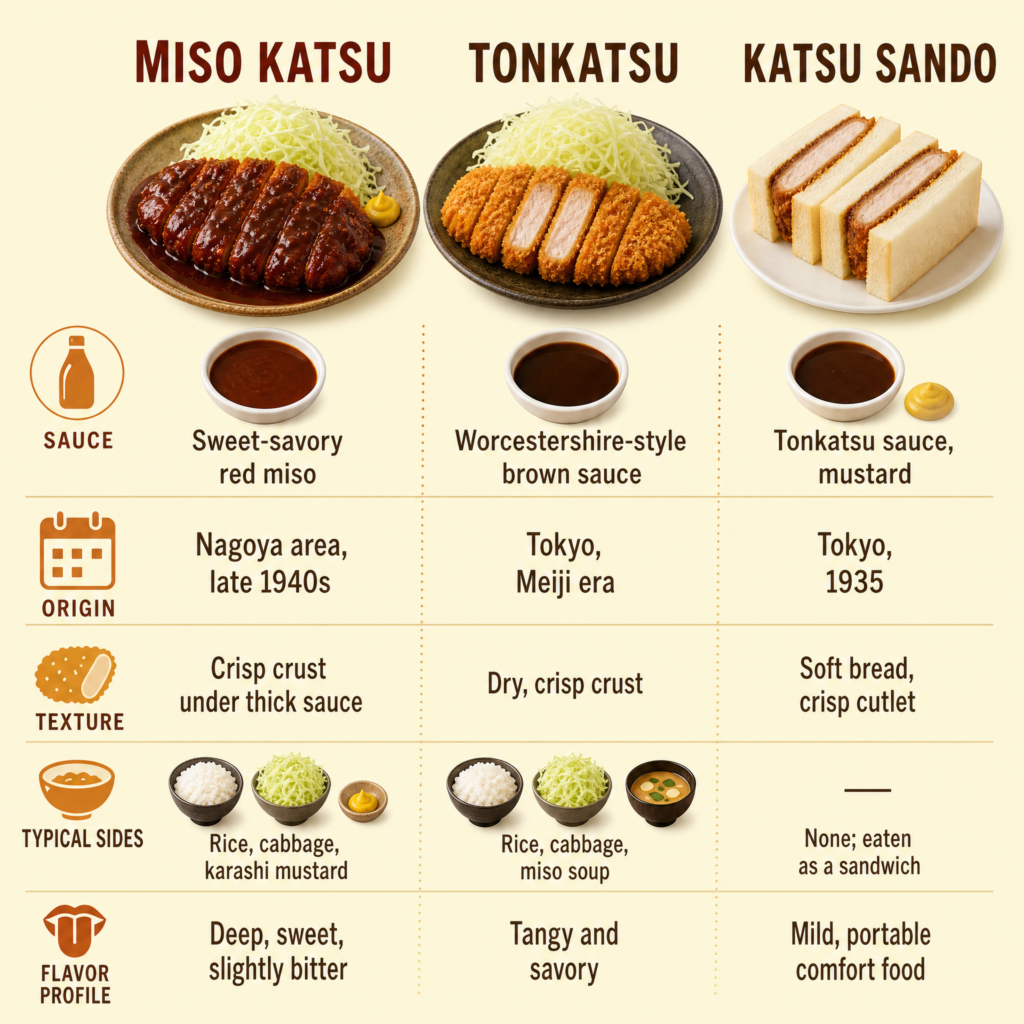
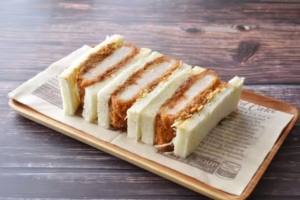
These three katsu dishes look related, and they are. Still, each one plays a different role. The table sums up the contrast.
| Miso Katsu | Tonkatsu | Katsu Sando | |
|---|---|---|---|
| Sauce | Sweet-savory red miso | Worcestershire-style brown sauce | Tonkatsu sauce, mustard |
| Origin | Nagoya area, late 1940s | Tokyo, Meiji era | Tokyo, 1935 |
| Texture | Crisp crust under thick sauce | Dry, crisp crust | Soft bread, crisp cutlet |
| Typical sides | Rice, cabbage, karashi mustard | Rice, cabbage, miso soup | None; eaten as a sandwich |
| Flavor profile | Deep, sweet, slightly bitter | Tangy and savory | Mild, portable comfort food |
How to Make Miso Katsu
The good news: if you can make tonkatsu, you can make this. Only the sauce is new.
Ingredients for the Cutlet
| For the cutlet | Amount |
|---|---|
| Pork loin (medium thickness) | 200 g |
| Salt and pepper | A pinch |
| Cabbage, shredded | 1/2 cup |
| Egg | 1 large |
| Flour | 6 tbsp |
| Panko bread crumbs | 1 cup |
| Cooking oil | For deep-frying |
Ingredients for the Miso Sauce
| For the miso sauce | Amount |
|---|---|
| Hatcho miso (red miso) | 2 tbsp |
| Sugar | 2 tbsp |
| Mirin | 2 tbsp |
| Soy sauce | 2 tbsp |
| Water | 2 tbsp |
Steps
- Prepare the pork. Pat it dry, pound it lightly, and cut the sinew. Season with salt and pepper.
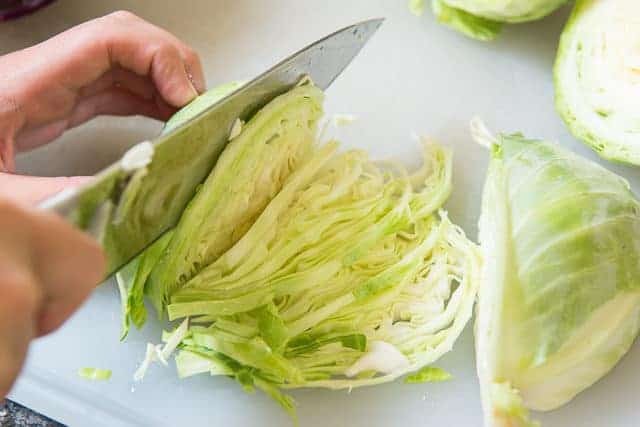
- Shred the cabbage. Wash, drain, and cut it into thin julienne strips.
- Set up the breading. Place flour, beaten egg, and panko in three separate bowls.
- Bread the pork. Coat with flour, dip in egg, then press panko firmly onto the meat.
- Fry at 170-175°C. Cook until golden brown, then drain and slice into strips.
- Make the sauce. Mix all sauce ingredients, then warm in a pan for 2 to 3 minutes. Pour over the katsu and serve with cabbage and rice.
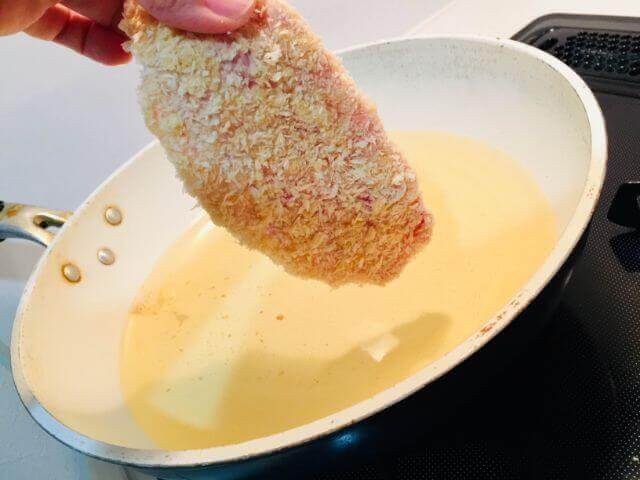
Watch the sauce closely as it heats. Miso burns quickly, so keep the heat low. If the sauce feels too strong, add a spoon of water or dashi. For a lighter touch, pour it over just one side of the cutlet.
Is Miso Katsu Healthy?
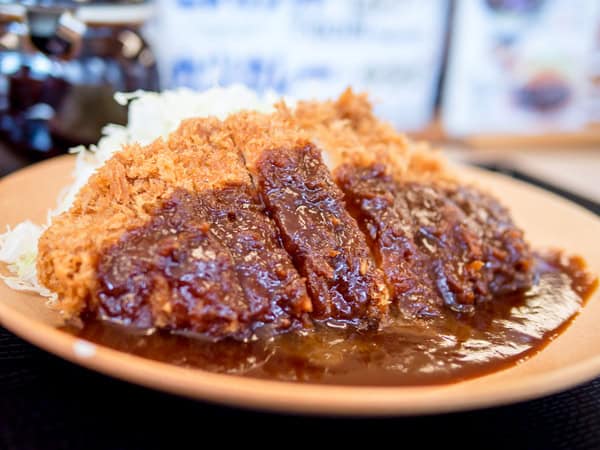
Miso is a fermented food, and pork provides protein and vitamin B1. Even so, Miso Katsu is still a rich fried dish. The breading absorbs oil, and the sauce contains a fair amount of sugar. So moderation matters here.
The cabbage on the side helps balance the meal. Pair it with rice and miso soup for a classic set. Treat it as an occasional pleasure, and it fits fine into most diets.
Best Places to Eat Miso Katsu in Nagoya
Countless shops across Nagoya serve this dish. These three are reliable starting points, each with a different character.
Ajidokoro Kano (味処 叶)
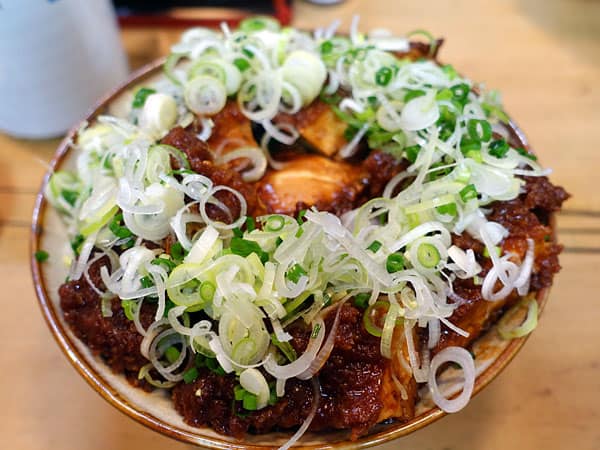
Founded in 1949, this is the home of the original miso katsudon. The shop simmers each cutlet in its long-nurtured miso tare, rather than just pouring sauce on top. A soft-boiled egg crowns the bowl. Celebrities still drop by, and lunch lines form before opening.
- Address: 3-4-110 Sakae, Naka Ward, Nagoya
- Price: around 1,500 to 2,000 yen for the original bowl.
- Access: about 3 minutes from Sakae Station.
- What to order: the original miso katsudon; note that miso soup is a separate order.
Tonpachi (とん八)
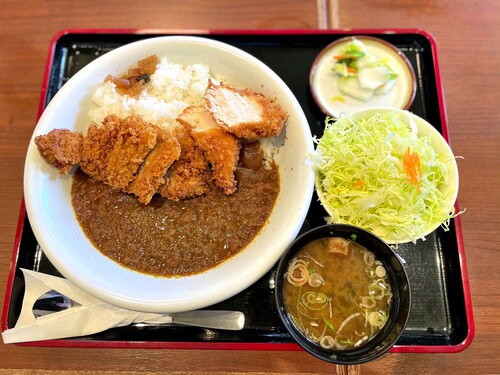
Tonpachi draws long lines at lunch and dinner. The sauce looks thick and dark, yet it tastes light and gentle. The soft meat wins fans too. A cheese-topped variant offers a fun twist.
- Address: 3-17-15 Chiyoda, Naka Ward, Nagoya
- Price: around 1,000 to 1,500 yen.
- Access: a few minutes from JR Tsurumai Station.
- What to order: the classic set, or the cheese miso katsu.
Kurobuta Ramuchi (黒豚屋らむちぃ)
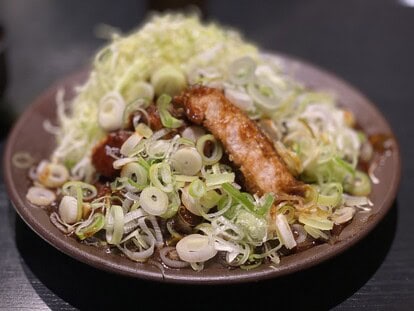
Ramuchi sits in the center of Sakae, Nagoya’s busiest district. Its miso katsu comes piled with green onions over the sauce. Locals gather here after work, so the mood stays lively.
- Address: Sakae ST Building B1F, 3-15-6 Sakae, Naka-ku, Nagoya
- Price: around 1,200 to 1,800 yen.
- Access: central Sakae, near Sakae Station.
- What to order: kurobuta miso katsu with green onions.
Where to Buy Miso Katsu Sauce to Take Home
Want the flavor at home? Bottled miso katsu sauce is easy to find in Nagoya. Supermarkets in Aichi stock local favorites like Nakamo’s “Tsuketemiso Kaketemiso,” a squeeze-tube miso sauce. Souvenir shops at Nagoya Station and Chubu Airport carry gift versions too. You can also order hatcho miso and ready-made sauces online, so a Nagoya-style dinner is never far away.
Conclusion
Miso Katsu turns a familiar pork cutlet into something distinctly Nagoya. The hatcho miso sauce adds depth that regular tonkatsu sauce cannot match. Crisp, rich, and a little bold, it captures the city’s love of red miso in one plate.
If you visit Nagoya, try it alongside the city’s other classics. For the full picture, our guide on what to eat in Nagoya covers 20 must-try dishes.
Miso Katsu FAQ
What is Miso Katsu?
Miso Katsu is a Nagoya-style pork cutlet topped with red miso sauce. Cooks bread and deep-fry pork loin, then cover it with a sweet-savory sauce. The sauce blends hatcho miso, sugar, and dashi. It is one of the signature dishes of Nagoya meshi.
What kind of miso is used?
Most shops use hatcho miso, a dark red soybean miso from Aichi. Makers age it for two to three years, which gives it deep umami and mild bitterness. Sugar and dashi then soften it into a rich sauce. That balance defines the dish’s flavor.
Is it different from tonkatsu?
Yes, though the cutlet itself is the same. Regular tonkatsu comes with a tangy Worcestershire-style brown sauce. Miso Katsu replaces it with a thick red miso sauce. The result tastes deeper, sweeter, and distinctly Nagoya.
Where can I eat it in Nagoya?
You can find it all over the city. Ajidokoro Kano in Sakae created the original miso katsudon. Tonpachi near Tsurumai Station and Kurobuta Ramuchi in Sakae are also popular. Many set-meal restaurants and food halls serve it too.
Can I make it at home?
Yes, quite easily. Make a standard breaded pork cutlet, then simmer red miso, sugar, mirin, soy sauce, and water. Pour the warm sauce over the fried katsu. If hatcho miso is hard to find, any red miso works in a pinch.
Is Miso Katsu very sweet?
It is sweet, but not candy-like. The sugar balances the natural bitterness of hatcho miso. Most sauces land on a sweet-savory middle ground. Shops also vary, so some pour a lighter, gentler sauce than others.
References
- Ajidokoro Kano, History of the Original Miso Katsudon, https://www.misokatu-kanou.com/history.html (Surveyed: June 2026)
- Nagoya Convention & Visitors Bureau, Nagoya Meshi Guide, https://www.nagoya-info.jp/ (Surveyed: June 2026)
- Aichi Now (Aichi Prefectural Tourism), Nagoya Meshi, https://www.aichi-now.jp/ (Surveyed: June 2026)
Related Articles
- Tonkatsu (とんかつ) (Surveyed: June 2026)
- Haccho Miso (八丁味噌) (Surveyed: June 2026)
- Tebasaki (手羽先) (Surveyed: June 2026)
- Hitsumabushi (ひつまぶし) (Surveyed: June 2026)
- What to Eat in Nagoya: 20 Must-Try Foods (Surveyed: June 2026)



Comments