


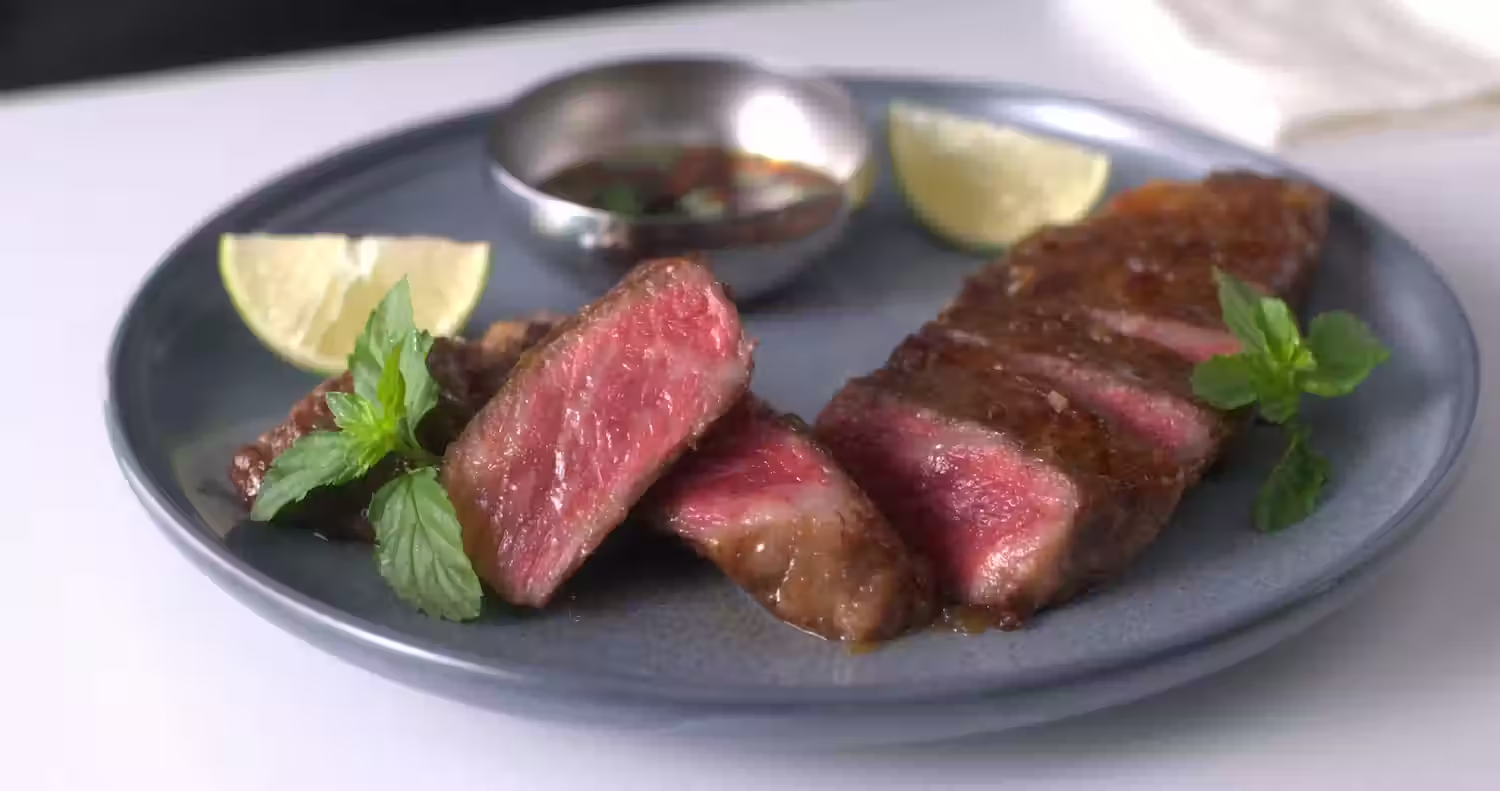



Miyazaki beef is certified wagyu from Japanese Black cattle raised in Miyazaki Prefecture. It also needs a meat quality grade of 4 or 5. In other words, not every steak from Miyazaki qualifies. Miyazaki beef must also meet a bloodline rule, and Japan protects the name as a Geographical Indication.
This guide explains its certification rules, history, grading, flavor, cooking methods, prices, and places to try it. For a trip to southern Kyushu, it also points to Miyazaki food and regional cuisine worth eating alongside it.
What Is Miyazaki Beef? Definition and Certification Rules
Simply put, Miyazaki beef is a protected regional brand of Japanese wagyu. Only Japanese Black cattle that meet the breed, origin, bloodline, and grade rules can carry the name. The Miyazaki Wagyu Council manages the brand’s standards and certification system. Meanwhile, Japan’s national grading system scores each carcass.
Miyazaki Beef Quick Facts
- Origin Miyazaki Prefecture, southeastern Kyushu
- Breed Japanese Black cattle (黒毛和種, kuroge washu)
- Required grade Meat quality grade 4 or 5
- Best-known feature Fine marbling, gentle sweetness, and a rich aroma
- Best ways to eat Steak, teppanyaki, yakiniku, and shabu-shabu
- Legal protection Japanese Geographical Indication No. 55, December 2017

The Four Certification Rules
The official rules come from the Miyazaki Wagyu Council and the national GI specification. For clarity, they can be summarized under four practical headings.
- Breed The animal must be a Japanese Black, which is one of Japan’s four native wagyu breeds.
- Origin It must be born in Miyazaki and raised there for the longest part of its life. However, the GI rules allow a narrow exception for some calves registered through the Miyazaki branch.
- Bloodline Its sire must be a Miyazaki prefectural bull or another bull designated for cattle improvement. This rule first took effect in April 2017.
- Grade The carcass must earn a meat quality grade of 4 or 5 from the Japan Meat Grading Association.
Miyazaki Beef, Miyazaki Wagyu, or Just Beef From Miyazaki?
These names look similar, but they do not always mean the same thing. Miyazaki beef (宮崎牛, Miyazaki gyu) is the certified brand. The GI register also lists “Miyazaki Wagyu” as an English name for it, so English menus may use either term.
Japanese labels are trickier, though. For instance, 宮崎和牛 may appear in broader commercial descriptions. However, it does not automatically prove that the meat qualifies for the certified brand. Likewise, “beef produced in Miyazaki” can cover any cattle raised there, including crossbreeds. So look for the official name 宮崎牛, the council’s logo, and traceability information.
What Geographical Indication Protection Means
On December 15, 2017, Miyazaki beef received Japanese Geographical Indication protection as registration No. 55. A GI protects the name of a product whose qualities are linked to its region. In practice, the system protects the registered name against unauthorized use on products that do not follow the registered specification.
Why Is Miyazaki Beef Special?
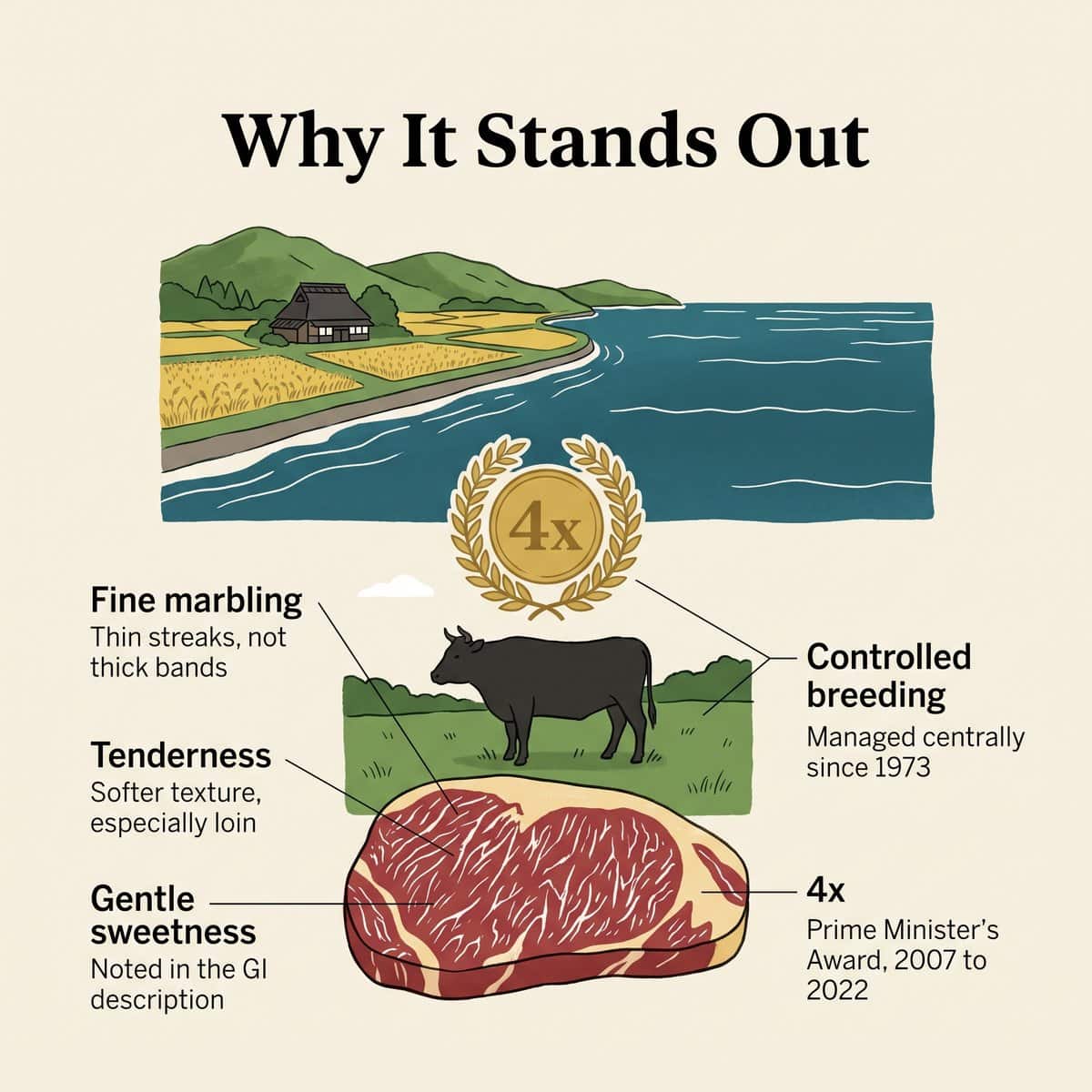
Above all, its reputation rests on consistent marbling and a tightly managed breeding system. The GI registration describes fine marbling, a gentle sweetness that spreads in the mouth, and a rich aroma. Breeding is a large part of that story, as the history below shows.
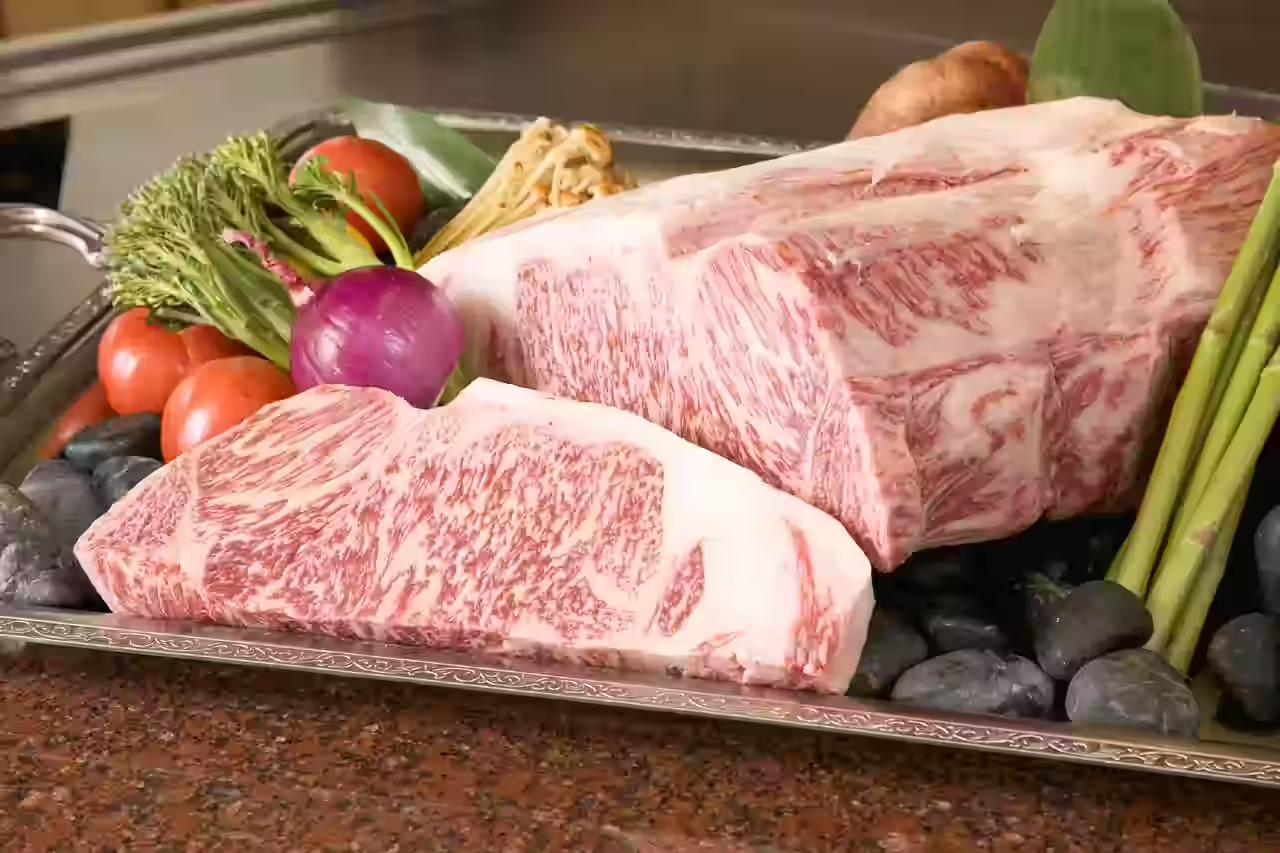
- Fine marbling: thin streaks of fat run through the lean meat instead of sitting in thick bands.
- Tenderness: that intramuscular fat tends to keep the texture soft, especially in loin cuts.
- Gentle sweetness: the GI description notes a sweetness that spreads in the mouth.
- Controlled breeding: the prefecture has managed its breeding bulls centrally since 1973.
Competition results also add weight to the claim. In fact, Miyazaki teams won the Prime Minister’s Award at four consecutive National Wagyu Ability Expositions, from 2007 through 2022. However, the winning division differed between events, as the timeline below shows.
History of Miyazaki Beef
Miyazaki was mainly horse country before World War II. After the war, however, horse farming declined and cattle numbers rose quickly. Farmers brought in bulls from the Chugoku region and began improving their herds.

At first, the prefecture mostly sold calves to other regions. Then it moved toward fattening its own cattle and building a local brand. Finally, the council behind the name formed in 1986, and the brand followed that same year.
Miyazaki Beef Timeline
- 1959 The prefecture sets feeding standards for fattening cattle, beyond calf production.
- 1971 According to the council’s history, Miyazaki shifts to an integrated system covering calves, fattening, and meat processing.
- 1973 Japan’s first unified management of prefectural breeding bulls begins, later called the Miyazaki Method.
- 1986 The prefecture, JA groups, and related bodies form the Miyazaki Wagyu Council, which launches the brand.
- 2007 At the 9th National Wagyu Ability Exposition in Tottori, Miyazaki wins the Prime Minister’s Award in both divisions.
- 2010 A foot-and-mouth disease outbreak causes the loss of 297,808 livestock in the prefecture.
- 2012 At the 10th exposition in Nagasaki, Miyazaki wins the award in the breeding cattle division.
- 2017 A bloodline rule joins the brand standards in April. Miyazaki then wins the beef cattle division in Miyagi, and GI protection follows in December.
- 2022 In Kagoshima, Miyazaki wins the beef cattle division again, for a fourth consecutive Prime Minister’s Award.
The 2010 Outbreak and Recovery
Above all, the 2010 outbreak hit Miyazaki hard. According to the prefecture, it took 297,808 animals. It also affected farms, local businesses, and daily life far beyond livestock. The prefecture also reports that only 5 of its 55 breeding bulls survived.
Afterward, the prefecture moved quickly to rebuild. For instance, it shortened bull testing, developed new sires, and split its bulls between two sites to reduce risk. It also strengthened farm biosecurity and set a monthly day for disinfection across the prefecture.
Miyazaki Beef Grades: What A4 and A5 Mean
Miyazaki beef must have a meat quality grade of 4 or 5. The letter in labels such as A4 refers to something else entirely, namely yield. So the two parts of a Japanese beef grade measure different things, and it helps to read them separately.

Yield Grade: A, B, or C
Firstly, the letter estimates how much usable meat a carcass yields. Grade A means a better-than-standard yield, B is standard, and C falls below standard. However, it says nothing direct about flavor or tenderness.
Meat Quality Grade: 1 to 5
The number, by contrast, reflects quality. Graders score four factors on a five-point scale, and the lowest of the four becomes the final grade. For example, a carcass with superb marbling but grade-4 fat color still ends up as a 4.
- Marbling: measured on the Beef Marbling Standard (BMS) from No. 1 to No. 12.
- Meat color and brightness: judged against a standard color chart.
- Firmness and texture: how firm the lean is and how fine its grain looks.
- Fat color, luster, and quality: graders compare the fat with the Beef Fat Standard and assess its luster and overall quality.
The BMS ranges below apply only to the marbling factor. The final meat quality grade is still the lowest score among all four factors.
| Meat quality grade | BMS range for the marbling factor | Counts as Miyazaki beef? |
|---|---|---|
| 5 | No. 8 to No. 12 | Can qualify if all other rules are met |
| 4 | No. 5 to No. 7 | Can qualify if all other rules are met |
| 3 | No. 3 to No. 4 | No |
| 2 | No. 2 | No |
| 1 | No. 1 | No |
For a deeper look at the whole system, see our Japanese wagyu grading guide.
Is Miyazaki Beef Always A4 or A5?
Not by rule. The official specification requires meat quality grade 4 or 5 but does not restrict the yield letter to A. So the written standard does not automatically exclude B4, B5, C4, or C5. Many restaurants advertise A4 or A5, yet the official requirement is the number, not the letter.
How Miyazaki Cattle Are Bred and Raised
A coordinated breeding system is central to Miyazaki beef production. Producers, agricultural cooperatives, and the prefectural government built it together, and it is often called the Miyazaki Method. Under it, the prefecture manages its breeding bulls in one program rather than leaving each farm to choose alone.

In particular, breeders combine desirable traits from three major Japanese Black lines. Through this selective breeding, Miyazaki developed influential bulls such as Anpei and Itohide.
- Kedaka line: valued for physique.
- Ito line: valued for overall balance.
- Tajima line: valued for high meat quality and marbling.
Interestingly, Miyazaki’s influence reaches well beyond its own brand. For example, the GI specification notes that about 40% of calves born in the prefecture move to other regions. There, they become the starting stock for other branded beef. As of February 1, 2025, Miyazaki ranked third in Japan for total beef cattle and second for Japanese Black cattle.
What Does Miyazaki Beef Taste Like?
Miyazaki beef is known for fine marbling, a gentle sweetness, and a rich aroma, according to its official GI description. In general, well-marbled wagyu feels tender, and its fat softens readily in the mouth. However, the balance of fat, lean flavor, and richness varies by cut, grade, portion size, and cooking method.

- Aroma Described as rich in the official GI description.
- Texture Usually soft, especially in marbled loin cuts.
- Fat Gently sweet, according to the GI description.
- Lean More savory and beefy in cuts such as round.
Is it too rich? For some people, yes, at least in large portions. Even a few slices of grade-5 sirloin can feel like plenty. If heavy marbling is not your thing, choose round or tenderloin instead. A smaller course also helps.
Miyazaki Beef vs Kobe Beef
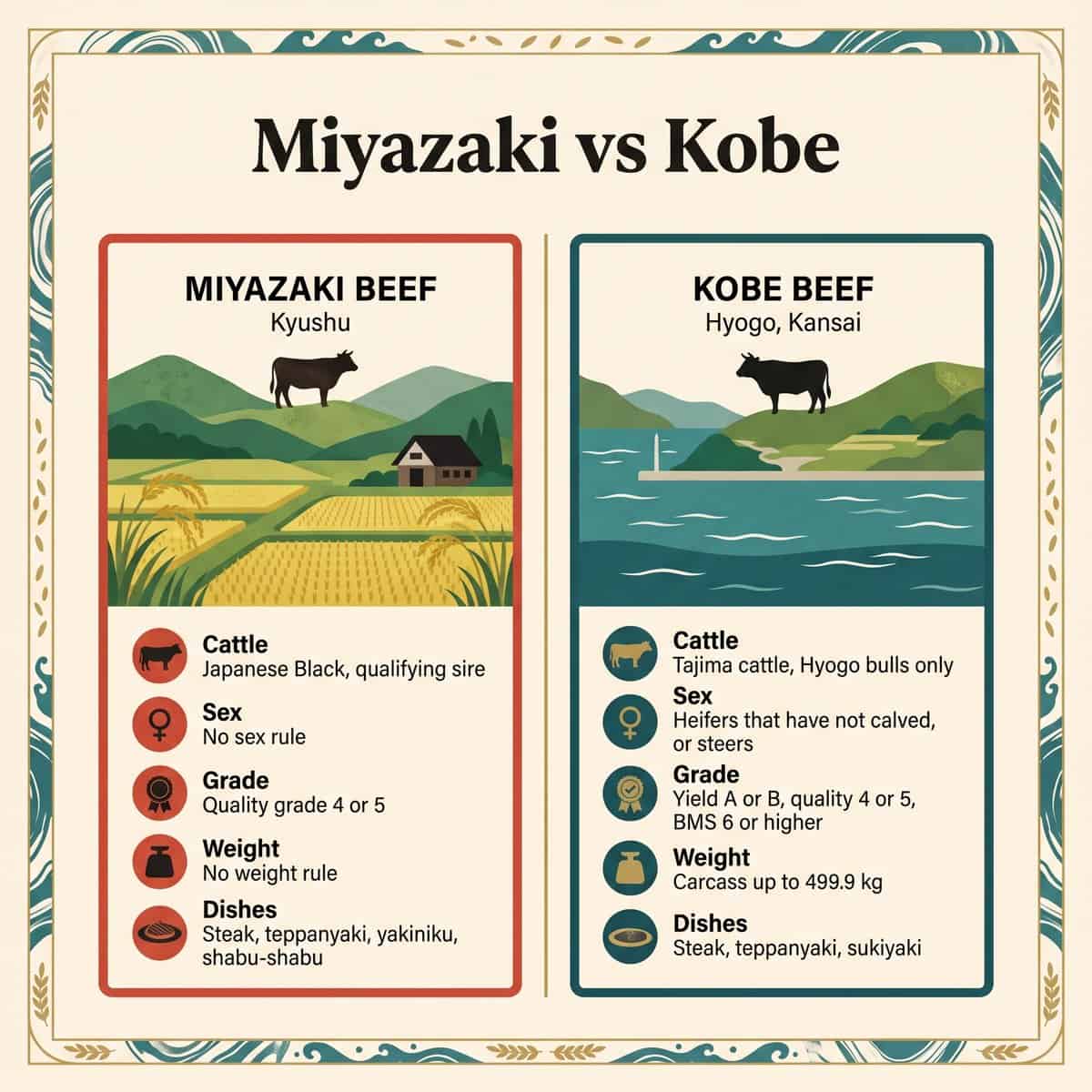
Neither brand is simply better. Both are certified Japanese Black wagyu, but they follow different rules. For example, Kobe beef specifies additional conditions for Tajima lineage, sex, yield grade, marbling, age, and carcass weight. Miyazaki beef uses a different set of rules centered on breed, rearing history, sire, and meat quality grade.
| Point | Miyazaki beef | Kobe beef |
|---|---|---|
| Region | Miyazaki Prefecture, Kyushu | Hyogo Prefecture, Kansai |
| Cattle | Japanese Black with a qualifying sire | Tajima cattle bred only from Hyogo’s prefectural bulls |
| Sex | No sex rule in the brand standard | Heifers that have not calved, or steers |
| Grade rule | Meat quality grade 4 or 5 | Yield A or B, quality 4 or 5, and BMS No. 6 or higher |
| Weight rule | None | Carcass up to 499.9 kg |
| Common restaurant preparations | Steak, teppanyaki, yakiniku, shabu-shabu | Steak, teppanyaki, sukiyaki |
For the Hyogo side, also read our guide to Kobe beef. In practice, the cut, grade, and cooking often shape the meal as much as the brand does.
How Should You Cook Miyazaki Beef?
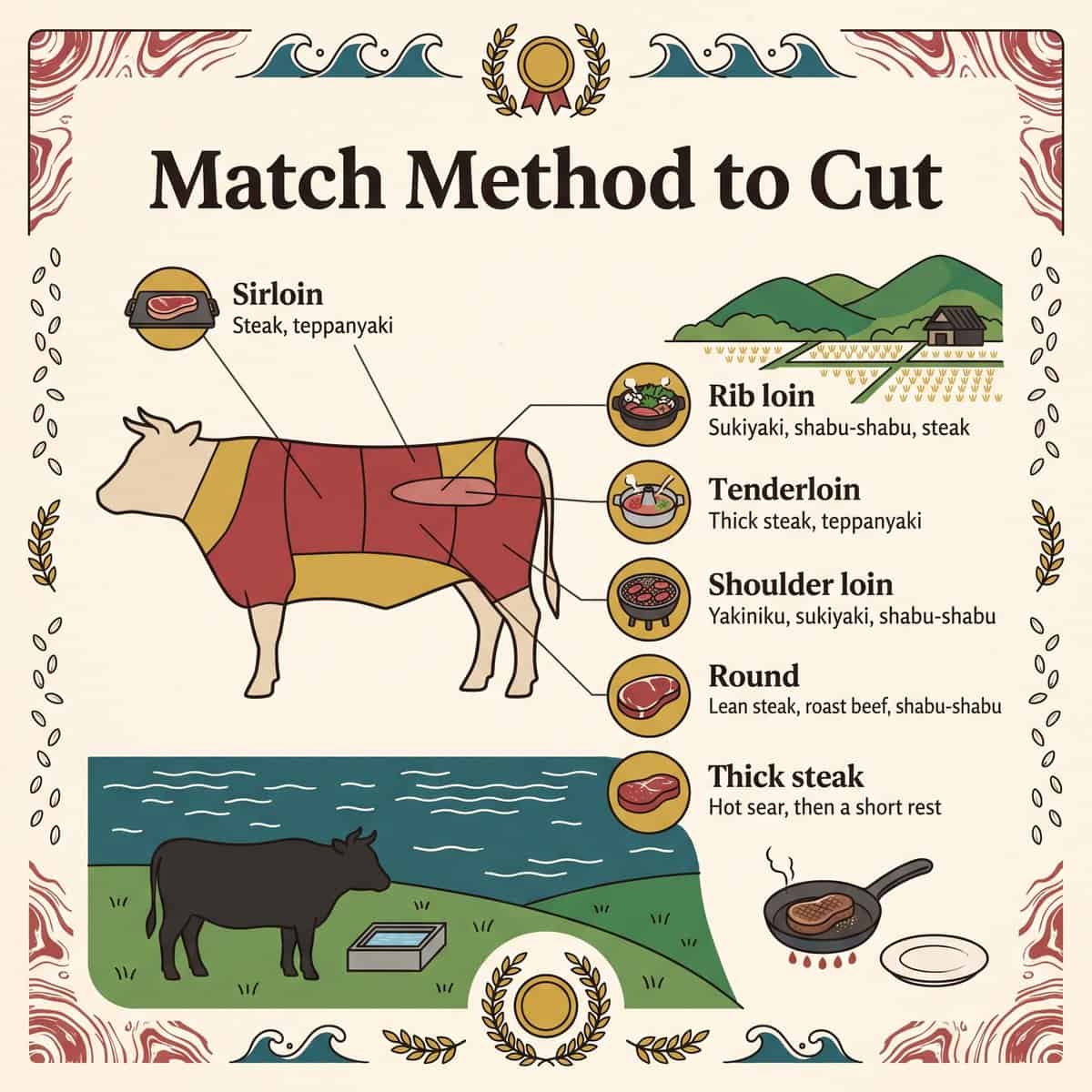
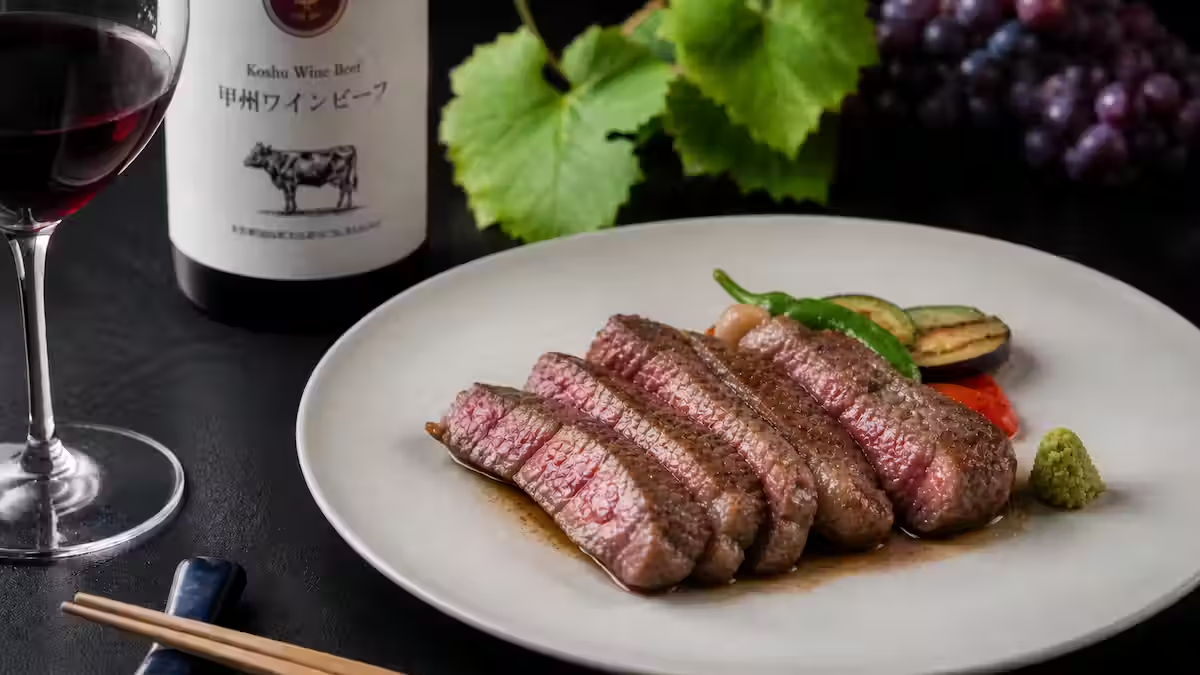
Above all, match the method to the thickness. Thick steaks need quick, high heat and a short rest. Thin slices, however, only need seconds in a pan or hot broth. In both cases, prolonged cooking can render out too much intramuscular fat and reduce the soft texture of marbled cuts.
Best Cuts and Cooking Methods
| Cut | Texture | Good for |
|---|---|---|
| Sirloin | Even marbling, rich and sweet | Steak, teppanyaki |
| Rib loin | Heavy marbling, deep flavor | Sukiyaki, shabu-shabu, steak |
| Tenderloin (fillet) | Very tender, less fat | Thick steak, teppanyaki |
| Shoulder loin (chuck roll) | Savory lean with some marbling | Yakiniku, sukiyaki, shabu-shabu |
| Round (momo) | Lean and beefy | Lean steak, roast beef, shabu-shabu |
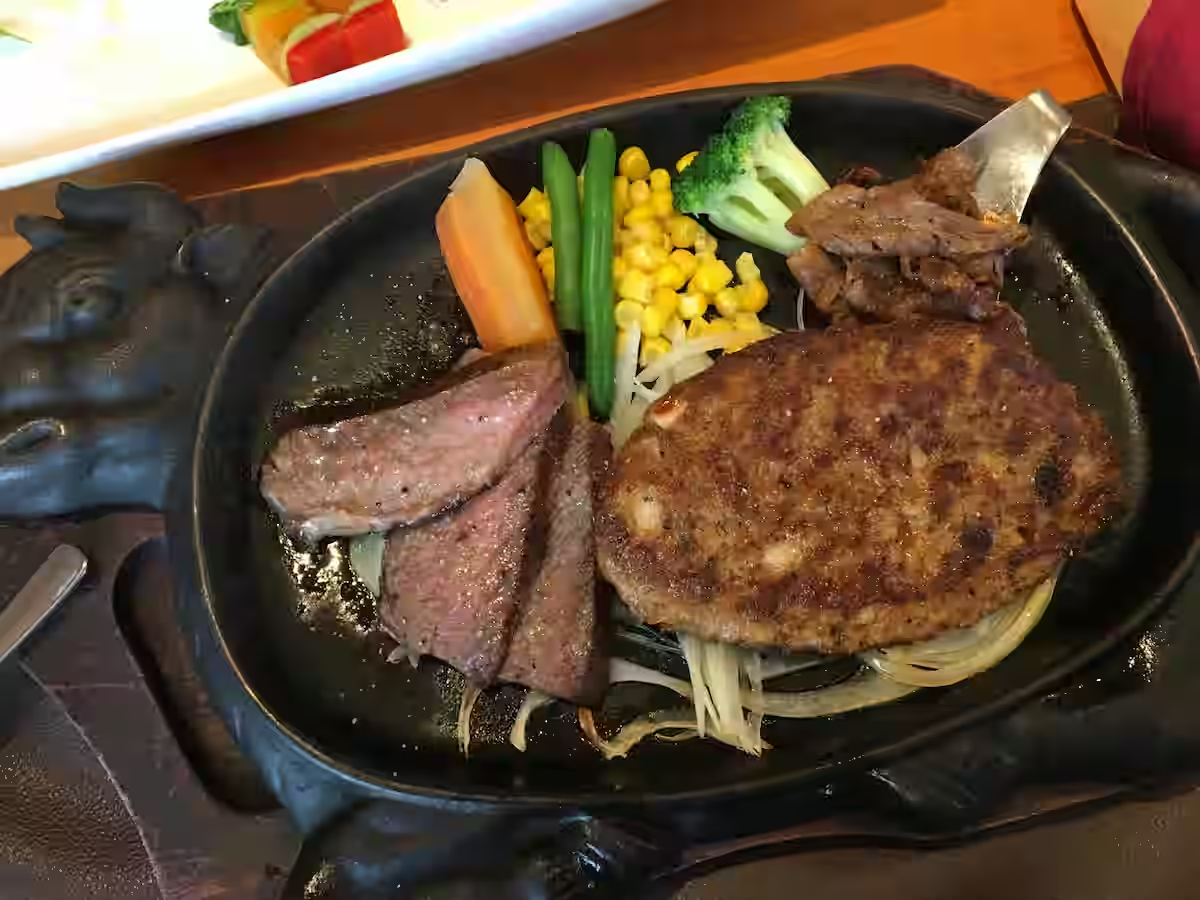
Each style works a little differently. For example, teppanyaki and steak sear thick cuts on hot iron. Meanwhile, yakiniku lets diners grill each slice to their preferred doneness. Similarly, sukiyaki simmers thin slices in sweet soy sauce, while shabu-shabu swishes them briefly in broth.
How to Cook a Thick Steak at Home
- First, thaw frozen beef slowly in the refrigerator, never on the counter at room temperature.
- Remove the steak from the refrigerator only briefly while you prepare the pan and seasonings. Do not leave raw beef at room temperature for long.
- Then pat the surface dry with kitchen paper for a better crust.
- Next, salt the meat just before it goes into the pan.
- Sear both sides in a very hot pan, using the steak’s own fat if you like.
- Finally, rest the steak for a few minutes before slicing. Cook it to your preferred safe doneness.
Recipe: Miyazaki Beef Rolls With Potato and Cheese
Thin slices also suit everyday home cooking, so this recipe wraps them around potato and cheese. Use thinly sliced Miyazaki beef, ideally shoulder loin or round. As a result, you get a small, savory roll that works as a side dish or a light main.
Ingredients for 4 People
- Thinly sliced Miyazaki beef: 200 g
- Potatoes: 50 g
- Cheese: 100 g
- Broccoli: 40 g
- Garlic: 10 g
- Salad oil: 20 g
- Flour: 14 g
- Light soy sauce: 7 g
- Sake: 7 g
- Salt and pepper: 1 g
Instructions
- Wrap the potatoes with the skin on and heat them in the microwave for 4 minutes.
- Peel the potatoes and cut them into 1 cm cubes.
- Cut the cheese into 1 cm square sticks.
- Spread out the beef slices and sprinkle them with salt, pepper, and flour.
- Place potato and cheese on each slice, then roll it up while shaping it.
- Heat part of the oil in a frying pan and add the thinly sliced garlic.
- Add the beef rolls with the sake and light soy sauce. Turn them often and fry until golden brown and the beef is fully cooked.
- Heat the remaining oil in a second pan, fry the broccoli, and season it with salt and pepper.
Serve the rolls hot, together with the broccoli. Refrigerate any leftovers promptly.
How Much Does Miyazaki Beef Cost?
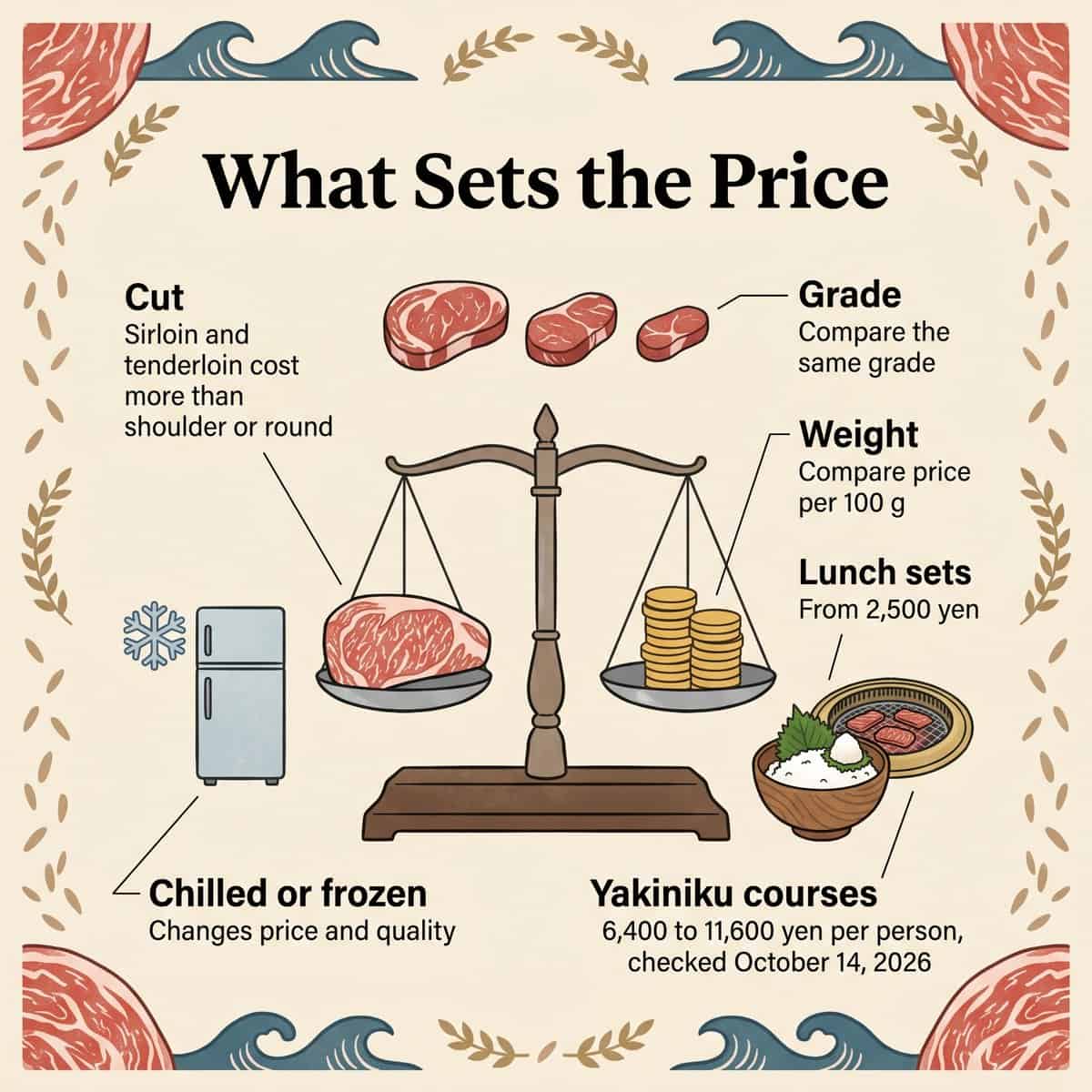
Miyazaki beef costs more than ordinary beef, but the range is wide. In particular, the price depends on the cut, grade, weight, and whether you eat out. Prices also change often, so compare like with like.
Retail Prices
In shops, compare prices per 100 g for the same cut and grade. Thin slices of shoulder or round usually cost far less than sirloin or tenderloin steaks. Also check whether the meat is chilled or frozen, since that changes both price and quality.
Restaurant Prices in Miyazaki City
Lunch is usually the cheapest way to try it. At the restaurants below, Miyazaki beef lunch sets start at 2,500 yen. Standard yakiniku courses, meanwhile, run from 6,400 to 11,600 yen per person. These figures come from official menus checked on October 14, 2026, including tax, and may change.
Where to Eat Miyazaki Beef
Generally, Miyazaki City is the easiest place to start, because certified restaurants cluster there. Still, the three below are examples, not a ranking. For more options, the Miyazaki Wagyu Council publishes a list of designated restaurants and shops inside and outside Japan.
Yakiniku Kokaen Honten (焼肉の幸加園 本店)

According to its official website, this evening-only yakiniku restaurant was the first designated Miyazaki beef restaurant. The site also says all the beef it serves is ranked A4 to A5. Its courses, for example, run from a 10-dish regular set to a 12-dish premium set. Alternatively, order skirt steak or shio-koji marinated beef by the plate.
- Recommended Miyazaki beef harami (skirt steak), 2,500 yen; half portion 1,500 yen
- Budget Standard courses 6,400 to 11,600 yen per person; larger sets cost more
- Address 1-1-1 Ehiranishi, Miyazaki City, Miyazaki
- Phone 0985-26-0458
- Hours 16:00 to 23:00 (last order 22:30); open daily except the year-end and New Year holidays
- Website Yakiniku Kokaen official site
Information checked: October 14, 2026. Prices and hours may change, so check the official site before visiting.
Teppanyaki Steak Hitotsuba Miyachiku (鉄板焼ステーキ 一ツ葉ミヤチク)

This teppanyaki restaurant sits among pine trees in the Hitotsuba area of Miyazaki City. A chef cooks at your table, and lunch is the better-value visit. Besides the steak, each course includes soup, grilled vegetables, a salad bar, a drink bar, and rice.
- Recommended Miyazaki beef round steak course, 150 g, 4,200 yen
- Budget Steak courses 4,200 to 13,500 yen
- Address 1401-255 Maehama, Shinbeppu-cho, Miyazaki City, Miyazaki
- Phone 0985-28-2914
- Hours Lunch 11:00 to 15:00 (last order 14:00); dinner 17:00 to 21:30 (last order 20:30); irregular closures
- Website Hitotsuba Miyachiku official site
Information checked: October 14, 2026. The official site lists dinner times in more than one way, so call ahead to confirm.
Tonkatsu & Shabu-Shabu Miyachiku (とんかつ・しゃぶしゃぶ ミヤチク)

This restaurant especially suits anyone who prefers lean beef. Its signature shabu-shabu set brings 150 g of lean Miyazaki beef. Vegetables, rice, miso soup, udon, and a salad bar come with it. Note that shabu-shabu sets need at least two diners. For a lighter meal, the limited lean beef cutlet set is another option.
- Recommended Miyazaki beef lean shabu-shabu set, 150 g, 3,980 yen per person
- Budget Cutlet set 2,500 yen; steak sets 3,480 to 7,980 yen
- Address 173-5 Shoei-cho, Miyazaki City, Miyazaki
- Phone 0985-89-2989
- Hours Lunch 11:00 to 15:00 (last order 14:00); dinner Tuesday to Friday 17:00 to 20:00, weekends and holidays 17:00 to 21:00
- Website Tonkatsu & Shabu-Shabu Miyachiku official site
Information checked: October 14, 2026. Prices and hours may change, so check the official site before visiting.
If Someone at Your Table Skips Beef
Miyazaki also offers many local dishes for diners who do not want beef. Chicken Nanban, fried chicken with sweet vinegar and tartar sauce, is one of the prefecture’s best-known dishes. In summer, Hiyajiru offers a cold miso soup poured over rice. For a vegetable side, look for Kiriboshi daikon, the dried radish strips that are a Miyazaki specialty.
Where to Buy Miyazaki Beef
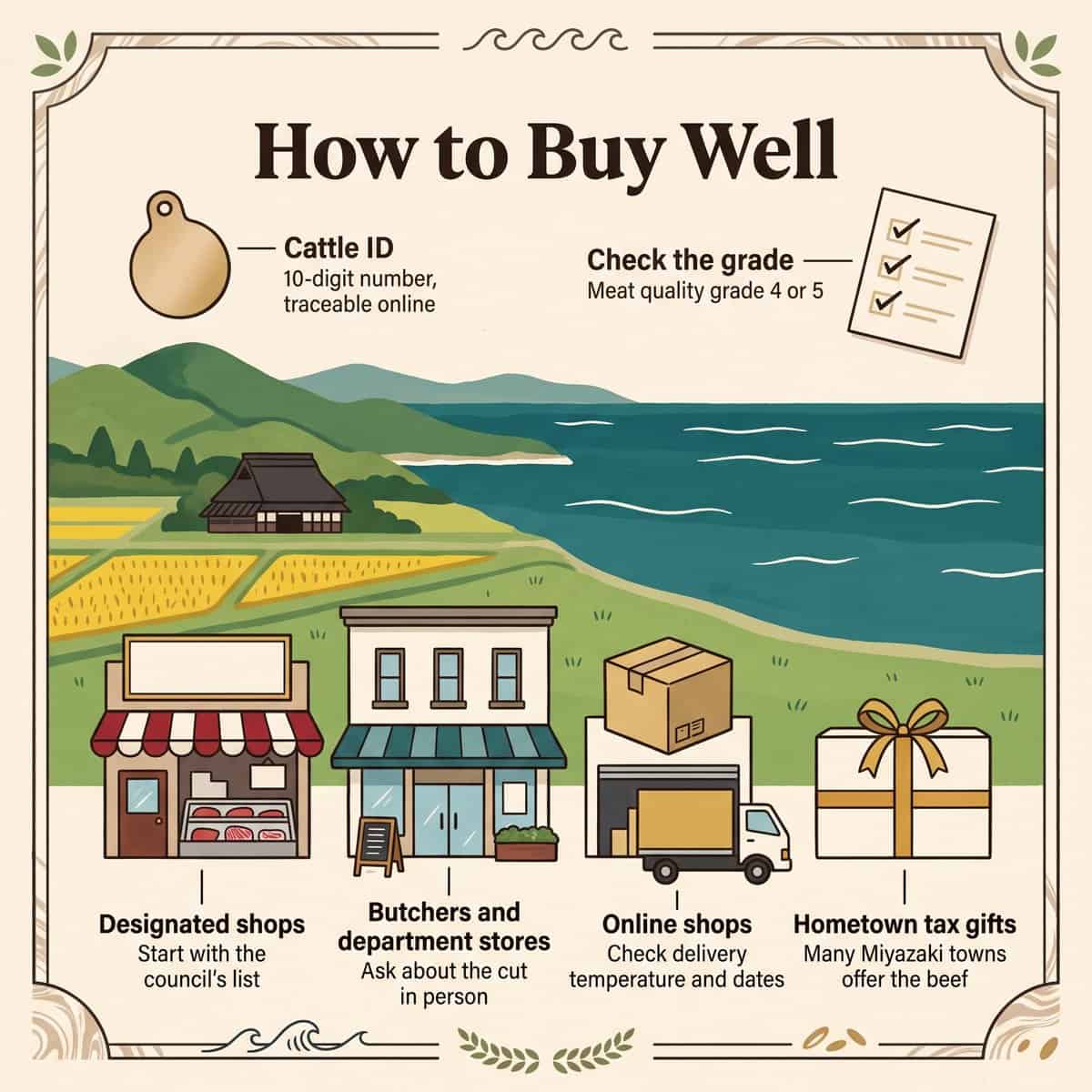
In Japan, you can buy it from designated butchers, department stores, online shops, and hometown tax donation programs. Outside Japan, meanwhile, the council lists authorized overseas restaurants and stores. Wherever you shop, buy from a seller that can show the brand name and the animal’s details.
- Designated shops: the council’s list is the safest starting point.
- Butchers and department stores: good for checking the cut and asking questions in person.
- Online shops: convenient, although you should check delivery temperature and dates.
- Hometown tax donations (furusato nozei): many Miyazaki towns offer the beef as a thank-you gift.
What to Check Before You Buy
Buying checklist
- The exact name 宮崎牛 (Miyazaki beef) or the council’s logo
- Meat quality grade, which must be 4 or 5
- Cut, weight, and price per 100 g
- Chilled or frozen, plus the use-by date
- Seller name, ideally a designated shop
- The 10-digit cattle ID number, which you can look up on Japan’s cattle traceability service
Is Miyazaki Beef Worth Trying?

Yes, especially if you want to taste wagyu at its source. For a first try, choose a lunch steak or lean shabu-shabu rather than a heavy grade-5 dinner. Then, if you enjoy the richness, move on to sirloin or a full yakiniku course.
In Miyazaki, pair it with local dishes and a slow evening rather than a rushed meal. Afterward, compare it with other regional wagyu brands in Japan, such as Matsusaka beef and Omi beef.
Miyazaki Beef FAQ
About the Brand
- What makes Miyazaki beef different from other types of wagyu?
-
The difference lies in its certification rules. In principle, qualifying cattle are born in Miyazaki and spend the longest rearing period there. They also need a qualifying sire and meat quality grade 4 or 5. The prefecture has also managed its breeding bulls centrally since 1973. That system aims to keep quality consistent.
- Is Miyazaki beef the same as Miyazaki wagyu?
-
In English, usually yes. After all, the GI register lists Miyazaki Wagyu as an English name for the certified brand. In Japanese, however, 宮崎和牛 may appear in broader commercial descriptions and does not prove certification. Instead, look for 宮崎牛, the official logo, and traceability details.
- Is all Miyazaki wagyu A5?
-
No. The brand accepts meat quality grade 4 as well as grade 5. Many restaurants do serve A4 or A5, yet the letter refers to yield, not quality. Grade-4 beef can meet the brand standard when it also satisfies the breed, origin, rearing, and sire requirements.
- Why is Miyazaki beef expensive?
-
Several costs add up. First, raising Japanese Black cattle takes time and careful feeding. Also, only grade-4 or grade-5 carcasses qualify. Certification and traceability likely add further cost. Finally, loin and fillet cuts are limited, so they cost the most.
Eating and Buying
- Where can I eat Miyazaki beef in Japan?
-
Generally, Miyazaki City has the widest choice of certified restaurants. In addition, the Miyazaki Wagyu Council publishes a list of designated restaurants and shops across the prefecture and elsewhere in Japan. Check that list first, then confirm hours on each restaurant’s own site.
- Can I buy authentic Miyazaki beef outside Japan?
-
Yes, in some countries. The council lists authorized overseas restaurants and stores, so start there. Ask the seller for proof of origin, such as the brand logo or cattle ID. Also, be cautious with vague labels like “Miyazaki-style wagyu.”
- What is the best cut for first-time diners?
-
It depends on how much richness you enjoy. For example, sirloin shows off the marbling and sweetness best. If you prefer a lighter bite, try round or tenderloin instead. Either way, a small lunch portion is a sensible way to start.
- What are the best ways to cook Miyazaki beef?
-
Use quick, high heat for thick steaks, and rest them briefly before slicing. Thin slices, by contrast, suit shabu-shabu, sukiyaki, or a quick pan-fry. Also cook ground beef through completely. The cooking section above has step-by-step tips.
References
- Ministry of Agriculture, Forestry and Fisheries – Geographical Indication No. 55: Miyazaki Gyu [editor’s translation] (Accessed October 2026)
- Japan Meat Grading Association – Beef Carcass Trading Standards [editor’s translation] (Accessed October 2026)
- Miyazaki Wagyu Council – About Miyazaki Wagyu (Accessed October 2026)
- Miyazaki Prefecture – Miyazaki Beef Wins Four Consecutive Prime Minister’s Awards [editor’s translation] (Accessed October 2026)
- Ministry of Agriculture, Forestry and Fisheries – Miyazaki Gyu GI Specification [editor’s translation] (Accessed October 2026)
- Kobe Beef Marketing and Distribution Promotion Association – Definition of Kobe Beef (Accessed October 2026)
- Miyazaki Wagyu Council – Change to the Definition of Miyazaki Beef, April 2017 [editor’s translation] (Accessed October 2026)
- Miyazaki Prefecture – Foot-and-Mouth Disease Recovery Memorial Site [editor’s translation] (Accessed October 2026)
- National Livestock Breeding Center – Cattle Individual Identification Search (Accessed October 2026)
- Miyazaki Prefecture – Early Development and Dispersed Management of Breeding Bulls [editor’s translation] (Accessed October 2026)
- Asian-Australasian Journal of Animal Sciences – Gotoh, T., Nishimura, T., Kuchida, K., & Mannen, H. (2018). The Japanese Wagyu beef industry: Current situation and future prospects, a review (Accessed October 2026)
- Ministry of Agriculture, Forestry and Fisheries, Kyushu Regional Office – Miyazaki Livestock Data Based on the 2025 Livestock Statistics [editor’s translation] (Accessed October 2026)
Related Articles
- Wagyu Beef (和牛) (Surveyed: October 2026)
- Kobe Beef (神戸牛) (Surveyed: October 2026)
- Matsusaka Beef (松阪牛) (Surveyed: October 2026)
- Omi Beef (近江牛) (Surveyed: October 2026)
- Miyazaki Food and Regional Cuisine (Surveyed: October 2026)
- Chicken Nanban (チキン南蛮) (Surveyed: October 2026)
- Hiyajiru (冷や汁) (Surveyed: October 2026)
- Kiriboshi Daikon (切り干し大根) (Surveyed: October 2026)
- Miyazaki Jitokko (宮崎地頭鶏) (Surveyed: October 2026)




Comments