




Most visitors imagine sushi as a slice of fish on hand-shaped rice. In Osaka, however, sushi often comes as colorful rectangles pressed in a wooden mold. Sweet vinegared rice, simmered eel, shrimp, omelet and cured fish sit together in neat layers. Some older pages spell it “Oosaka,” but the dish is the same.
Why does it matter? Because this style tells a story about Osaka itself, a merchant city that liked food it could carry. So this guide covers the main types, the history and the taste. It also adds a home recipe and places to buy it.
What Is Osaka Sushi?
Osaka sushi (Osaka-zushi, 大阪寿司) refers to several sushi styles that originated in Osaka and became associated with the city. Unlike Tokyo-style nigiri, cooks usually press it in a wooden mold with seasoned rice and cooked or cured toppings. The best-known forms are hakozushi and battera. The term also covers rolled makizushi and warm steamed sushi.
Quick Facts
- Japanese name
- 大阪寿司 (Osaka-zushi)
- Origin
- Osaka and the wider Kansai region
- Main style
- Pressed sushi (oshizushi), especially box-pressed hakozushi
- Typical toppings
- Conger eel, shrimp, thick omelet, small sea bream, shiitake, cured mackerel
- Rice flavor
- Vinegared and noticeably sweet; some shops use kombu
- Serving temperature
- Cool or room temperature; steamed sushi is served warm
- Best-known types
- Hakozushi, battera, makizushi, mushizushi
- Soy sauce
- Optional, since toppings are already seasoned

Key Takeaways
- Osaka sushi is an umbrella term for several Kansai sushi styles.
- Its signature is hakozushi, pressed in a square wooden mold.
- Battera, made with cured mackerel and kombu, is the best-known variety.
- Most toppings get cooked, simmered or vinegar-cured.
- The rice tastes sweeter and firmer than typical nigiri rice.
- It grew popular as a portable meal for theater trips and gifts.
Is Osaka Sushi the Same as Oshizushi?
Not exactly. Osaka sushi is the broad family, while oshizushi (押し寿司), or pressed sushi, is its main technique. Within that, two names come up most often:
押し寿司
Oshizushi
Any sushi pressed into shape with a mold or weight.
箱寿司
Hakozushi
Box sushi pressed in a square wooden mold, often with several colorful toppings.
バッテラ
Battera
A pressed sushi of cured mackerel topped with a thin sheet of kombu.
Is Osaka Sushi Raw?
Mostly not. Most toppings are cooked or cured rather than completely raw, although battera uses vinegar-cured mackerel that is never heated. For example, cooks simmer conger eel, boil shrimp, and cure mackerel in salt and vinegar. So if raw fish makes you hesitate, this regional style is a gentle place to start.
Main Types of Osaka Sushi
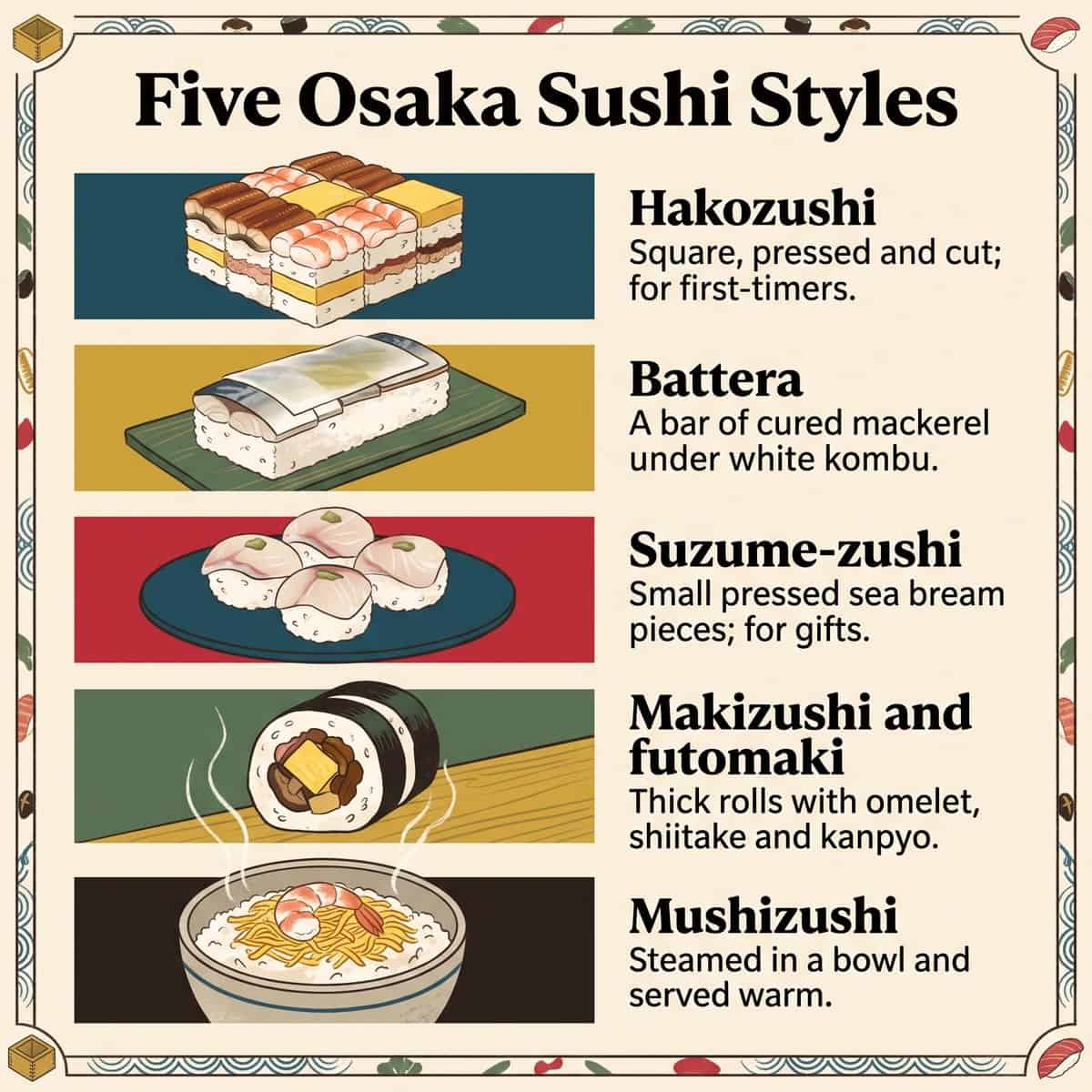
The four most common kinds of Osaka sushi are hakozushi, battera, futomaki-style makizushi and warm mushizushi. Together, they cover the styles most visitors meet in Osaka today. Each uses seasoned rice, yet the shape, topping and temperature differ. This table, therefore, gives a quick overview.
| Type | Shape | Typical toppings or fillings | Served | Best for |
|---|---|---|---|---|
| Hakozushi 箱寿司 | Square, pressed and cut | Conger eel, shrimp, omelet, sea bream | Cool | First-time visitors |
| Battera バッテラ | Rectangular bar, pressed | Cured mackerel and white kombu | Cool | Mackerel fans, takeaway |
| Suzume-zushi 雀鮨 | Pressed, small pieces | Small sea bream and kombu | Cool | Gifts and souvenirs |
| Makizushi / futomaki 巻き寿司 | Thick roll, sliced | Omelet, shiitake, kanpyo, eel, cucumber | Cool | Picnics, Setsubun |
| Mushizushi 蒸し寿司 | Rice in a bowl or box | Conger eel, shrimp, shredded egg | Warm | Winter dining |
Contents vary by shop and household.
Hakozushi (Box Sushi)
First, hakozushi is box-pressed sushi made in a square wooden mold. Cooks layer rice and prepared toppings, press them with a lid, and then slice the block. Take Yoshino Sushi, a long-running shop in Semba. Its box holds grilled conger eel, thick omelet, small sea bream, shrimp, shiitake and nori. As a result, it looks almost like a small mosaic.
Battera (Mackerel Pressed Sushi)

Battera is an Osaka pressed sushi of thin cured mackerel, vinegared rice and white kombu. According to MAFF’s “Our Regional Cuisines” database, Sushi Tsune in Minami-Semba developed it in the early 1890s. At first, the shop used gizzard shad, and the shape looked like a small boat.
The ministry also explains the name as coming from the Portuguese word for a small boat. Later, mackerel and a square mold became standard. Today you can find battera in supermarkets and convenience stores too. So it is easily the most everyday kind of Osaka sushi.
Battera vs Saba-zushi
People often confuse battera with saba-zushi, the mackerel sushi famous in Kyoto. Both, of course, use cured mackerel and rice. However, battera usually uses thinner slices pressed in a square mold under a layer of kombu. Kyoto-style saba-zushi, by contrast, often comes as a long bar shaped with a thick fillet. The line between them is blurry, so treat this as a general pattern.
Suzume-zushi (Small Sea Bream Sushi)
Suzume-zushi is a pressed sushi made with small sea bream. Sushiman, an Osaka sushi company, traces its own roots to 1653 and says it began specializing in suzume-zushi in 1781. Its version wraps salted sea bream in white kombu. Even now, it remains a classic Osaka gift.
Makizushi and Osaka-Style Futomaki
Osaka-style thick rolls combine seasoned vegetables with egg and cooked seafood. For instance, typical fillings include shiitake, kanpyo gourd, cucumber, thick omelet, shrimp and conger eel. Today, seven fillings are common in rolls for Setsubun in early February, though recipes vary. For more fillings and shapes, see our guide to Kansai-style makizushi.
Mushizushi (Steamed Sushi)
Mushizushi is warm sushi. Cooks top seasoned rice with simmered conger eel, shrimp, shiitake and shredded egg, then steam it. Because it is warm, it makes a comforting winter meal. Yoshino Sushi still sells steamed versions, and department stores carry gift boxes. Read more in our guide to steamed mushizushi.
History of Osaka Sushi
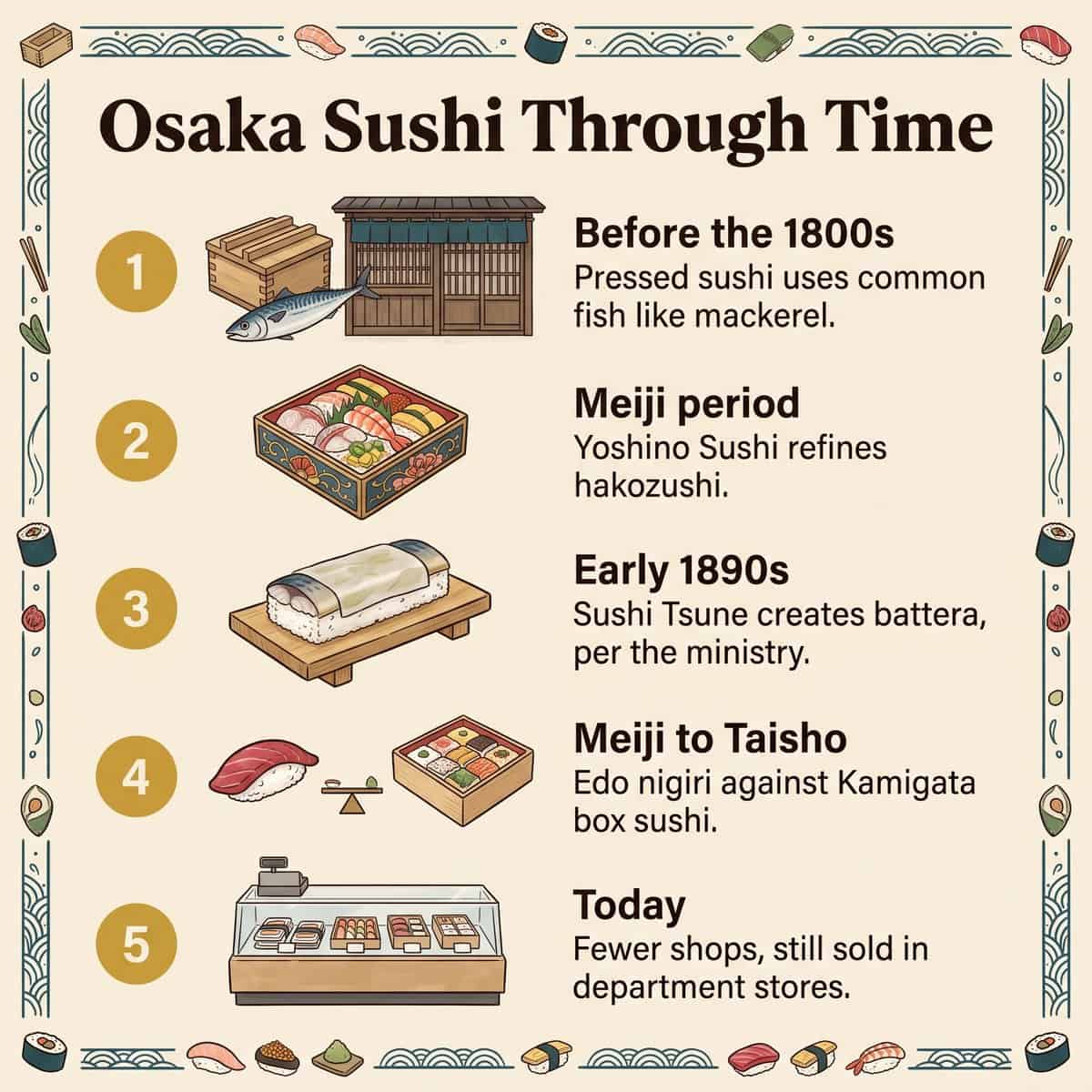
Osaka’s pressed-sushi tradition developed around portability, preservation and presentation. Plain pressed sushi made with everyday fish came first. Then, in the Meiji period, Osaka shops turned it into a colorful, premium boxed meal.
- Before the 1800s
At first, pressed sushi uses common fish such as mackerel and horse mackerel. Sushiman also traces its own business to 1653.
- Meiji period (1868–1912)
Yoshino Sushi in Semba develops an elaborate hakozushi with sea bream, shrimp and conger eel.
- Early 1890s
Sushi Tsune in Minami-Semba creates battera, according to Japan’s Ministry of Agriculture.
- Meiji to Taisho
People contrast “Edo’s nigiri” with “Kamigata’s box sushi,” Kamigata being the old name for the Kyoto-Osaka area.
- Today
Fewer shops make hakozushi, yet department stores and local shops still sell it.
Why Is Osaka Known for Pressed Sushi?
Osaka became known for pressed sushi because the style fit how the city ate. According to MAFF’s “Our Regional Cuisines” database, merchants valued box sushi as theater food and as gifts. Pressed blocks traveled well, looked tidy, and needed no last-minute shaping. By contrast, Tokyo’s nigiri culture grew around eating at the counter. As a result, people in the Meiji and Taisho eras spoke of “Edo’s nigiri and Kamigata’s box sushi.”
Merchant and Theater Culture
During the Meiji period, Yoshino Sushi in Semba developed a more elaborate box sushi. Instead of everyday fish, it used premium toppings such as sea bream, shrimp and conger eel. Colorful hakozushi was easy to carry. As a result, diners bought it for theater intermissions and as a souvenir.
Semba was Osaka’s merchant district, so good-looking food mattered. A neat box of sushi therefore worked well as a gift for clients or as hospitality food. Over time, the style spread across the region as a dish for celebrations.
What Does “Nisun Rokubu” Mean?
Box sushi has a nickname, nisun rokubu no kaiseki (二寸六分の懐石). Nisun rokubu is an old measurement, and Yoshino Sushi says its mold measures about 8.5 cm inside. So the phrase means roughly “a kaiseki meal in a small box.” In other words, it praises the care packed into a compact space.
When Do People Eat Osaka Sushi?
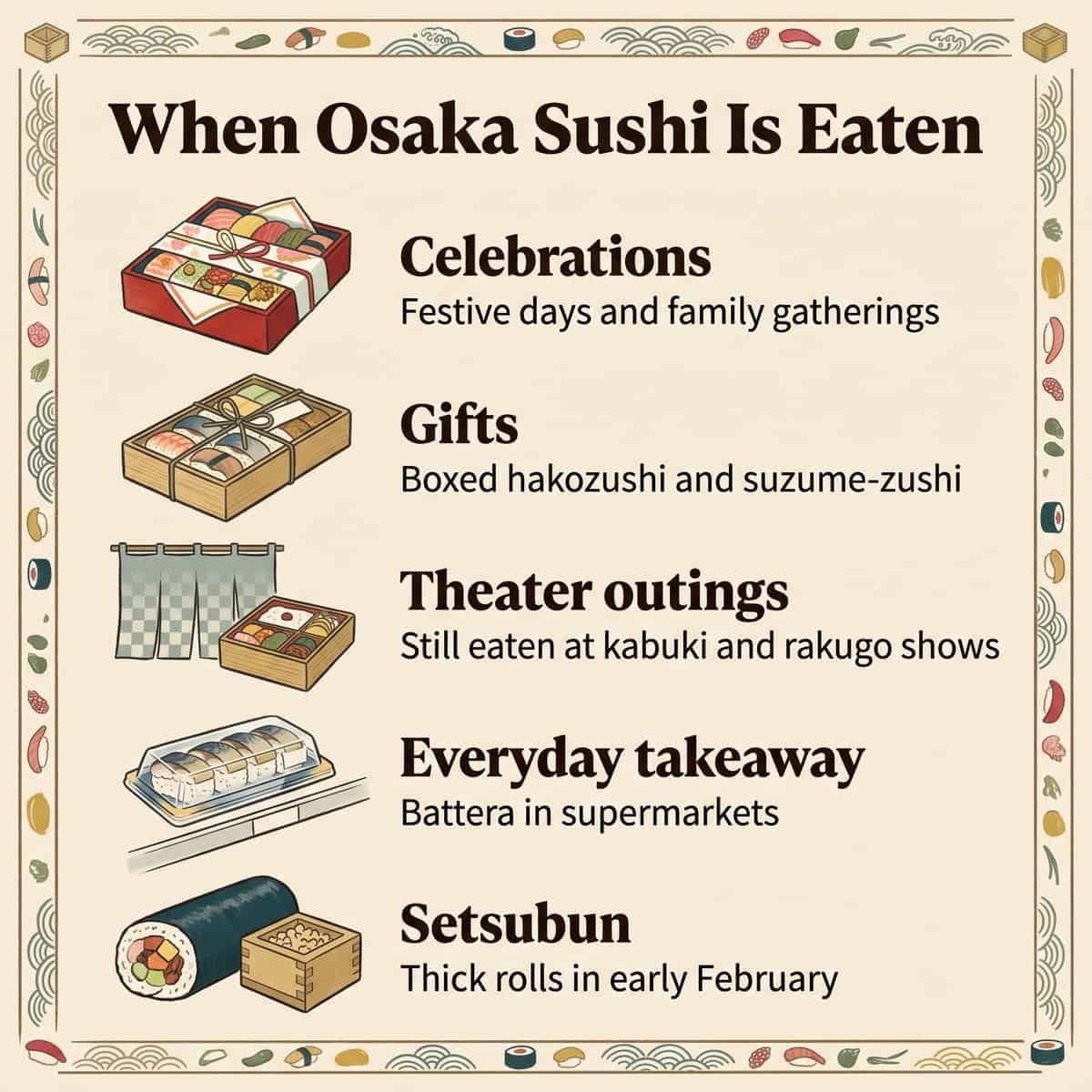
Celebrations
A festive dish for special days and family gatherings.
Gifts
Boxed hakozushi and suzume-zushi make classic Osaka presents.
Theater outings
Still eaten at kabuki and rakugo shows, as in the Meiji era.
Everyday takeaway
Battera turns up in supermarkets for a quick meal at home.
Setsubun
Thick rolls appear in early February for the bean-throwing festival.
Osaka Sushi Today
So the dish still has a place in daily life. Even so, hakozushi takes time and skill, and Osaka’s tourism bureau notes that fewer shops now make it. Yoshino Sushi also says few craftsmen still make the wooden molds. Honestly, that makes a visit feel a little more urgent.
What Makes Osaka Sushi Unique?

Above all, Osaka sushi stands out for its rice. Its rice is often firmer and more noticeably sweet than the rice used for Edomae nigiri. Osaka’s tourism bureau says box sushi suits a firm rice from nearby Omi, in today’s Shiga Prefecture. Cooks then cook it with kombu dashi and season it with sugar and mirin.
Sugar also helps the rice retain moisture. This matters because Osaka sushi usually reaches the table cool or at room temperature, often hours after pressing. Meanwhile, cooks season each topping separately, so every layer adds its own flavor.
How Does Osaka Sushi Taste?
Osaka sushi tastes sweet, vinegared and savory at once, with a soft, dense bite. Compared with nigiri, the rice feels firmer and more compact. Hakozushi then puts sweet egg, shrimp and soy-glazed eel in the same mouthful.
Battera, by contrast, pairs rich cured mackerel with a thin sheet of kombu. The kombu adds a gentle savory note and a soft sea aroma. Overall, it is a sweeter, denser alternative to Edomae nigiri, and some people find it surprisingly filling.
Osaka Sushi vs Edomae Sushi
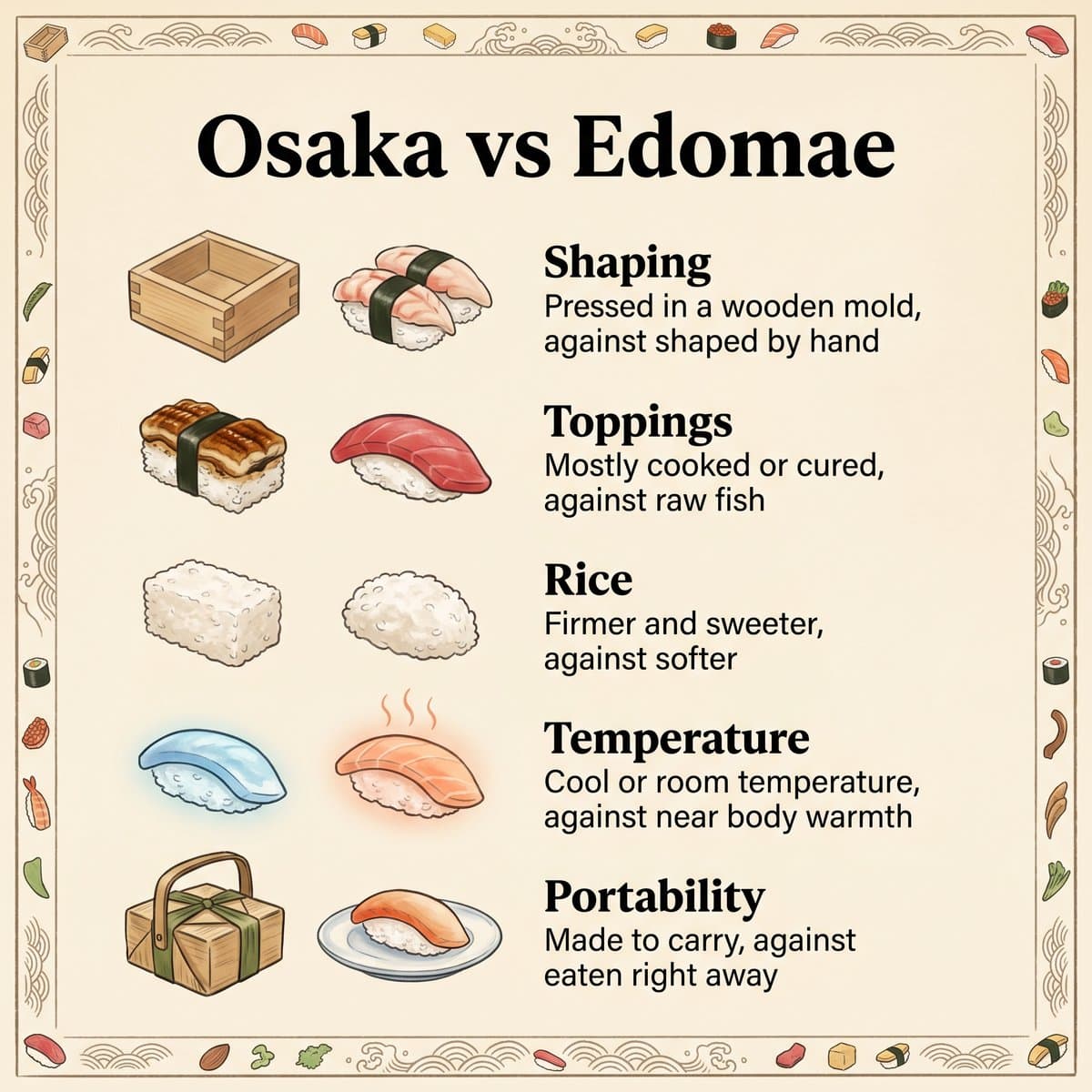
The biggest difference is shape. In Tokyo, sushi is strongly associated with nigiri, which consists of hand-shaped rice topped with fish or another ingredient. Osaka cooks, by contrast, press sushi in a mold and cut it. Still, both styles prepare fish carefully, since Edomae sushi also cures and simmers many toppings.
Osaka sushi
- Shaping: pressed in a wooden mold
- Toppings: mostly cooked or cured
- Rice: firmer and sweeter
- Temperature: cool or room temperature
- Portability: made to carry
Edomae nigiri
- Shaping: shaped by hand
- Toppings: raw and prepared fish
- Rice: softer and less sweet
- Temperature: close to body warmth
- Portability: best eaten right away
Our overview of Japanese sushi styles covers more regional types. For instance, Nara’s kakinoha-zushi is another Kansai pressed sushi, wrapped in persimmon leaves.
How Osaka Sushi Is Made
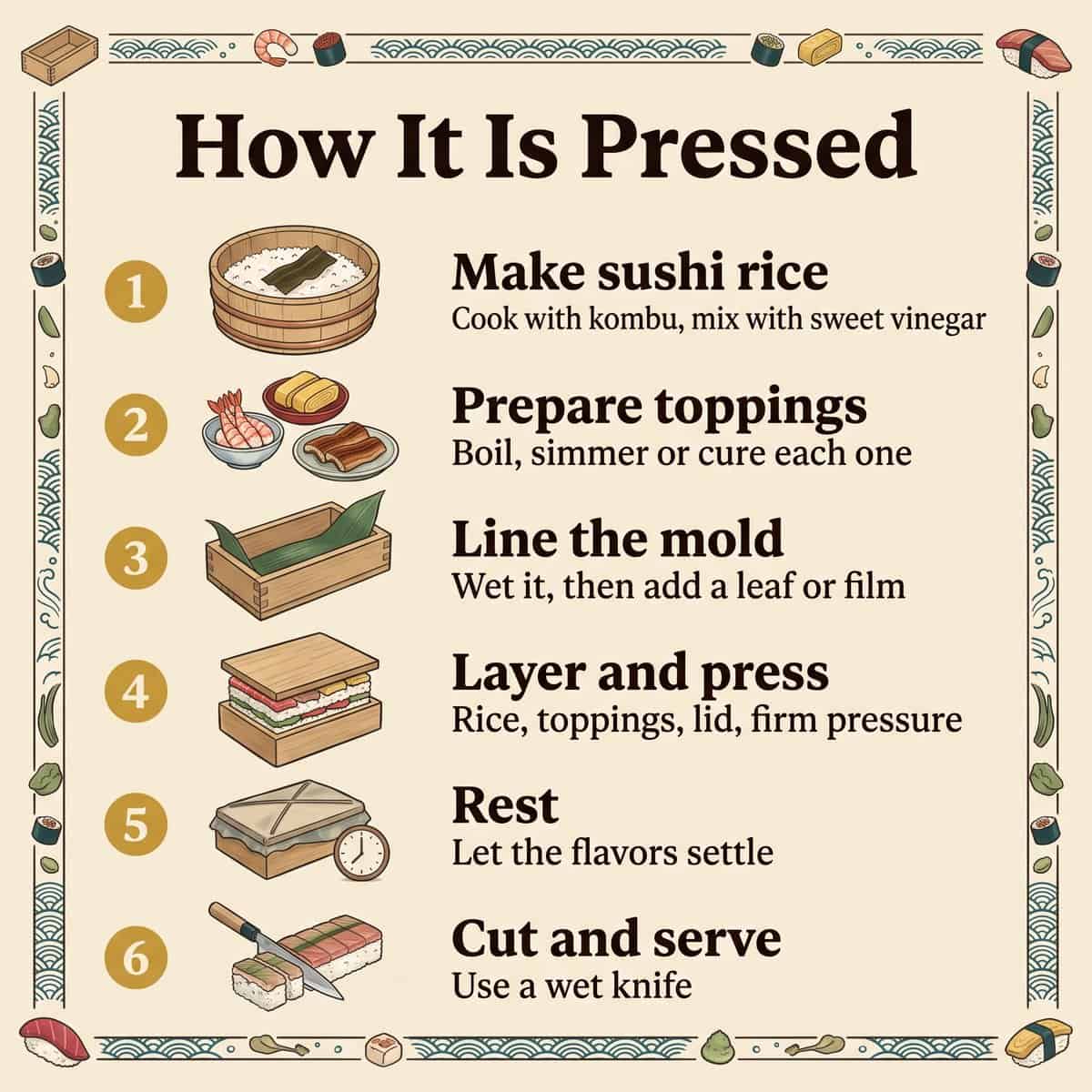
Cooks make oshizushi by pressing seasoned rice and toppings in a mold. First they prepare each part, then everything comes together quickly. Here is the basic flow.
- 1Make sushi ricecook with kombu, mix with sweet vinegar
- 2Prepare toppingsboil, simmer or cure each one
- 3Line the moldwet it, then add a leaf or film
- 4Layer and pressrice, toppings, lid, firm pressure
- 5Restlet the flavors settle
- 6Cut and serveuse a wet knife
Pressing removes air from between the layers, so the block holds together when cut. Yoshino Sushi describes pressing firmly with both hands rather than using a weight. Don’t own a mold? A small loaf pan lined with plastic wrap is a reasonable stand-in, although the edges come out softer.
How to Eat Osaka Sushi
Most pieces come already seasoned, so you can eat them in one or two bites. Soy sauce is optional, since Japan’s Ministry of Agriculture notes that battera can be eaten without it. Chopsticks or fingers both work, so use whatever feels comfortable.
Storage and Food Safety
Pressing or seasoning alone does not make sushi shelf-stable. Follow the seller’s date and storage instructions, keep takeaway sushi chilled, and eat it promptly.
In addition, Japan’s health ministry advises keeping cooked takeaway food out of warm temperatures. For example, Yoshino Sushi asks buyers to eat its shipped box sushi on the day it arrives.
Osaka Sushi Recipe
This three-layer recipe follows a traditional Osaka home style and lists ingredients in metric weights. It takes some prep, but each step is simple. You will need a wooden pressing mold, called an oshibako. Also have a pot, a bamboo skewer, a sharp knife and a cutting board ready.

Osaka Sushi (Three-Layer Hakozushi)
Ingredients
Sushi rice
- Rice300 g
- Dashi kombu5 g
- Rice vinegar (A)56 g
- Sugar (A)21 g
- Salt (A)7 g
Shrimp
- Shrimp200 g
- Rice vinegar (B)28 g
- Sugar (B)7 g
- Salt (B)4 g
Omelet
- Egg35 g
- Dashi stock (C)7 g
- Mirin (C)7 g
- Sugar (C)14 g
- Salt (C)2 g
Conger eel
- Grilled conger eel (store-bought)200 g
- Dashi stock (D)70 g
- Koikuchi (regular) soy sauce (D)28 g
- Mirin (D)28 g
- Sugar (D)14 g
Shiitake
- Dried shiitake30 g
- Tsuyu (dashi-soy stock) (E)100 g
- Sugar (E)21 g
- Koikuchi soy sauce (E)14 g
Top layer and lining
- Kodai sasazuke (store-bought cured small sea bream)3 pieces
- Roasted nori1/3 sheet
- Haran leaves or plastic food filmas needed
Step-by-Step Instructions
- Make the sushi rice. Cook the rice with the kombu, then mix in sushi vinegar A.
- Prepare the shrimp. Devein and rinse the shrimp. Thread a bamboo skewer from the tail along the belly, then boil in salted water.
- Marinate the shrimp. Once cool, remove the skewers and shells. Soak in vinegar mixture B for 5 to 6 minutes, then slice each in half.
- Make the omelet. Season the egg with C and cook it into an omelet about 2 cm thick.
- Cook the eel. Simmer the grilled conger eel in D for about 10 minutes, then let it cool in the liquid.
- Season the shiitake. Soak the shiitake in water, simmer them in E until they absorb the flavor, then chop.
- Line the mold. Cut the shrimp, omelet and eel to fit the mold. Wet the mold, then line it with haran leaves moistened with vinegared water.
- First layer. Fill the mold evenly with sushi rice. Top with the omelet and shrimp, add another leaf, cover with the lid and press evenly.
- Second and third layers. Repeat with the eel and shiitake for one layer. Then use nori and kodai sasazuke for the last, pressing after each.
- Cut and serve. Cut each layer into six equal pieces and arrange them on a plate.
Allergens: contains egg, shrimp, fish and soy. Soy sauce and tsuyu may contain wheat.
Diet: this recipe is not vegetarian or vegan, since it includes egg and seafood.
Gluten-free: tamari can replace soy sauce only if every other ingredient is also checked.
Safety: cook shrimp and egg fully, keep raw seafood apart from cooked toppings, and refrigerate leftovers.
Finally, wipe the knife with a damp cloth between cuts, and the edges stay clean. A short rest before slicing also helps the layers hold together.
Where to Eat Osaka Sushi
You can find Osaka sushi at specialist shops, in department-store food halls, and at some local sushi and noodle shops. Many places focus on takeaway, so plan to eat it at your hotel or in a park. While you are in the city, look at our list of other foods to try in Osaka.
Information checked on October 19, 2026. Hours, prices, and availability may change; check the official website before visiting.
Yoshino Sushi Main Shop, Semba (吉野寿司 本店)
For hakozushi in Semba, Yoshino Sushi is the classic choice. The shop mainly sells takeaway, but it also has upstairs seating. As one price example, its online shop lists a box for about 1.5 people at ¥3,802, including tax.
- Address
- 3-4-14 Awajimachi, Chuo-ku, Osaka
大阪市中央区淡路町3-4-14 - Access
- About 5 minutes on foot from Yodoyabashi Station (Exit 11) or Hommachi Station (Exit 3)
- Phone
- 06-6231-7181
- Hours
- Takeaway from 9:30; closing time differs across the official pages
- Closed
- Saturdays, Sundays and holidays
- Branch
- Takashimaya Osaka, Namba
- Website
- yoshino-sushi.co.jp
Sushiman (すし萬)
Sushiman, meanwhile, specializes in koidai suzume-zushi, its pressed small sea bream. Its main takeaway shop sits in Utsubo-hommachi, and restaurants operate inside Daimaru Shinsaibashi and the Rihga Royal Hotel. Both restaurants also give priority to reservations.
- Main shop
- 2-3-7 Utsubo-hommachi, Nishi-ku, Osaka
大阪市西区靭本町2-3-7 - Phone
- 06-6448-0734
- Hours
- 10:00–17:00; closed Sundays
- Restaurant
- Daimaru Shinsaibashi, Main Building 10F (reservations preferred)
- Website
- sushiman.co.jp
Department-Store Food Halls

Department-store basements are the easiest option for travelers. Sushiman’s official list includes takeaway counters in these food halls:
Umeda
Hankyu Umeda, B1
Shinsaibashi
Daimaru Shinsaibashi, Main Building B1
Namba
Takashimaya Osaka, B1 (Yoshino Sushi too)
Uehommachi
Kintetsu Uehommachi, B1
Abeno
Kintetsu Abeno Harukas, Wing Building B2
Not every counter carries every item each day, so arrive earlier for the best choice. Local shops count too. For example, a 2026 Osaka City ward newsletter highlights a long-running soba and sushi shop in Juso. It still sells box sushi.
Can You Buy Osaka Sushi Outside Osaka?
Yes, in some cases. Yoshino Sushi sells box sushi online and ships it chilled within Japan, though not to every region. Its official page also asks buyers to eat it on the day it arrives. In addition, Sushiman lists shops outside Osaka, including Kobe, Nagoya, Yokohama and Tokyo’s Aoyama area. Overseas shipping, however, is generally not an option for fresh sushi like this.
Nearby Kansai Tradition: Izuju, Kyoto (いづ重)

Traveling on to Kyoto? Izuju, near Yasaka Shrine in Gion, is a Meiji-era shop known for mackerel sushi and small box sushi. Tasting it after battera then shows how Kyoto and Osaka handle mackerel differently.
- Address
- 292-1 Gion-machi Kitagawa, Higashiyama-ku, Kyoto
京都市東山区祇園町北側292-1 - Phone
- 075-561-0019
- Closed
- Wednesdays and Thursdays
- Website
- gion-izuju.com
Why Osaka Sushi Is Worth Trying
Osaka sushi shows a different side of Japanese sushi. It is pressed rather than shaped, sweet rather than sharp, and built to travel. If you only try one, pick a box of hakozushi from Semba. Then grab battera from a food hall and compare.
Prefer to cook? Then the recipe above works well for a weekend project. Either way, our guide to Japanese sushi dishes is a good next stop.
Osaka Sushi FAQ
About the Dish
- What is Osaka sushi?
-
Osaka sushi is a family of regional sushi styles from Osaka, Japan. The term includes pressed sushi, thick rolls and steamed sushi. However, its best-known form is hakozushi, pressed in a square wooden mold. Cooks also prepare most toppings by simmering or curing.
- What is the difference between Osaka sushi and Edomae sushi?
-
Osaka cooks press sushi in a mold, while Edomae chefs shape nigiri by hand. The Osaka style also uses firmer, sweeter rice. Cooks also simmer or cure most toppings, so it travels well. Nigiri, by contrast, tastes best right after the chef makes it.
- Is Osaka sushi made with raw fish?
-
Mostly no. Typical toppings include simmered conger eel, boiled shrimp, omelet and vinegar-cured fish. For battera, though, cooks cure the mackerel with salt and vinegar instead of cooking it. If you avoid raw fish, ask the shop about specific items.
- What is battera?
-
Battera is an Osaka pressed sushi made with cured mackerel, vinegared rice and a thin sheet of white kombu. Japan’s Ministry of Agriculture credits Sushi Tsune in Minami-Semba with creating it in the early 1890s. The ministry links the name to the Portuguese word for a small boat. Today you can buy it in supermarkets as well as specialist shops.
- What fish is used in battera?
-
Battera uses vinegar-cured mackerel topped with a thin sheet of white kombu. According to Japan’s Ministry of Agriculture, the first version used gizzard shad, called konoshiro in Japanese. Mackerel later became the standard topping. Some shops also make similar pressed sushi with other fish, so check the label.
Taste and Temperature
- Is Osaka sushi served hot or cold?
-
Most Osaka sushi is served cool or at room temperature. Hakozushi, battera and thick rolls are all made ahead and eaten that way. Mushizushi is the exception, since cooks steam it and serve it warm, especially in winter. Keep takeaway boxes chilled until you eat them.
- Why is Osaka sushi sweeter than nigiri?
-
The rice is the main reason. Osaka’s tourism bureau explains that box-sushi rice is cooked with kombu dashi and seasoned with sugar and mirin. Sugar also keeps the rice moist, which suits sushi eaten hours after pressing. On top of that, simmered toppings like eel and shiitake add their own sweetness.
Eating, Making and Buying
- Should I dip Osaka sushi in soy sauce?
-
You don’t need to. The rice and toppings are already seasoned, and battera is commonly eaten without soy sauce. A light dip is fine if you prefer it. Try a piece plain first.
- Can I make pressed sushi without an oshibako?
-
Yes, a small loaf pan or rectangular container works. Line it with plastic wrap, add the rice and toppings, then press with a flat object of the same size. The edges will be softer than with a wooden mold. Still, the layers hold together well enough for home meals.
- Where can I eat Osaka sushi in Osaka?
-
Try specialist shops such as Yoshino Sushi in Semba or Sushiman. Department-store food halls in Umeda, Shinsaibashi and Namba also sell it for takeaway. Many shops focus on takeaway rather than dining in. Check the official websites for current hours before you go.
- How long does Osaka sushi keep?
-
Eat it as soon as you reasonably can. Pressing and seasoning do not make sushi shelf-stable. Follow the seller’s date and storage instructions, and keep it chilled on hot days. Also refrigerate homemade sushi if you aren’t eating it right away.
References
- Ministry of Agriculture, Forestry and Fisheries – Our Regional Cuisines: Osaka Sushi, Osaka Prefecture (Accessed October 2026)
- Ministry of Agriculture, Forestry and Fisheries – Our Regional Cuisines: Battera and Ehomaki / Makizushi, Osaka Prefecture (Accessed October 2026)
- Osaka Convention and Tourism Bureau (OSAKA-INFO) – Osaka Sushi: Hakozushi and Battera (Accessed October 2026)
- Yoshino Sushi – History (Accessed October 2026)
- Yoshino Sushi – Shop Information (Accessed October 2026)
- Yoshino Sushi – Hakozushi Online Shop (Accessed October 2026)
- Sushiman – Shop List (Accessed October 2026)
- Sushiman – Company History (Accessed October 2026)
- Osaka Prefectural Government – Osaka-mon Meihin: Osaka Sushi and Prepared Foods (Accessed October 2026)
- Ministry of Health, Labour and Welfare – Hygiene Management for Takeout and Delivery Food at Restaurants (2020) (Accessed October 2026)
- Izuju – Official Website (Accessed October 2026)
Related Articles
- Makizushi (Surveyed: October 2026)
- Mushi Zushi (蒸し寿司) (Surveyed: October 2026)
- Kakinoha Zushi (柿の葉寿司) (Surveyed: October 2026)
- What Is Edomae Sushi? (Surveyed: October 2026)
- Sushi (Surveyed: October 2026)
- What to Eat in Osaka: 20 Must-Try Foods (Surveyed: October 2026)



Comments